
My name is Igor Ivitskiy. I work with Google Ads and I regularly see the exact same story. A person creates a website: a blog, a directory, a service, or a niche project. They invest in content and traffic slowly starts flowing. Then a logical question arises: how can you get money from these visitors? The first answer the internet gives is almost always the same: install Google AdSense.
AdSense is indeed the simplest way to monetize a website. But simple does not mean profitable. In this article I will explain in simple terms how this system works, what your payouts depend on, what the official Google documentation says about it, and why a site owner with their own product or service usually needs more than just AdSense. Let me be honest right away: there will be no earning promises here and I will not provide specific income numbers. They depend on a bunch of factors and are unique to every website.
How Google AdSense works in simple terms
The scheme consists of three parties. The first party is the advertisers. These are companies that want to show their ads to people. They go to Google Ads, set up campaigns, and pay Google for impressions and clicks. The second party is you, the website owner. You register in AdSense, put a special code on your site, and once the site is approved, ads start showing in these spots. The third party is Google itself. It connects advertisers and website owners, runs the auction, and distributes the money.
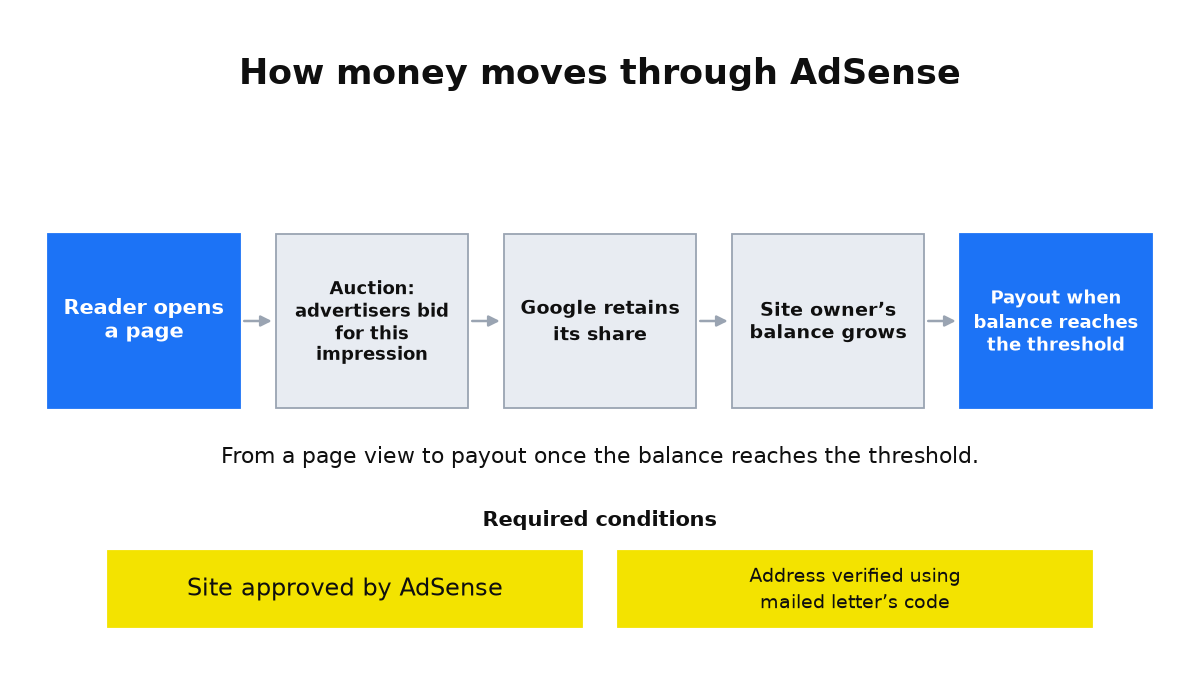
When a visitor lands on your page, AdSense runs an auction in a fraction of a second among advertisers who are interested in this person and this topic. The ad with the highest net bid gets shown. You receive a share of what the advertiser paid; since 2024 Google calculates the publisher share for content sites per impression rather than per click. Google keeps the rest as a middleman.
And here is the main thing you need to understand once and for all: your AdSense income is someone else’s advertising expense. You are not paid because your website is pretty. You are paid a share of the money advertisers are willing to spend for your audience’s attention. If advertisers in your niche pay a lot, such as in finance, insurance, or legal services, your share will be more noticeable. If ads in your niche are cheap, like entertainment content or poetry, you will get much less from the same amount of visitors. The bids in your niche determine your income ceiling, and you have almost no influence over them.
What AdSense payouts depend on
The question “how much does AdSense pay” has no single answer because the result is a combination of several factors:
- Niche and advertiser bids. In competitive commercial topics advertisers pay top dollar, while in mass entertainment topics they pay pennies.
- Audience location. A thousand views from countries with an expensive advertising market cost times more than a thousand views from countries with cheap ads.
- Traffic type. People who came from a search for a specific query are more interesting to advertisers than random visitors from social networks who looked at one page and left.
- Format and placement of ad blocks. Where the block is placed, its size, and whether it is visible without scrolling all affect the cost of an impression.
- Seasonality. Before holidays and during peak periods for a niche, advertisers raise their bids, while in dead months bids drop.
This is exactly why I intentionally do not provide any income numbers. Any number you find on the internet without reference to niche, country, and traffic will tell you nothing about your website. There is only one way to see your forecast: connect AdSense and look at the statistics in your own account after a few weeks.
What the official Google documentation says
The basic rules of the game are written in the AdSense Help Center, and I strongly advise reading it instead of forum retellings. Here are the main points:
| Topic | What it says |
|---|---|
| Payment threshold | Google transfers money only after your balance accumulates an amount not lower than the payment threshold for your currency. Until the threshold is reached, the money keeps accumulating. |
| Address verification | After reaching the verification threshold, Google sends a letter with a PIN code to your postal address. Payments do not start without entering this code in your account. |
| Tax information | You must submit tax information in the appropriate form within your account. This determines whether anything will be withheld from your payouts. |
| Content requirements | Your website must comply with the AdSense program policies and publisher policies: no prohibited topics, no fraud, no scraped content, and no click inflation. Accounts are banned for violations. |
By the way, I wrote a separate article about the PIN code letters because people often panicked when they received a regular paper letter from Google: a letter from Google AdSense: what it is and what to do with it.
Why AdSense alone is not enough
And now for the main idea of this article. AdSense is selling someone else’s advertising on your website. You are selling the attention of your audience to advertisers, and Google pays you a share for this. The problem is that the price of this attention through AdSense is almost always lower than its real value. You get pennies from a thousand views, but the advertiser who bought that click can make a sale from the very same visitor with a margin that exceeds your payout many times over.
Look at the logic without any numbers. If your website attracts an audience looking for something, such as repairs, education, electronics, or services, you have two paths. The first path is to sell their attention cheaply through an ad block and get a microscopic share of the advertiser’s budget. The second path is to offer this audience something of your own. Your own product, your own service, or a booking for your consultation. A single lead for your own service has an incomparable value to you compared to thousands of ad impressions. If you have something to sell, AdSense turns from a source of income into a loss. You are giving your potential clients away to someone else’s ads, and you are distracting them from your own offer.
Three scenarios for a website owner
Scenario 1: AdSense only
Who this fits: owners of mass content projects without their own product. News sites, entertainment portals, directories where the only asset is traffic. The limitations are obvious: to live on AdSense, you need a very large amount of traffic in a niche with decent bids, preferably from wealthy countries. You are completely dependent on Google’s rules, the season, and advertiser bids that you cannot influence.
Scenario 2: AdSense plus your own product
Who this fits: those who already have their own product or service, but part of the website content is informational and does not lead to a sale. For example, you promote your stuff on pages with commercial intent, while AdSense hangs as a bonus on purely informational articles that do not sell anything. The limitation here is that ads must not compete with your offer. If a competitor’s ad suddenly shows up on your service page, you pay for it with lost leads.
Scenario 3: Your own ads instead of AdSense
Who this fits: owners of websites who have something to sell. Instead of someone else’s ads in ad spaces, you show banners for your own services, products, or subscriptions. The exact same traffic starts working directly for you: it brings leads and sales instead of a tiny percentage of someone else’s ad budget. The limitation is that you need your own product and the skill to drive traffic to it, including through Google Ads, so you can scale beyond organic visitors.
When this does not apply
I will be honest, because otherwise the article would be unfair. AdSense and traffic monetization in general will not work at all in the following cases:
- Low traffic. If a few dozen people visit the site per day, no monetization system will give a noticeable result. You need to build an audience first.
- Audience from countries with cheap ads. Advertiser bids are low there, so your share will be symbolic even with decent traffic.
- Low bid niches. Advertisers buy entertainment and mass content cheaply, and big payouts just do not happen there.
- Content violates the rules. Prohibited topics, copied texts, click fraud: Google sees this and blocks the account, often forever.
The conclusion is simple. AdSense is a fine starting tool if you have mass content and no product of your own. But if you have your own service or product, that same traffic can work for you much better. Not through pennies for showing someone else’s ads, but through leads for your own business. This is exactly what I teach in my free masterclass: how to turn the traffic you already have or traffic you bring through Google Ads into leads for your own product. You can see the order of magnitude for paid traffic in my Google Ads benchmarks for 2026. Register using the link below.
My e-book “19 Google Ads Secrets”: how to get the most out of Google Ads without draining your budget, drawn from real campaigns and tests.
See the book →