IT advertising works only when you understand how this business actually sells. The niche decides the marketing plan, the channels, the audience, and the budget. Copying an ecommerce playbook here burns money before the first real lead shows up.
Demand and supply in the IT industry
The IT services market keeps growing in every region, and competition grows with it. Companies in almost every industry buy software and IT help: private business, manufacturing, energy, finance, government. They buy it to:
- automate daily work;
- tighten management, online payments, analytics, and reporting;
- put AI into real tasks.
Building an IT product often takes a full team, a long calendar, and a large budget. The buyer rarely sees that process. The buyer sees the end goal. Marketing has one job: make it obvious why this company should be the one that delivers it.
Plenty of owners have not yet recognized or defined the need. They do not know which product they need or why they need it. Advertising can explain that in plain language before anyone asks for a quote.
What makes the IT market different
How IT differs from other businesses:
- IT firms often sell across borders. Teams ship work for large vendors such as Microsoft and Intel, and they take clients in other countries.
- Most IT marketing is B2B: one business selling a product or a service to another business.
- The buying decision is always a group decision. Several people sign off, each with a different job and a different fear, so each one needs an argument in a language that person understands.
- Projects are large, rare, and expensive. A lead that can become a client will not be cheap.
- Many IT companies work with large enterprises and public bodies, so the work sits close to how a whole economy runs.
Directions in the IT market
IT covers many lines of work, for example:
- building your own product: apps and software for automation, accounting, finance, and analysis;
- selling and supporting ready-made products: installing software and keeping it running;
- making, assembling, and selling computers and mobile devices;
- telecom, including satellite links and Wi-Fi;
- outsourcing: running another company’s information system end to end;
- training specialists;
- expertise and consulting (business consulting);
- providing a remote IT team for one concrete client task.
Each line needs its own marketing. The ads have to hit different people with a different promise.
Marketing for IT companies
IT marketing is the work of promoting information technology products and services. What is different about it:
- The company needs a marketing strategy first. Advertising plans, hiring, and market positioning all sit under that strategy.
- Marketing has to build the IT brand, not only the offer. Competitors often sell the same products and the same services.
- Use more than one channel. Some will pay off sooner. Others matter later, when a buyer finally has a budget.
- The start needs a serious budget. The first honest read on results comes after 2 to 3 months, because deals are large and rare, so the statistics pile up slowly.
Ways to stay in touch with the client
In IT, an ad almost never turns into a sale on the same day. You have to walk the person from the first click to the contract, stay visible, and show that the team is stable and knows the work. The point of that contact is simple: when the need finally appears, they already know whom to call.
That contact lives on these surfaces:
- Social networks. Keep a real account in each network you use, post cases, stories, photos, video reports, and interviews, and answer comments.
- Email. A newsletter lets you send a personal offer, invite someone to an offline or online IT event, or offer a discount.
- The website. It has to show the company and the products in plain language. A blog that walks through how a product is built, and which problems it removes, helps the ads convert. Add pages around real interests, video, interviews with IT specialists, and case breakdowns.
- IT forums and specialist sites. They grow recognition and expertise, and they start introductions that later become clients.
- Offline events: conferences, presentations, TV, radio. That is PR, and IT marketing still needs it.
Search ads for promoting IT services
Run search and display ads for IT services mostly to grow the brand. Even with a sound plan, the first campaign will rarely produce fast sales. These are the places where an IT company can put the product in front of a future buyer:
How I split demand in IT
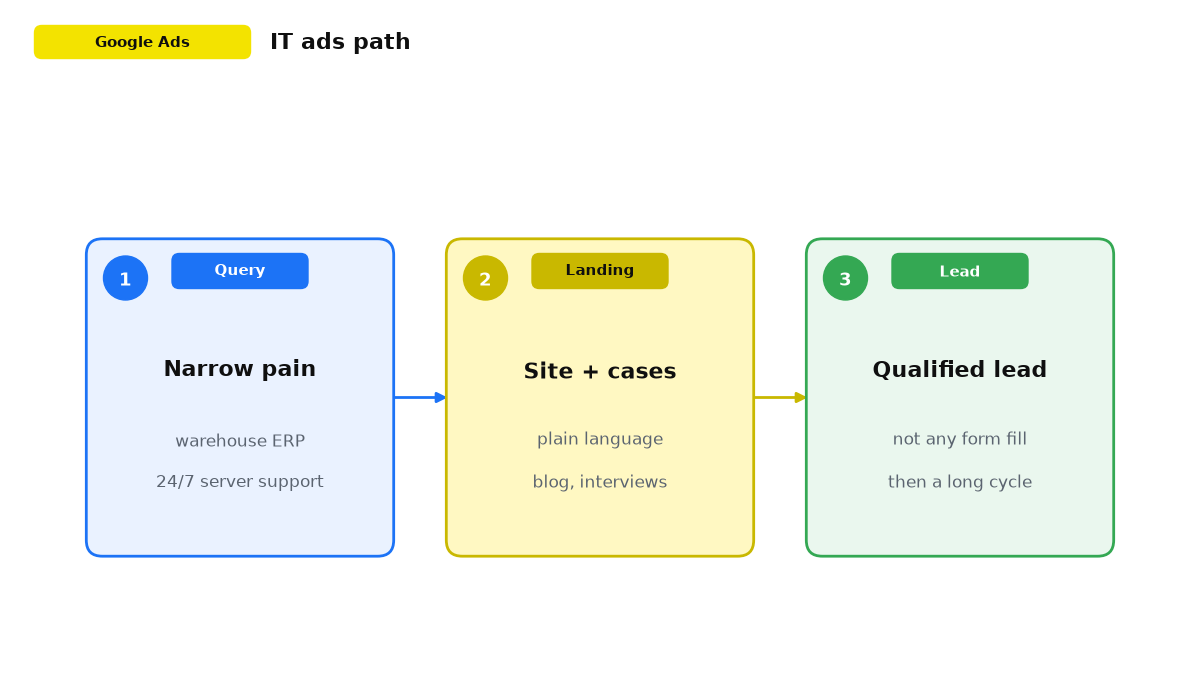
I split demand into three intents: brand, category/problem, and competitor. I optimize for a qualified lead, not for any form fill.
In the official Google help on conversion goals, primary conversion actions are the ones used for reporting and bidding. So the qualified lead has to be the primary conversion if that is what the campaign is optimizing for.
Once a qualified lead is the conversion you bid on, YouTube, the Display Network, and Search stop looking like three separate experiments. They become one path from the first click to a deal that can actually close.
- YouTube. Your own channel helps sell IT services if you fill it with useful video and keep the people who already watched you. Video ads can show the team, the results, and the practical jobs you take on.
- The Display Network is for banner ads aimed at people who already know you from the site or the YouTube channel. You can target audiences (age, interests, in-market, remarketing), IT sites, and competitor pages.
- Google Search. A search campaign costs more. It is usually the first meeting, then a long conversation across other channels. So you have to track assisted conversions and conversion paths, not only last-click sales. Use end-to-end analytics or Google Analytics if you want the full path from the first visit to the purchase.
Treat broad queries with care. They bring the wrong people. You get closer to real buyers with demographic and interest splits, a separate keyword set for each service line, and geo targeting.
Ready-made ad texts for IT services
Below are three working Google Ads variants for three IT models: outsourced development, a SaaS product, and IT support for a business. Headlines fit the 30 character limit, descriptions fit 90. Use them as a frame and swap in your timelines, price, and company name.
Ad 1: outsourced software development
- Headlines: “Custom Software Team”, “Team Ready in 2 Weeks”, “Free Project Estimate”
- Descriptions: “A dedicated team for your project. Clear reports and a fixed timeline for every sprint.”, “From brief to release. Cost and timeline estimate in one business day.”
Ad 2: a SaaS product
- Headlines: “SaaS for Your Business”, “No-Code Automation”, “Live Demo in 5 Minutes”
- Descriptions: “Cloud tools for records, analytics, and reports. No server install needed.”, “Try every feature free for 14 days. Onboarding support is included.”
Ad 3: IT support for a business
- Headlines: “24/7 Business IT Support”, “Outsourced Sysadmin”, “Reply in 15 Minutes”
- Descriptions: “Servers, network, and workstations on a plan instead of an in-house admin.”, “Monitoring and backups included. First infrastructure audit is free.”
Takeaways on advertising and marketing for IT
- The higher the competition and the cost of growing an IT business, the more carefully the marketer has to plan the promotion, including the ads.
- Do not wait for fast results. IT marketing compounds. As the site grows, expertise grows, and more channels go live, more people will know the brand, and some of them will become clients later.
- Once you have a contact, build a long relationship. Technical support after a software install is one way. Then the same buyer can come back with the next order.
- Keep moving. Watch the creatives your IT competitors run, try new ideas, and keep the ones that work.
- SEO can put the site on the first page of Google, which means more people see the IT offer. Bounce rate, time on site, and pages per visit tell you whether that traffic is actually using the site.
- To stop paying for campaigns that do not make money, review conversions often: how many you get and how much each one costs. Move budget toward the ads, audiences, keywords, and channels that work.