
New advertisers assume they lose because their budget is small. In the accounts I analyze, the picture is more specific: on the very same query, different advertisers pay very different prices per click, and everyone crowds into the same narrow set of terms.
Why CPC differs so much on the same query
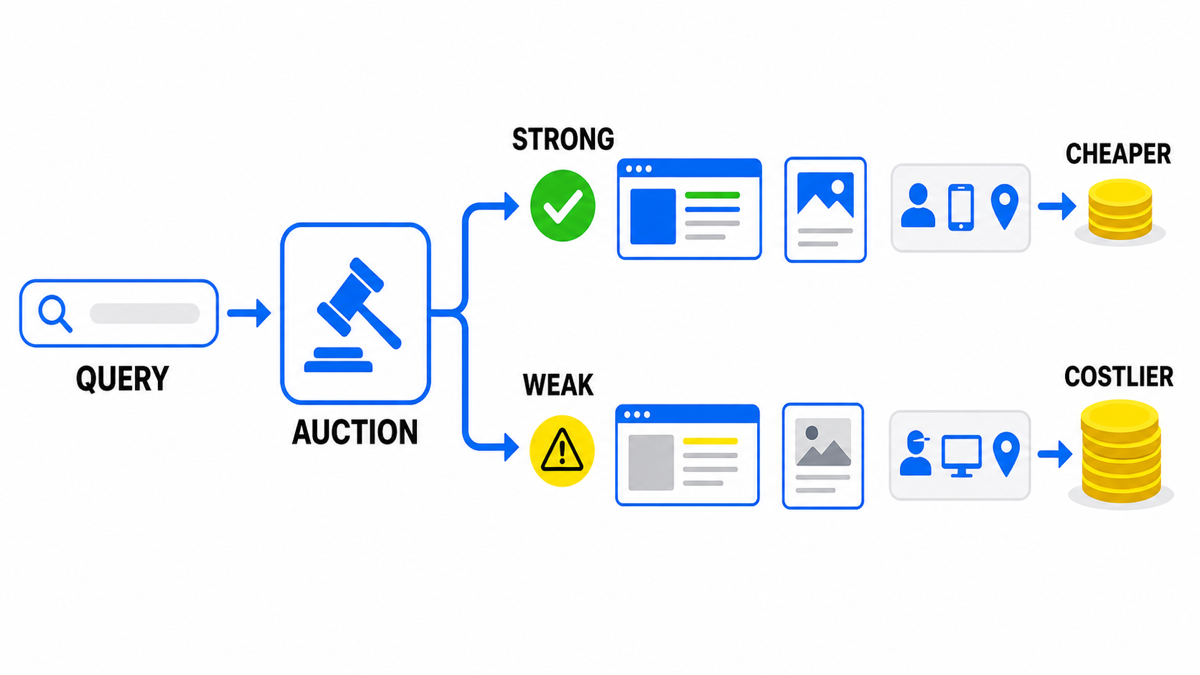
Google calculates Ad Rank separately in every auction, using your bid, the auction-time quality of your ad and landing page, thresholds, competition, the search context, and the expected impact of your assets. Two advertisers on the same query enter different auctions with different users, devices, locations, and quality. Higher quality can lower your cost per click.
So a 3x CPC gap is plausible without any special penalty: the cheaper advertisers likely had stronger auction-time quality. What this dataset cannot tell us is the cause of that specific gap, because it does not include each account’s age or Quality Score. Read the 3x as a warning that identical demand can cost wildly different amounts, not as proof of a newcomer surcharge.
Everyone is crowded into the same words
You might think the escape is cheaper long-tail keywords. In this niche, almost nobody managed it. For most advertisers in the niche, 90% to 98% of search spend went to terms the others were also paying for; the outlier still sat at 75%. The demand lives in a small set of contested head terms, so everyone crowds in and the price stays high for all of them.
And no single player dominated. The largest spender received only about 39% of the impressions it was eligible for. This is a crowded auction with no monopolist: several strong players, none able to own it, all paying the contested-term price.
The shift that actually changed the economics
If you cannot match the incumbents’ auction-time quality on the core queries, stop fighting only on those queries. In this dataset, one account put 37% of its budget into Performance Max and reported a $13 cost per acquisition, against $66 on Search in the same account. That is a 5x within-account gap. It is a testable finding, with a caveat: Performance Max inventory and attribution differ from Search, so the reported number flatters it.
Still, the direction is the lesson. Bidding harder on the crowded head terms did not open a gap like that for anyone. Changing the channel did. For a newer advertiser that means: keep your head-term spend disciplined, invest in the auction-time quality that lowers CPC over time, and test a channel the incumbents underuse.
The researcher’s take
The auction is not a level playing field, and pretending otherwise is expensive. A 3x CPC gap on identical demand is real and measurable. You do not close it by bidding more on the same crowded words. You close it by improving the auction-time quality that lowers your cost per click, and by competing where the incumbents are not looking. Fight the auction on the axis where you can actually win.
FAQ
Does Google charge new accounts more per click?
This data does not show that. It shows a large CPC gap between advertisers on the same query, which auction-time quality can explain on its own. What lowers your cost over time is stronger quality: relevant ads, fast landing pages, and the conversion data that helps Smart Bidding, though reported conversions are not themselves an ad-quality input.
Is long-tail the answer?
Sometimes, but in this niche the long tail was too thin to matter, because the demand lived in the contested head terms. Changing campaign type moved the economics more than chasing cheaper keywords did.
My e-book “19 Google Ads Secrets”: how to get the most out of Google Ads without draining your budget, drawn from real campaigns and tests.
See the book →