
What remarketing actually buys you
Remarketing buys a second chance with someone who already has context. It does not create intent. A visitor who compared prices, opened the cart, or started a quote may need one useful reminder. A visitor who bounced after five seconds is merely a known visitor. Paying to follow both treats recognition as demand.
Google now calls remarketing audiences “your data segments.” The segment records a past action, not a future purchase. Your job is to decide whether that action reveals an unfinished decision. For the wider account logic, use Google Ads: The Complete 2026 Guide.
Three situations where remarketing works
1. The person abandoned a specific high-intent action
A US shopper put a $180 item in the cart but did not pay. A UK prospect opened the pricing page and started a quote. The next step is visible. Show the exact offer, answer the likely objection, and exclude the user immediately after purchase.
2. The timing creates a genuine reason to return
A 7-day quote is expiring, a 30-day replenishment window is approaching, or registration closes on Friday. The ad carries new information. It is not the same generic creative repeated 12 times.
3. The second message resolves a known objection
Someone visited pricing, then a comparison page, but not the contact form. The next ad should address proof, implementation time, or total cost. Send the person to the missing answer, not the homepage.
All three cases share one mechanism: the first visit revealed an unfinished job, and the second message helps finish it. Past traffic alone is not enough.
Four situations where remarketing quietly loses money
| Symptom | What is really happening | What to do instead |
|---|---|---|
| A list has 140 active users, spends irregularly, and CPA swings every week | It clears the technical minimum but produces too few auctions and conversions for stable delivery | Combine closely related segments, lengthen membership from 7 to 30 days where justified, or use Search Observation |
| One person receives 12 impressions in 3 days | Frequency has become irritation because neither message nor offer changes | Cap Display or Video frequency, rotate creative, and exclude users after a meaningful interaction |
| Remarketing reports 900% ROAS while total sales stay flat | The campaign is collecting credit near the purchase, not necessarily causing it | Run a holdout or geographic lift test and judge incremental CPA or incremental ROAS |
| Recent buyers keep seeing the acquisition offer for 30 days | The exclusion is missing, delayed, or based on a weak conversion signal | Exclude purchasers using a verified sale; cross-sell only when there is a distinct next need |
As of August 2026, Google Ads supports manual frequency caps for Display and Video, but not for Demand Gen. Reach, average frequency, creative fatigue, membership duration, and purchaser exclusions are operating controls, not reporting trivia. Google Ads Help confirms the channel limitation.
The attribution trap: why remarketing always looks profitable
Remarketing meets the customer late, so it is unusually good at winning conversion credit. Last click gives the final interaction all the credit. Data-driven attribution distributes credit across observed interactions. Neither answers the causal question: would this person have bought without the remarketing impression?
Google makes the distinction explicit. Attributed conversions follow tracking and attribution rules. Conversion Lift compares an exposed group with a control group to estimate conversions caused by advertising. Google documents these as different measurements.
Before scaling, compare remarketing spend with blended sales, direct traffic, branded search, and confirmed revenue. If your account is eligible, use Conversion Lift. Otherwise, create the cleanest holdout you can and keep conversion goals close to real revenue.
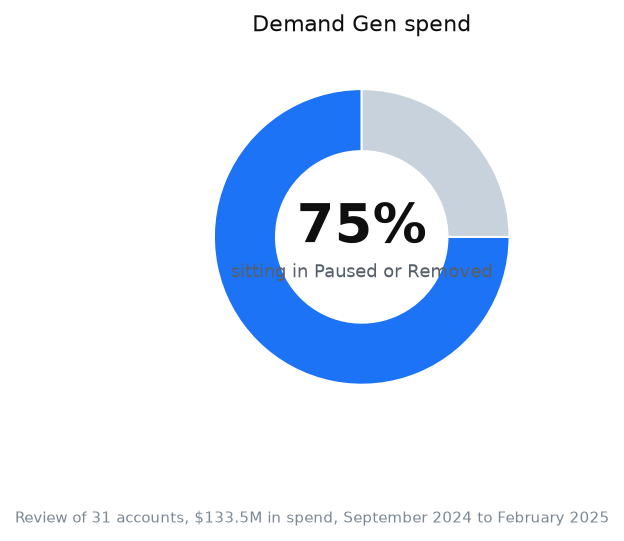
Our own evidence shows why a post mortem matters. In our review of $133.5 million in spend and 24 million rows from September 2024 through February 2025, 75% of all money spent on Demand Gen campaigns that each spent more than $1,000 now sits in Paused or Removed status, against 8.6% for other campaign types.
This measures abandonment, not remarketing quality. It shows how audience-led formats get switched on with enthusiasm, then switched off without a verdict on whether targeting, creative, frequency, or measurement failed.
My e-book “19 Google Ads Secrets”: how to get the most out of Google Ads without draining your budget, drawn from real campaigns and tests.
See the book →Minimum audience size and the learning phase problem
Google’s official serving threshold is 100 active users in the previous 30 days for Display, Search, and YouTube data segments. That is eligibility, not commercial viability. A list of 100 can technically serve and still generate only 2 conversions a month. Google explains the current thresholds here.
Automated bidding learns from conversion volume, conversion delay, and bid strategy. Google says calibration can take up to 3 weeks or 1 to 2 conversion cycles after a material change. A thin list may stop displaying the Learning label yet remain starved of useful outcomes.
Work backward from the decision. If you need 20 sales to judge CPA and the segment can plausibly create only 4, the test is undersized. Broaden the membership window, combine segments with the same intent, move the audience to observation, or spend the money on demand capture.
Do not reset bids and creatives every few days. Each change leaves less comparable evidence.
When this does not apply
Do not kill remarketing merely because the audience is small. A manually bid campaign can serve a narrow, valuable list without conversion-based learning. The warning also matters less when the ad is a genuinely timed reminder and confirmed revenue proves the economics.
A high reported frequency does not prove harm by itself. A short launch may require repeated exposure. Keep it only if blended or incremental results improve, complaints stay low, and recent converters are excluded.
Search Observation audiences do not restrict reach. They can provide comparison data without turning the campaign into a chase of past visitors.
FAQ
What is remarketing in Google Ads?
Remarketing uses your first-party audience data to reach people who previously interacted with your site, app, ads, or business. Google Ads now usually calls these audiences your data segments.
Does remarketing still work in 2026?
Yes, when a previous action signals an unfinished decision and the next ad adds a useful reason to return. It loses money when the audience is weak, frequency is uncontrolled, buyers are not excluded, or attributed revenue is mistaken for incremental revenue.
How many users do you need for Google Ads remarketing?
As of August 2026, Google states a minimum of 100 active users in the last 30 days for Display, Search, and YouTube data segments. A viable campaign usually needs more because bidding and evaluation depend on conversions, not list eligibility.
What is the difference between remarketing and retargeting?
In everyday PPC use, both terms usually mean advertising again to people who already interacted with the business. Google prefers “your data segments,” while marketers still use remarketing and retargeting.
Sources
- Google Ads Help, “About your data segments”. Accessed August 10, 2026.
- Google Ads Help, “About your data segment compatibility”. Accessed August 10, 2026.
- Google Ads Help, “Use frequency capping”. Accessed August 10, 2026.
- Google Ads Help, “About attribution models”. Accessed August 10, 2026.
- Google Ads Help, “Understand your Conversion Lift based on users measurement data”. Accessed August 10, 2026.
- Google Ads Help, “Duration of the learning period for campaigns and what affects it”. Accessed August 10, 2026.