A PPC specialist manages advertising that charges for each click. PPC stands for Pay Per Click. The format includes search ads, display banners, Gmail ads, YouTube ads, and ads in mobile apps. The specialist’s job is to attract interested people, bring them to the company’s website, and help the business turn those visits into purchases or enquiries.
What a PPC specialist needs to know
The skill requirements used to be limited. PPC work often followed a simple sequence:
- Sign in to the client’s advertising account.
- Select the required settings.
- Enter a keyword in the right field.
- Set the bid.
A practitioner did not need to understand the whole system to produce a result. Knowing 10-15 technical tactics could be enough to build a reputation as a capable specialist.
Google Ads later moved further toward automation. Isolated tricks no longer produce reliable results when used without a wider model. A modern PPC specialist needs a solid grasp of online marketing, an understanding of how the client’s business works, and the ability to think beyond campaign settings.
That wider role requires the specialist to understand:
- how people interact with a search engine;
- what role the website plays and how it should support the visitor;
- what influences a customer’s decision;
- how to analyze visitor behavior on the website;
- how to collect accurate website data and send it back to the advertising platform;
- how to optimize advertising with analytics.
Beyond campaign setup, a modern PPC specialist may also handle:
- analytics configuration;
- website optimization;
- advertising copy;
- sales funnels for the specific business;
- coordination between all these parts.
A business owner therefore needs more than someone who operates an advertising interface. The useful specialist connects the click to the sale and explains performance in business terms.
Theory turns into results once you see the whole system. My e-book “19 Google Ads Secrets” shows how to get the most out of Google Ads without draining your budget, drawn from real campaigns and tests.
See the book →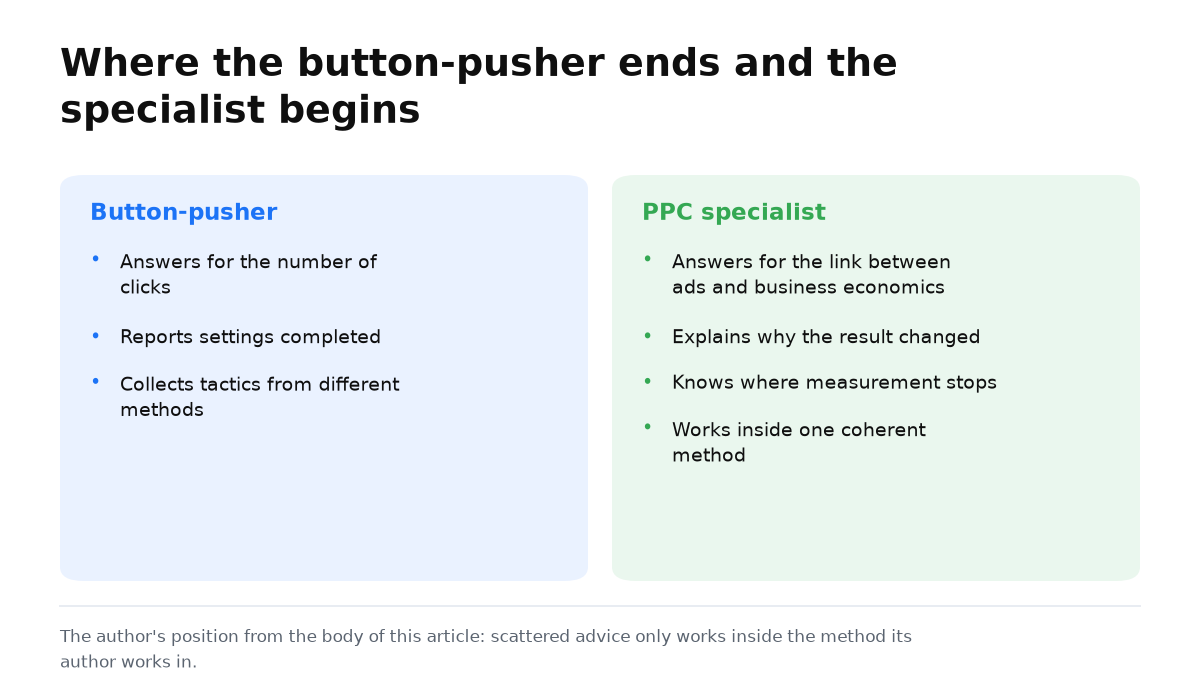
How to become a PPC specialist
People who try to learn PPC independently usually face two main difficulties.
Where campaign setup ends and PPC expertise begins
For me, a strong PPC specialist is accountable not for the number of clicks or completed settings, but for the connection between advertising data and business economics. The person should explain why performance changed, where measurement is limited, and what decision follows from the data.
Google describes the context of professional advertising account management in its official guidance on the Google Partners program.
- There is too much scattered information about Google Ads and PPC. Videos, articles, diagrams, and tutorials appear across many places without forming one coherent system. Reviewing them takes time, and the pieces do not immediately become a working model.
- Advice from an experienced practitioner works best inside the method used by that practitioner. If you borrow campaign structure from one person and keyword selection from another, the methods may conflict. The result can be advertising that cannot compete or meet its goals.
Conclusions about the PPC profession
A promising junior PPC specialist starts by choosing one method and learning it thoroughly. The person needs to understand its logic, gain experience, and follow the recommended sequence. Additional tactics are worth testing later, once the specialist can judge what supports the strategy and what may waste money or cause harm. With experience, the practitioner learns to separate useful advice from noise and evaluate new information critically.
The main characteristics of the PPC profession in 2026 are:
- PPC is a varied and engaging field.
- It requires marketing judgment and an understanding of online business.
- Following one coherent method builds a foundation faster than mixing incompatible tactics at random.