
When a small business owner opens more and more analytics screens without a specific decision in mind, deeper reporting becomes a costly use of limited time. This guide narrows web analytics to a compact system that should expand only when extra detail changes the next decision.
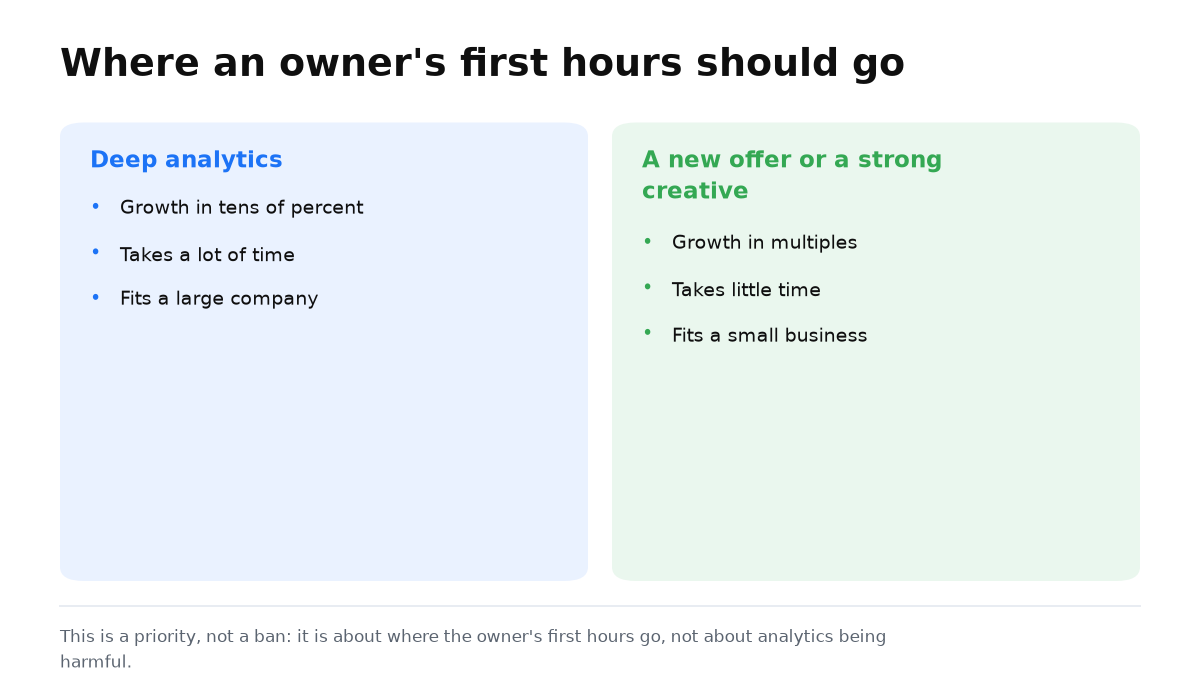
Deep analytics is not automatic proof of a mature business. For a small company, it can become an expensive priority mistake. It may consume a great deal of time to produce gains measured in tens of percent, while a stronger offer or creative can produce gains in multiples with less time. This is not an argument against measurement. It is an order of operations.
For the wider measurement framework, begin with ad analytics for business owners. That guide connects owner-level numbers to decisions. Here we narrow the task to web analytics and keep only the reporting that a small business can use.
What web analytics means in plain English
Web analytics connects behaviour on your website with an owner’s question. The useful question is not simply how many sessions occurred. It is where enquiries came from, which ones became qualified, and what should change next. The interface is secondary. Define the decision first, then collect the data required to make it.
A company being prepared for sale may focus on its customer base. A solo owner may put net profit at the centre. A company preparing for a public offering may manage toward revenue. There is no universal main metric because the right metric depends on the company you are building.
Three reports that are enough for an owner
These do not have to be three standard GA4 screens. Think of them as three management answers that can appear in the analytics interface, a spreadsheet, or a short agency report.
| Report | What it should contain | Decision for the owner |
|---|---|---|
| Traffic and sources | Source, campaign, cost, visits, and key actions for the same period | Where to add budget, what to limit, and where to check tagging |
| Key actions | Enquiries, calls, bookings, or purchases by landing page | Which offer and page move a visitor to the next step |
| Sales reconciliation | Qualified enquiries, paid deals, and refunds matched back to source | Whether advertising is buying customers rather than website activity |
The traffic report is not a visitor counter. It helps reveal a gap between an ad click and a website visit, a change in the mix of sources, or spend that is not accompanied by key actions. Look at the direction of change and ask a focused question rather than judging a campaign by one attractive column.
The key actions report separates useful behaviour from noise. A page view may help diagnosis but is not an enquiry. A button click may indicate intent but does not confirm a conversation or payment. The owner must define the action after which the business has genuinely moved closer to revenue.
The sales reconciliation brings analytics back to cash. If a source brings many enquiries but the sales team rejects them as unqualified, inspect the promise, audience, or qualification rule. If enquiries are qualified but do not close, web analytics should not hide a problem in sales, pricing, or service delivery.
How to read these reports without an analyst
Start by recording the deviation rather than inventing its cause. Compare equivalent completed periods. Ask whether the traffic volume changed, the share of key actions changed, or the share of sales after those actions changed. This sequence prevents one behavioural metric from becoming a convenient explanation for every sales problem.
Next, locate the break. Traffic is present but key actions are missing: check the match between the ad and page, the offer, and the technical recording. Key actions are present but qualified enquiries are missing: inspect the promise, audience, and enquiry criteria. Qualified enquiries are present but payments are missing: inspect sales, pricing, or delivery.
End the review with a written decision. You might keep the budget unchanged while checking a form, revise the landing page offer, or ask the sales team to record why an enquiry was rejected. A report without a next action becomes a ritual of watching numbers.
What you can ignore completely
The Realtime report is the first candidate. According to Google’s documentation, one of its purposes is to verify that measurement code works on a site or app. That makes it useful for checking tracking, not for routine business decisions. Compare completed periods instead of reacting to a moving number right now.
Do not interpret bounce rate without context either. In GA4, bounce rate is the percentage of sessions that were not engaged, so it is the inverse of engagement rate. That definition comes from the official Google Analytics guidance. The metric can suggest where to investigate, but it cannot tell you whether the business made money.
- Do not open every standard dashboard merely because it exists.
- Do not compare channels by sessions when the decision concerns payments.
- Do not watch an incomplete current day when a sale takes longer to mature.
- Do not commission another dashboard until you can name the decision it will change.
When to deepen your analytics
More depth is justified when the simple reconciliation repeatedly reveals a gap but cannot explain it. Campaigns might produce a similar volume of enquiries while the share of qualified enquiries differs. Several channels might also touch the same customer, making a simple source rule produce conflicting budget decisions.
Another signal is the business cost of a wrong decision. For a large company, gains measured in tens of percent can justify many analyst hours. For a small business with an untested offer, the same time is often better spent on a new proposition and creative that can change results in multiples. Remove the large, obvious constraint before optimising finer differences.
What unnecessary analytics really costs
The cost is not limited to an analyst’s fee. The owner spends attention agreeing on events, checking reports, debating attribution, and maintaining the system. If nobody tests the offer during that time, the business has purchased a more precise description of a weak result instead of a stronger result.
Detailed data storage also has boundaries. In the standard version of GA4, user-level and event-level data can be retained for 2 or 14 months. Longer retention periods are available in Analytics 360. The setting does not affect standard aggregated reports, but it does affect explorations. These boundaries are documented in Google’s data retention guidance. Design detailed analysis for a real question instead of storing complexity for an imagined future use.
How this differs from end-to-end analytics
In this guide, web analytics covers behaviour on the site and recorded key actions. End-to-end analytics continues the route into the CRM, deal status, payment, and the result matched back to the advertising source. That broader system is useful when an enquiry is not yet revenue and a sales process sits between the two.
Not every business needs that setup immediately. If the three simple reports already produce an unambiguous budget decision, a more complex system can wait. Add depth when it resolves a costly uncertainty, not because a new dashboard is available.
You now have a minimum reporting system: sources, key actions, and a reconciliation with sales, plus a rule for every proposed dashboard. The next step is to check whether advertising activity leads to money and whether the offer is currently the stronger lever.
My e-book “19 Google Ads Secrets”: how to get the most out of Google Ads without draining your budget, drawn from real campaigns and tests.
See the book →When this does not apply
- Tracking is broken or key actions are recorded more than once. Restore data reliability before analysing performance.
- The sale happens away from the website and its traffic source is not passed into the CRM. Web reports alone cannot demonstrate return.
- The company has a complex customer journey, several teams, and a high cost of misallocating budget. Deeper analysis may be justified earlier.
- The owner has not defined the company being built or its main metric. Even an accurate report then lacks a decision criterion.
Questions and answers
Which reports does a small business really need?
Where people came from, which key actions they completed, and which actions became qualified enquiries or payments. The interface matters less than those three answers.
When should a small business hire an analyst?
When a simple reconciliation repeatedly reveals an expensive gap, the team cannot find the cause, and the expected benefit is greater than the time and complexity of the system.
Which costs more, an analyst or a missed offer problem?
For a small business with an untested proposition, failing to notice a weak offer is often more expensive. Deep analytics can optimise in tens of percent, while a stronger offer or creative can change the result in multiples.