
It is easy to show activity in advertising for pest control services. It is much harder to prove the financial effect of that activity. Oleg Logutenkov’s case matters precisely because it contains no impressive performance figure. A crisis made it impossible for the family business to separate the effect of advertising from external conditions. The outcome is therefore framed honestly as understanding the process, not as growth in leads or revenue.
That is a useful starting point for a pest control owner. Before scaling campaigns, you need to see how demand, keywords, ads, and account data connect. The broader diagnostic framework is covered in the guide to Google Ads for service businesses. Here, the experience of an owner in the same industry is the center of the story.
A family business with scattered advertising knowledge
Oleg describes the business in direct terms: “I work with my wife: disinfection, insect control, and rodent control.” In a service company like this, an owner may handle operations, incoming inquiries, and marketing at the same time. The advertising account should support decisions instead of becoming another source of uncertainty.
Before the training, there was plenty of information but no coherent system. Oleg still had questions about keywords, ads, and the analytics inside the account. The problem was not the absence of isolated tips. The missing part was the connection between them: what the owner was changing, which signal he expected, and how that signal should inform the next decision.
What changed after the training
The mechanism was a set of short lessons without filler. Instead of sitting through long sessions where the practical idea was buried, Oleg could take a compact explanation and compare it with his own account. For a busy owner, this is more than a convenient format. A short learning cycle makes it easier to move from an explanation to checking a specific setting or decision.
Oleg described the outcome as “a complete understanding of the processes that we manage through the advertising account.” That is less dramatic than a claim of sudden growth, but it identifies a meaningful change. Keywords, ads, and account indicators stop looking like unrelated controls. The owner can explain what is being changed, what should happen next, and what evidence would justify another decision.
Why there is no financial result to report
Oleg is explicit: “To be honest, we could not assess the financial side.” This is not a flaw in the case. It is the correct boundary for the conclusion. When market conditions, demand, or the company’s capacity to fulfill work are changing at the same time, the movement in business finances cannot automatically be credited to advertising.
Manageability is not the same as profit. It creates the conditions for evaluating advertising more responsibly later. An owner can see the campaign logic, record changes, and avoid confusing events in the account with events outside it. An honest limit like this is more useful than a bold result with no defensible causal link.
How a pest control owner can apply the mechanism
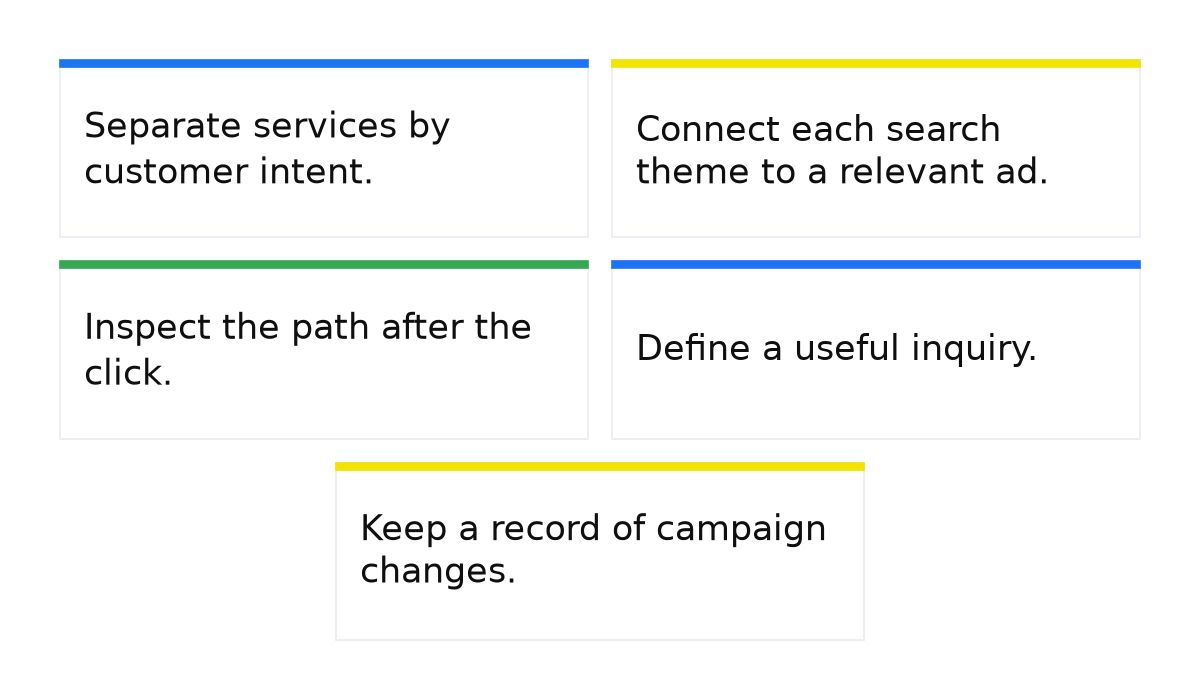
- Separate services by customer intent. Disinfection, insect control, and rodent control should not automatically lead to the same generic message.
- Connect each search theme to a relevant ad. A potential customer should immediately recognize the problem that brought them to search.
- Inspect the path after the click. The landing page or form should continue the ad’s promise and provide a clear way to inquire.
- Define a useful inquiry. A click, a call, a submitted form, and a confirmed job answer different business questions.
- Keep a record of campaign changes. Without a decision log, it is difficult to tell what affected advertising behavior.
These are my recommendations for applying the lesson from Oleg’s experience to your own account. His testimonial describes gaining an understanding of the process; it does not document him following this checklist. Start with that understanding, make deliberate changes, and then assess the business effect.
When this does not apply
Understanding the account will not fix a business that misses inquiries, cannot fulfill the work, or does not record where customers came from. The approach also cannot establish financial impact during major external disruption if that influence cannot be separated. Finally, another owner’s experience is not a promise that your campaign will produce the same outcome.
If your pest control account contains plenty of activity but few clear causes and consequences, start by auditing its logic. Connect services, search terms, ads, landing pages, and inquiry records so each setting supports a decision you can explain.
My e-book “19 Google Ads Secrets”: how to get the most out of Google Ads without draining your budget, drawn from real campaigns and tests.
See the book →