
Two customers can each make one purchase and contribute very different amounts to your business. Maximize conversion value helps Google Ads account for that difference when setting bids. Adding a target return on ad spend, or Target ROAS, tells the system how much conversion value you want for each advertising dollar.
How Maximize conversion value works
You send conversion values to Google Ads, and the system uses those values to inform its bids. When you set a target ROAS, you specify the relationship you want between conversion value and ad spend. For example, a 300% target means $3 in conversion value for every $1 spent on advertising.
Do not confuse this with net profit. The meaning of your ROAS depends on what you report as conversion value: revenue or a value calculated after product costs. A large percentage in the advertising report does not tell you which costs have been accounted for.
- ROAS formula: conversion value / advertising spend × 100%.
- A separate calculation: if you receive $100 and spend $50 on advertising, you have $50 left after ad spend. That remainder equals 100% of the advertising cost, but this is not the ROAS calculation.
- The business implication: money left after advertising is not automatically net profit. Product costs and other business expenses still need to be accounted for.
Maximize conversion value versus Target ROAS
You may encounter both terms in Google Ads. The practical distinction is whether you have supplied a return target.
- Maximize conversion value without a target. The system tries to generate as much total conversion value as possible within your budget.
- Maximize conversion value with a target ROAS. The system tries to generate conversion value while working towards your specified average return on ad spend.
Without a target, your instruction is to pursue conversion value within the budget. With a target, you add a desired ratio between value and cost. That ratio guides bidding; it is not a promise that every conversion or reporting period will meet it.
What I standardize before using Target ROAS
I only enable value-based bidding when the same reported amount means the same thing across every conversion input. I check currencies, refunds, value assignment rules, and when values are updated. Otherwise, the strategy optimizes figures that cannot meaningfully be compared. A high reported ROAS then creates confidence without giving the owner a reliable basis for decisions.
The formula, bidding logic, and data requirements are explained in Google’s official Target ROAS documentation.
Four conditions for value-based bidding
Before switching strategies, check four things. They determine whether the data you give the system reflects the outcome your business needs.
- Conversion values reach your measurement system. Recording a purchase alone is not enough. If you want bidding to reflect what you earn on a product, calculate that consistently: the amount paid by the customer minus the product’s purchase cost. This calculation still does not cover every business expense.
- You have enough conversions to analyze. My practical rule of thumb for this approach is roughly 10 transactions a day. This is not a universal Google eligibility requirement. Check availability for the campaign type you use.
- The values have a financial basis. Do not attach arbitrary amounts to downloading a price list or viewing your contact page. Otherwise, the system learns to maximize invented scores rather than commercially valuable actions.
- You account for the delay between a click and a conversion. A long delay makes a quick assessment harder. Do not judge recent spending as though every resulting sale has already been recorded.
What conversion value means and how to track it
Imagine two people arriving through your ads and each making one purchase. The first generates $500 in profit and the second generates $8,000, measured on the same basis. A conversion count treats them equally. Your business does not: attracting more customers like the second buyer would be more valuable.
To show Google Ads that difference, you need measurement that sends the value of each conversion. This can involve both web development and analytics expertise. If you lack that experience, I recommend bringing in specialists. A complex implementation may cost several thousand dollars, so assess the investment before committing to it.
My budget guidelines concern the investment in end-to-end measurement:
- From $5,000 in monthly ad spend: start considering an implementation and work out its cost.
- From $10,000 in monthly ad spend: I recommend putting this measurement in place so further optimization and growth can be assessed against financial results.
These are my planning guidelines, not spending thresholds imposed by Google for access to Target ROAS.
Why an unrealistic target can stop delivery
Setting an ambitious percentage is easy. Creating the economics to support it is harder. If you expect $1,000,000 in value from $1 of advertising, Google may be unable to find opportunities that meet your target. Impressions can fall sharply or stop altogether.
Base the target on what your business and campaign can achieve. A higher number does not make customers more valuable. It can simply limit the auctions in which your ads compete.
How to choose a useful ROAS target
A useful target balances the financial return with the volume of business your campaign can generate. I look at both sides.
- The target must support your economics. Broad reach and plenty of sales do not help if the resulting value fails to justify the cost. Interpret the return according to the values you actually send to Google Ads.
- The target must be achievable. A 1000% target, for example, can sharply restrict impressions if the campaign cannot produce that ratio of value to spending. No percentage is inherently right without the business context.
A realistic target belongs alongside the four conditions above: consistent values, sufficient conversions, a financial basis for those values, and an allowance for conversion delays. Evaluate the achieved result as well as the percentage entered in your settings.
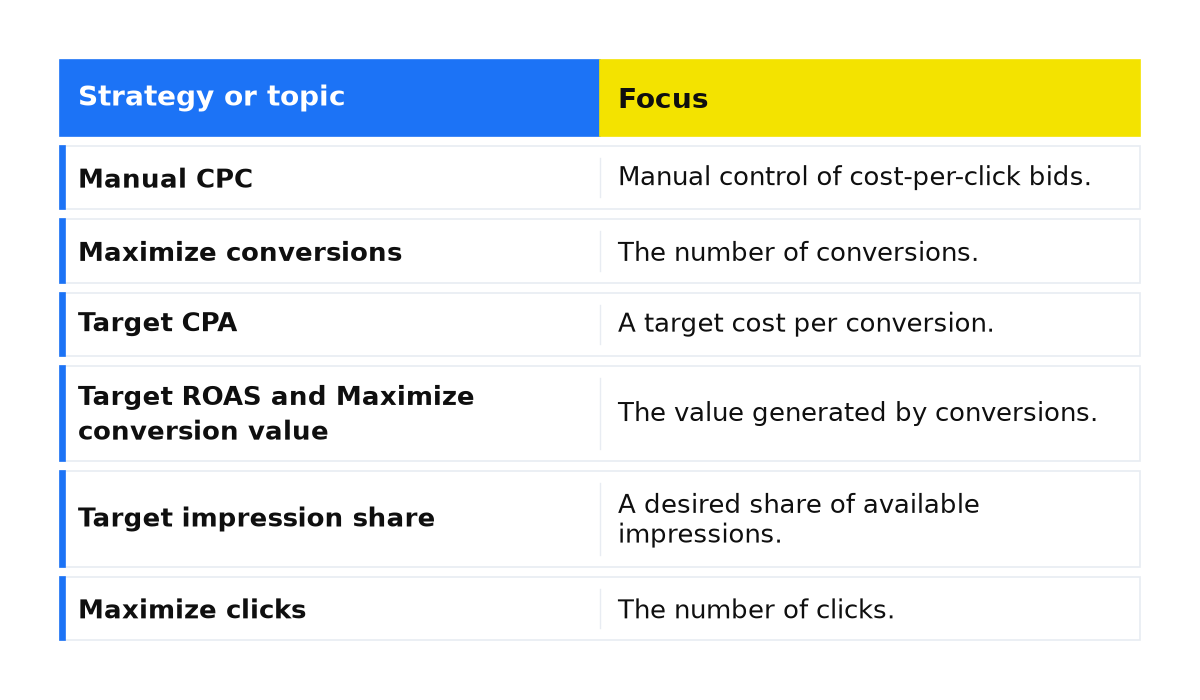
A guide to the different bidding strategies
Use the distinctions below to keep conversion value separate from other bidding objectives.
| Strategy or topic | Focus |
|---|---|
| Google Ads bidding strategies | The overall choice of how bids are managed. |
| Automated bidding | Google Ads sets bids through an automated strategy. |
| Manual CPC | Manual control of cost-per-click bids. |
| Maximize conversions | The number of conversions. |
| Target CPA | A target cost per conversion. |
| Target ROAS and Maximize conversion value | The value generated by conversions. |
| Target impression share | A desired share of available impressions. |
| Maximize clicks | The number of clicks. |
When this does not apply: value-based bidding is a poor fit when values are arbitrary, measurement is inconsistent, there are too few purchases to assess performance, or the target is disconnected from your economics. A long sales delay also makes evaluation harder. Fix measurement before expecting a change of bidding strategy to improve the business.

Managing advertising through financial results means connecting measurement, strategy selection, and ongoing evaluation. Learning to bring those pieces together is the next step towards using Google Ads with a clear business objective.
My e-book “19 Google Ads Secrets”: how to get the most out of Google Ads without draining your budget, drawn from real campaigns and tests.
See the book →