
The most expensive decisions in ad accounts are not caused by poor arithmetic. They happen because somebody reads a report before the relevant data has had time to appear. “Three days have passed, there are no leads, switch it off” is not just impatience. It shows that the business does not know its own conversion cycle.
What it is and why it is not just a few days
The conversion cycle is the interval between a click and the action you are paying to generate. For urgent services, it may be hours: a lock breaks, the customer clicks an ad, and calls. Services that require comparison may take several days. Expensive purchases and B2B sales take weeks, sometimes months.
Your cycle is specific to your business, not an industry average. Two clinics in the same city may have cycles of one day and one week if the first treats urgent pain while the second provides planned implant treatment.
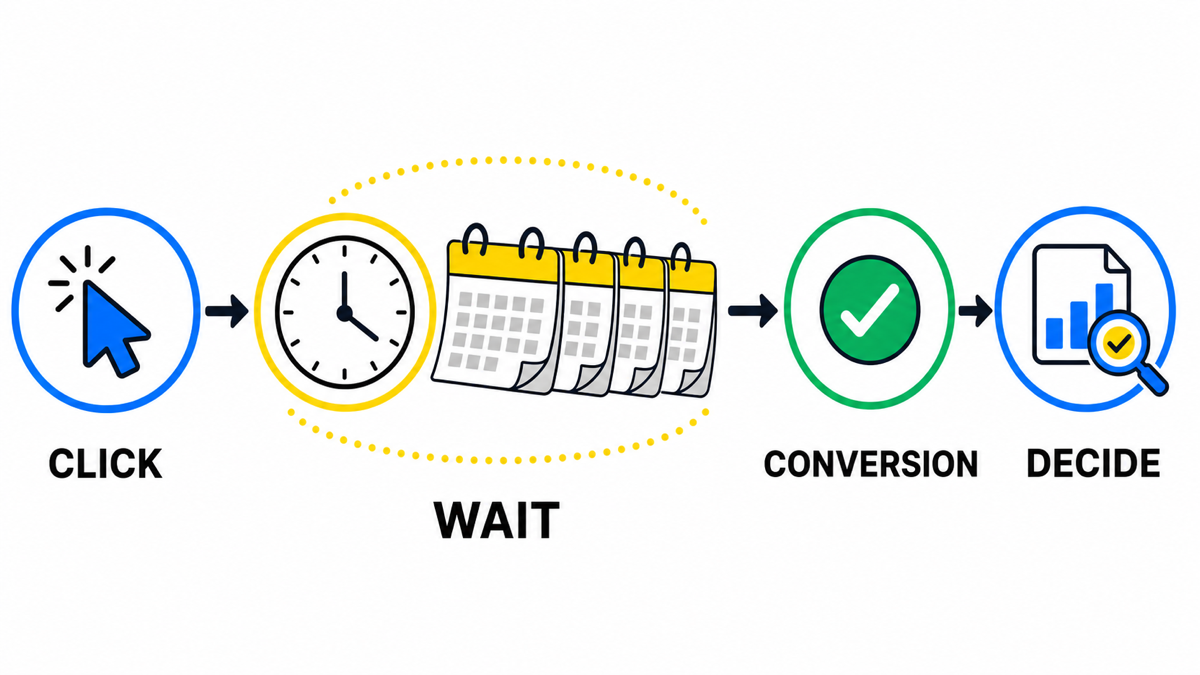
How to calculate your conversion cycle
- Take the last 30-50 enquiries for which you know the date of first contact and the date the person became a customer.
- Calculate the difference in days for each one, then use the median rather than the mean. One deal that took six months will distort the mean but have little effect on the median.
- Separately calculate how many days account for 80% of enquiries. Use that figure as the working cycle for advertising decisions.
- Compare it with the conversion window in Google Ads. If your cycle is longer than the window, the system will fail to credit some leads and you will assess performance using incomplete data.
If you do not have this data, ask the sales team for a rough estimate and test it again in a month. An approximate cycle is better than no estimate at all. Without one, you cannot know when a report contains enough information to read.
My e-book “19 Google Ads Secrets”: how to get the most out of Google Ads without draining your budget, drawn from real campaigns and tests.
See the book →How this changes the way you manage ads
You stop turning campaigns off too early. If the cycle is five days, judging performance on day three makes no sense because half of the eventual leads have not happened yet.
You wait for the right amount of time after a change. Google explains that the system reacts to a target change within minutes, but reaching it can take one or two conversion cycles. It also advises against making several target ROAS changes within a single cycle.
You understand learning timelines. Calibration after changing the bidding strategy can take up to three weeks or one to two conversion cycles. That is fast for a business with a one-day cycle, but it creates a very different planning problem for a B2B company with a one-month cycle.
Frequently asked questions
How is the conversion cycle different from the attribution window
The cycle is the actual delay in your business. The attribution window is a Google Ads setting that determines how long a conversion can still receive credit for a click. If the cycle exceeds the window, the system will not see some of your leads.
How long should I wait after changing a bid or budget
Wait for one or two of your own cycles, and no less. If the cycle is three days, that means nearly a week of patient observation. The rule of one change followed by one evaluation period becomes guesswork unless you know the cycle.