
Accounts do not just waste money on bad keywords. They attach real budget to entire campaigns that later go inactive. When I sort spend by whether the campaign is still running, a clear pattern appears: for some campaign types, a much larger share of historical spend is tied to campaigns that are now paused or removed.
Three quarters of the Demand Gen money was attached to campaigns that are no longer running. For Search it was under one dollar in ten. This is a spend-share comparison, not a survival rate, and status alone does not prove those campaigns failed. But the size of the gap is hard to ignore.
Status is not the same as failure
A paused campaign can be resumed; a removed one is deleted. Neither status, by itself, tells you whether the campaign produced value, completed a seasonal run, or was abandoned mid-test. That is exactly why a high inactive-spend share is a signal to investigate, not a verdict. The Demand Gen number stands out because the spend was large and the inactive share was extreme.
The activity often comes in bursts. In one account the change log jumped from about 34 edits a week to 816 for roughly three months, then fell back to 8. Bid edits made up 79% of that burst. That is an operational spike, not proof of a launch spree, but it is the shape of an account being worked hard and then left alone.
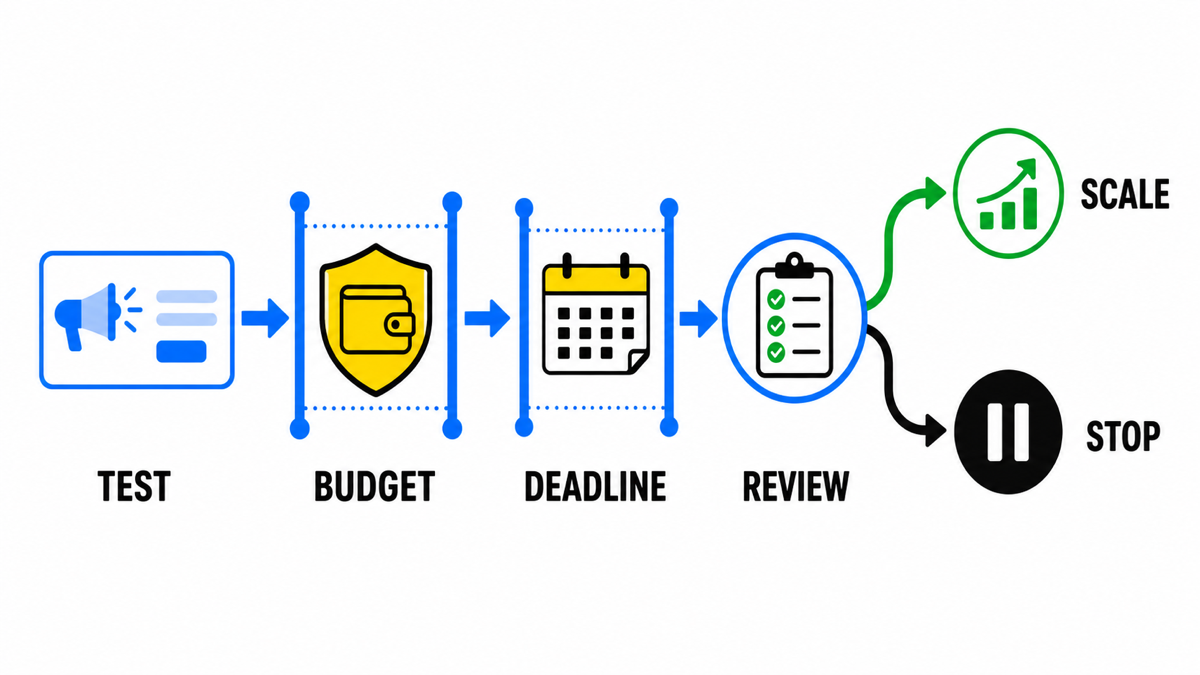
How to test without the pile-up
- Decide the kill criterion before you launch: what result, by what date, at what spend, tells you to stop. Write it down.
- Give automated formats like Demand Gen a fixed test budget and a fixed window. They use Smart Bidding and need a learning period, so set the evaluation window in advance.
- When a campaign fails its criterion, pause it, label the outcome, and record the lesson. Paused campaigns are not the problem; unexplained paused campaigns are.
- Review your inactive campaigns by category, test, seasonal, migration, before reading anything into the count.
The researcher’s take
Experimentation is good. Unexplained inactive spend is just clutter you cannot learn from. The accounts with the worst pile-ups were not the ones that tested too little, they were the ones that funded automated formats open-endedly and never came back to label the outcome. Test with a kill switch defined up front, especially on the formats that spend fastest, and pause with a reason attached, not in silence.
FAQ
Does a high paused share always mean waste?
No. Some pausing is healthy pruning or a finished seasonal run. It becomes a problem when large budget went inactive with no lesson captured. Status alone does not measure profitability, which is why the number is a prompt to investigate rather than a conclusion.
Should I avoid Demand Gen then?
No. Just fund it as a bounded test, not an open tap. It runs on Smart Bidding and needs a learning window, so a fixed budget and a pre-set evaluation date keep it from piling up unexplained.
My e-book “19 Google Ads Secrets”: how to get the most out of Google Ads without draining your budget, drawn from real campaigns and tests.
See the book →