
If advertising for a custom apparel or fabric printing shop spends money without producing value, the answer is not always another adjustment to the old campaign. It can be safer to realign the offer, landing page, and search intent from the ground up. That is what Dmitry Oksen did while studying: he developed a new project, built the website from the recommendations, and configured a new campaign from scratch.
This is a useful case for a workshop owner because Google Ads is supposed to attract people with a specific service need, not traffic in the abstract. The broader process is covered in this guide to diagnosing clicks that do not become leads. Here, the focus is narrower: what changed in one apparel production business and how to apply the mechanism without promising that another shop will reproduce its result.
What happened before the rebuild
Dmitry had managed advertising himself for a long time. Some products sold well through other channels, yet their Google campaigns were unprofitable. The business did not lack a real product or operating experience. The workshop was active, and its owner had already spent time trying to manage campaigns.
“We have a fabric printing workshop and garment production here”
Dmitry Oksen
Dmitry describes the earlier advertising problem plainly:
“some of the advertising campaigns we set up were simply unprofitable”
Dmitry Oksen
That is a particularly deceptive problem in made-to-order production. A click can look relevant while the person is seeking a finished retail item, a home printing method, training, or a different kind of supplier. The campaign records activity, but the query does not match the order that the workshop wants and is equipped to fulfill.
What Dmitry actually changed
Rather than patching the old setup, Dmitry assembled a new project alongside the course. He made the website according to the recommendations and configured the advertising campaign from scratch using the training method. The change therefore extended beyond ad copy. The landing experience and campaign structure were created as a connected system.
His account does not list every setting, so it would be wrong to credit a particular bidding strategy, match type, or negative keyword list. The defensible conclusion is narrower: the owner rebuilt the website according to the recommendations and launched a fresh campaign from the ground up instead of changing a single checkbox.
“I got, on the first day when I launched the advertising campaign using Igor’s methodology, a CTR of 32 percent”
Dmitry Oksen
What a 32% CTR means in this case
CTR is the share of impressions that result in an ad click. Dmitry’s 32% figure belongs to the first day of one newly launched campaign. It is an early signal that the ad may have matched searchers’ intent, though lead quality still needs to be checked.
| What is known | What it supports | What it does not prove |
|---|---|---|
| The campaign was built from scratch | The result followed a systematic rebuild | That one isolated setting caused it |
| First-day CTR was 32% | The ad earned a high share of clicks from its impressions | That this is an industry benchmark or stable average |
| Earlier campaigns were unprofitable | The previous launch process needed revision | That the new CTR already proves profit |
A high CTR does not reveal whether those clicks became orders, whether their cost works for the business, or whether production has enough margin. Read it as a diagnostic signal, not a final business outcome. The next test begins after the click: what the person requested, whether the job fits the workshop, and whether the conversation became a sale.
How to apply the mechanism in your workshop
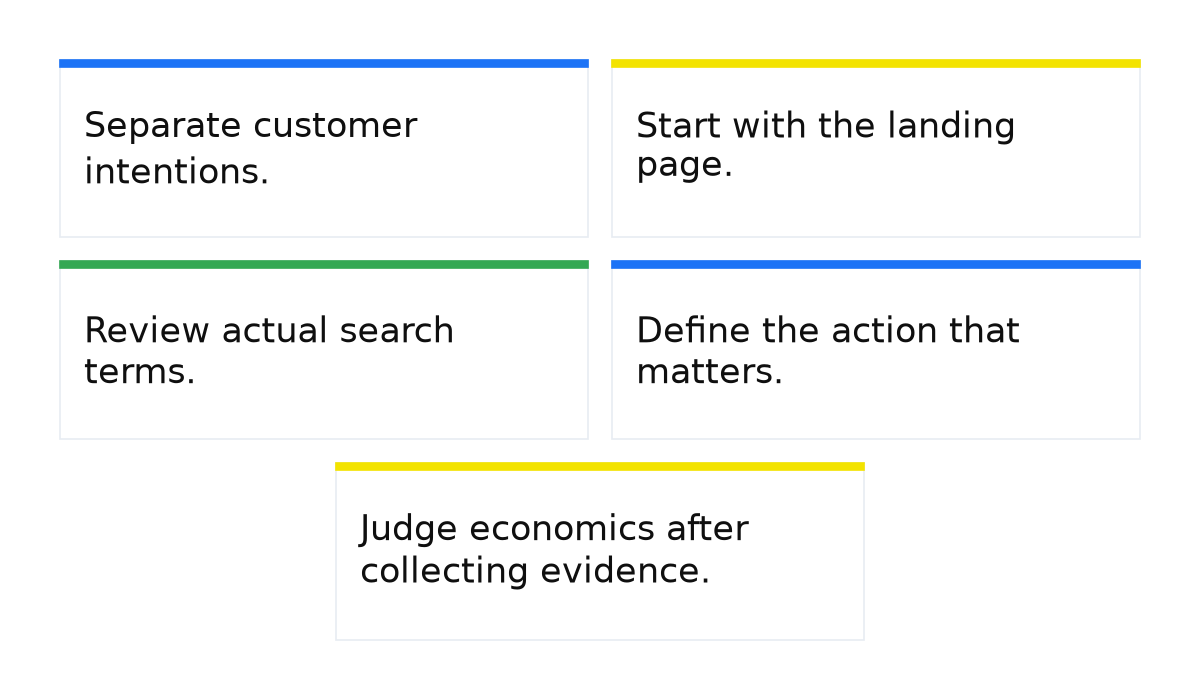
- Separate customer intentions. Custom sewing and fabric printing may need different pages, ads, and query groups. Do not ask one general ad to answer every need.
- Start with the landing page. After the click, a buyer should immediately understand what work you perform, who it is for, and how to discuss an order. A relevant click is easily lost when the page does not continue the ad’s promise.
- Review actual search terms. A relevant word does not automatically make a visitor a customer. Separate commercial intent from research, finished retail products, and services in formats you do not provide.
- Define the action that matters. Do not stop at clicks. Record the inquiry, what the prospect requested, and whether it fits your production.
- Judge economics after collecting evidence. CTR helps diagnose relevance. Budget decisions require information about inquiries, orders, and their value to the business.
When this does not apply
A campaign rebuild cannot compensate for a weak offer, a confusing page, or a lack of genuine demand for the service. A high CTR is also unhelpful when the workshop does not handle inquiries, cannot distinguish suitable orders from irrelevant ones, or does not know an acceptable acquisition cost.
Dmitry’s result is not a CTR benchmark for every apparel producer. It describes the first day of one specific campaign. The lesson stops being useful if later inquiries do not match the workshop’s services or the advertising remains unprofitable once orders are evaluated.
If Dmitry’s situation feels familiar, the next useful step is a structured review of your own customer intent, landing page, ad message, and inquiry measurement. Inspect that chain before you increase the budget.
My e-book “19 Google Ads Secrets”: how to get the most out of Google Ads without draining your budget, drawn from real campaigns and tests.
See the book →