
After moving abroad, business owners often ask me what will happen to their advertising and how they should pay for it. The good news is that working from another country does not itself require a change. Your ads can continue to run. The billing questions are which card to use, which currency will appear on invoices, and which taxes may apply.
I cover prepayments, automatic payments, and payment profiles in the separate guide on how to pay for Google Ads. Here, the focus is narrower: what the country of your payment profile controls and when it makes sense to use a profile in another country.
The main rule: your profile country controls billing
When you create a Google Ads account, you select the country and currency for its payment profile. That choice determines the available payment methods, invoice currency, and tax treatment. It cannot be changed. A payment profile is tied to one country, so another country requires another profile. In my experience, this is the biggest surprise after a move. People look for a country switch in the settings, but there is no such button.
This creates a simple decision that can save hours of searching.
Your move is temporary
The business and its customers remain in Ukraine, while you work remotely.
Do not change anything. Your Ukrainian account, hryvnia payment profile, and Ukrainian card work from another country, with no billing change inside Google. Discuss any personal tax obligations in your new place of residence with an accountant.
Your business has moved permanently
Your company, sole trader equivalent, customers, and revenue are now based in your country of residence.
Create a payment profile for that country. In practice, this is commonly created with a new account. You will use the local currency, local payment methods, and tax documents that your accountant can process.
If you are unsure, look at where the business is based, not where you happen to be sitting. The profile should match the legal advertiser and the accounting system that accepts the documents. That decision gives you a clean billing setup for the way the business actually operates.
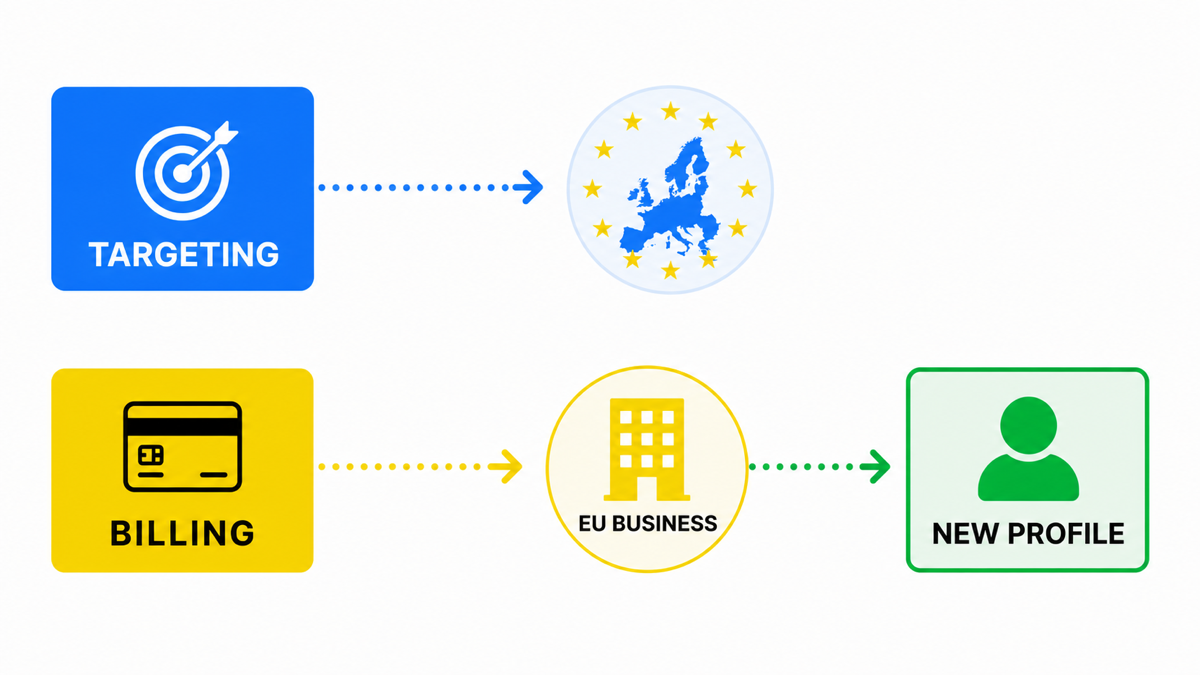
Once you know which side of this decision fits your business, you can choose the payment profile without mixing personal location, business registration, and advertising targets.
A card from another country can work, with caveats
A common transition is a Ukrainian payment profile with a German or Polish card. In my experience, a card from another country is usually accepted. However, the invoice currency and taxes still follow the profile country. Ask your bank about conversion terms because recurring charges can make those costs noticeable. This can work during a transition, but it is not a permanent setup.
Taxes follow the payment address
Advertisers with an EU payment address are served by Google Ireland. Google’s tax guidance states that Google cannot charge VAT when the payment address is outside the European Union. In some countries, advertisers must account for VAT on advertising services themselves, as described in the guidance. Ask a local accountant what applies to your country and status. I am deliberately not giving a percentage because rates differ by country and can change.
Verification: one business across every document
Google conducts advertiser verification using identity or organisation documents. Keep the profile, payment method, and documents aligned so they describe the same business. A profile from one country, a card from a second, and documents from a third can create questions that are difficult to answer during verification. A simple and consistent setup gives Google fewer reasons to investigate.
Frequently asked questions
Can I use a Ukrainian card while living in Germany?
Yes. A Ukrainian payment profile and card can work from another country. Living abroad does not by itself require a new profile. The practical question is whether hryvnia invoices and Ukrainian accounting still fit the business.
What happens to my old account if I create a new one in Europe?
The old account remains yours, but its history does not transfer to the new one. The new account starts from scratch and may initially pay more per click. The article on the cost of Google advertising discusses this as a new-account tax.
Do I need a European account to advertise in Europe?
No. Targeting is separate from the payment profile country, so you can target Germany from a Ukrainian account. You need a European profile only when the business itself is based in Europe. See the detailed guide to a Google Ads account in Europe.
My conclusion
Keep it simple. While the business remains legally based in Ukraine, leave the account and profile as they are and keep using a compatible card from abroad. When the company, taxes, and customers genuinely move, create a profile for the new country and complete verification with local documents. My working recommendation is one country across the profile, payment setup, and documents. Complicated combinations tend to create extra questions and waste time.