
In my agency practice, Performance Max makes sense for a service business once Search has demonstrated that its leads are real and the conversion goal reflects that quality. Before launch, I check qualified conversions, landing pages and the company’s own brand. If every form submission counts as success, I start by fixing measurement.
Otherwise, you risk paying for inquiries your team cannot pursue. I define a qualified lead, import confirmed outcomes, then check the settings. Continued spending should depend on qualified inquiries at a cost your business can support.
Should Performance Max replace Search?
Google describes Performance Max as a complement to keyword-based Search campaigns. It pursues a conversion goal across Search, YouTube, Display, Discover, Gmail and Maps within one campaign. Our Performance Max overview explains the setup. First, can you identify which inquiries are worth pursuing?
In our sample of 32 advertising accounts from September 2024 through February 2025, the median Performance Max share of an account’s budget was 2.8%; 12 of 32 accounts spent nothing on it. These were subscription and micro-SaaS services, not local service businesses. The figures show investment allocation, not effectiveness, and do not support the idea that everyone has moved their budget.
In one subscription-based online service account during that period, CPA was $13 for Performance Max versus $66 for Search. This was not a service business. CPA means cost per recorded conversion: an advertiser-defined event, probably a trial or sign-up, not a purchase or service inquiry. Performance Max attribution is more generous than Search attribution, explaining part of the gap. A channel can report a CPA several times lower than Search within one account. For services, compare the cost of qualified leads instead of relying on reported CPA.
What should you set up before launch?
Ask your sales team to define a lead they would accept. For example: someone needs your service, you can serve them, and they provide valid contact details. Agree on these criteria with your campaign manager before discussing a target cost.
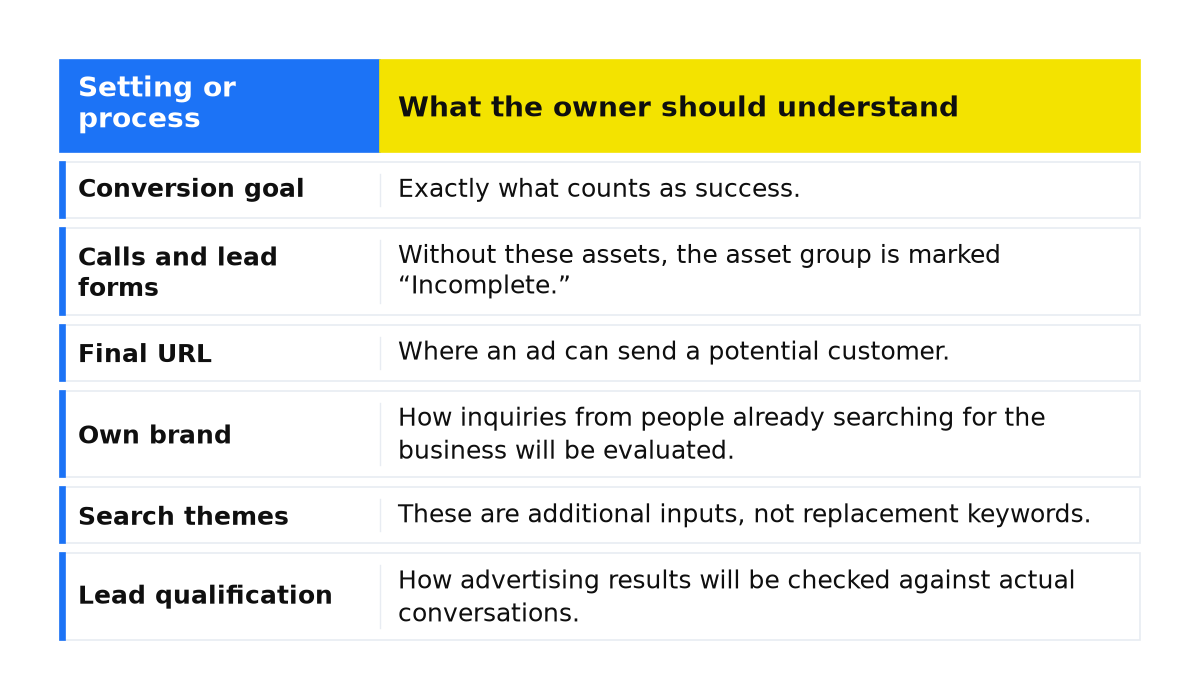
| Setting or process | My prelaunch check | What the owner should understand |
|---|---|---|
| Conversion goal | The goal represents a qualified lead; offline import of confirmed outcomes has been checked. | Exactly what counts as success. |
| Calls and lead forms | Relevant call assets or lead form assets are added when calls or leads are the primary conversion goal. | Without these assets, the asset group is marked “Incomplete.” |
| Final URL | Where strict page control is needed, expansion is off and approved service pages are specified; text customization stays on for page feeds. | Where an ad can send a potential customer. |
| Own brand | Brand exclusions are coordinated with the separate brand campaign. | How inquiries from people already searching for the business will be evaluated. |
| Search themes | The wording describes services in customers’ language. | These are additional inputs, not replacement keywords. |
| Lead qualification | The team records accepted inquiries and reasons for rejecting others. | How advertising results will be checked against actual conversations. |
In my experience, optimizing for any submitted form can attract people willing to complete forms without intending to buy. I address that through qualified conversions and offline import of confirmed outcomes. If customers call, use our guide to Google Ads call tracking alongside a review of what those conversations actually produced.
Google recommends using the same conversion goals as other successful campaigns and assigning values according to their business importance. I copy the Search goal only when it already measures qualified leads. If Search counts every form submission, I fix the goals in both campaigns first. A submitted form and an inquiry accepted by your sales team are different outcomes, so their costs do not provide a like-for-like comparison.
How do you keep visitors on approved service pages?
Google’s setup guidance says text customization and Final URL expansion are on by default. Expansion lets Google select another relevant page and generate a matching headline and description. Check this before launch, especially if your site has careers or help pages.
Google recommends keeping text customization and Final URL expansion on, using URL exclusions to remove unwanted sections such as the blog or FAQ. According to Google’s internal data, advertisers using expansion see an average of 9% more conversions at a similar CPA. Consider this option if you are comfortable letting the system choose among relevant pages to pursue more conversions.
A page feed is a list of URLs, and uploading one does not automatically restrict destinations. With expansion on, page feeds and “URL contains” rules provide guidance. With expansion off, they restrict destinations to the specified pages. Page feeds require text customization to stay on, even when Final URL expansion is off.
In my practice, I turn expansion off when a limited budget must go only to approved pages for a specific service. I accept potentially fewer conversions in exchange for control over the landing page. Give your campaign manager the agreed list and ask to see the restriction in the settings.
What about your brand and search themes?
Google recommends brand exclusions when a separate campaign handles brand traffic. In Performance Max, these exclusions apply to Search, Shopping and YouTube search. Our brand exclusions guide covers the setup. Agree in advance how you will evaluate inquiries from people who already knew your company and searched for it by name.
Performance Max search themes supplement keywords with information about demand. According to Google, you can add up to 50 per asset group. Use customers’ wording, such as air conditioning installation if you sell it. You still need to define a qualified inquiry.
How do you decide whether to keep the campaign?
Go to “Campaigns” → “Insights and reports” → “Channel performance.” The channel performance report includes spend, conversions, conversion value, actual CPA and the distribution across channels. Check the goal first: “Conversions” covers the goals the campaign optimizes toward, while “Results” covers all goals. Then examine which channels received the budget and which events were counted.
Review those events with whoever qualifies leads. If the report looks healthy but there are no worthwhile inquiries, revisit the conversion definition before comparing channel costs.
According to Google, bid strategy learning can take roughly 50 conversion events or 3 conversion cycles; existing data can speed it up. This describes learning duration, not a launch threshold. I do not reject a campaign on one weekly report.
For a worked example, a campaign receiving 8 qualified leads per week would reach 50 events in about 6 weeks (50 ÷ 8 ≈ 6.25). Use your own weekly lead volume and conversion cycle to estimate the time your campaign may need.
I keep a campaign when measurement is sound and, after allowing for the conversion cycle, it delivers qualified inquiries at an acceptable cost. Fix incorrect goals first. If inquiries have had time to be qualified and the economics remain unacceptable, consider stopping.
When this does not apply
Do not scale if your team cannot distinguish potential buyers from empty submissions, or confirmed outcomes never reach measurement. A financial verdict is premature until the conversion cycle has elapsed.
I recommend strict URL control when a limited budget must support specific service pages. It is not a universal requirement. The subscription-services dataset cannot prescribe your budget either: I base spending decisions on your qualified inquiries and what they cost.
Questions and answers
Must I run Search first?
Validating Search leads first is my practical recommendation for service businesses. I am not presenting it as a technical requirement for access to Performance Max.
Will search themes fix spam leads?
In my practice, I start with qualified conversions and offline import. Search themes describe demand; your team still needs to establish whether an inquiry is worth pursuing.
Should I copy the 2.8% budget share?
No. That is a sample median, not a spending recommendation. Set a test budget around your economics and your ability to evaluate the leads it produces.

For your next account check, match the conversions Performance Max counts to the inquiries your team accepts, then check the destination URLs and brand exclusions. Use any mismatch to decide which setting to fix before increasing spend.
My e-book “19 Google Ads Secrets”: how to get the most out of Google Ads without draining your budget, drawn from real campaigns and tests.
See the book →