
The line “Circumventing systems” in Google Ads means Google believes you are bypassing or interfering with its advertising systems and processes, or trying to do so. It sits in the “Abusing the ad network” policy, not in editorial cleanup of a headline.
An ad with this line does not serve. Google treats the violation as egregious, so the account can be suspended immediately and without prior warning. If a suspension banner is already up, start with what a Google Ads suspension means and what to do.
What it means
The official wording is in the Abusing the ad network policy. The English version is the one Google uses for enforcement; translations do not change the rule.
Google does not look at ad text alone. It may review the website, other accounts, and third-party sources.
In my practice with small businesses, this line rarely means a scheme to beat review. More often the owner opened a new account after an old suspension, a partner widget landed on the site, the page sends visitors to another domain, or billing sits on a friend’s profile.
What is at stake
An egregious violation, in Google’s definition, is unlawful or poses significant harm to users. When one is found, the account is suspended on detection and without prior warning. Ordinary repeated violations get a warning at least 7 days before a suspension.
A disapproved ad gets no impressions. A suspended account serves ads in no country; you can often still view reports, manage payments, and appeal. Reinstatement happens only in compelling circumstances. Google’s broader view is in the account suspensions overview.
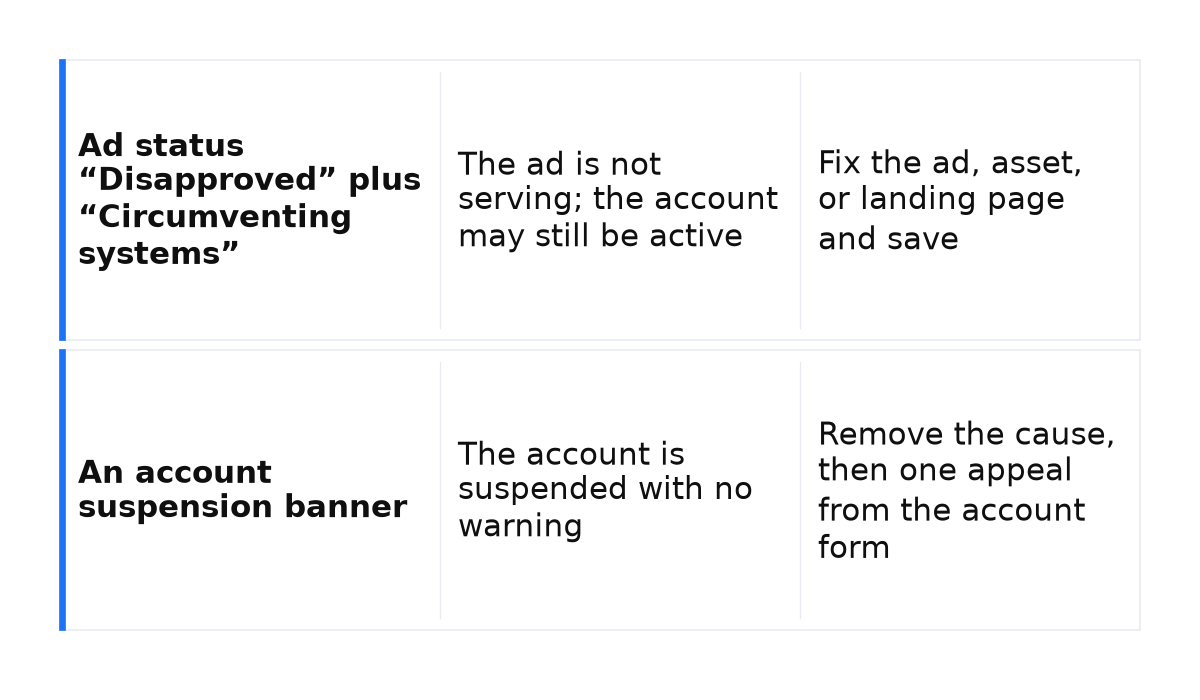
| What you see | What it means | First step |
|---|---|---|
| Ad status “Disapproved” plus “Circumventing systems” | The ad is not serving; the account may still be active | Fix the ad, asset, or landing page and save |
| An account suspension banner | The account is suspended with no warning | Remove the cause, then one appeal from the account form |
What to do
- Hover over “Disapproved” in the Status column and open the policy; add the Policy details column if needed. A “Contact us” link in the top banner means the account itself is suspended.
- Check the landing page before you rewrite the ad: third-party widgets, redirect chains, a domain shared with a previously suspended account, billing that is not in the business name.
- Remove the cause and save the ad, or change the final URL to a compliant page. Saving starts an automatic new review; status appears in the Status column and in Policy manager.
- If the issue is already fixed or the decision looks wrong, appeal from Policy manager. Each ad has 3 appeals; wait at least 24 hours between appeals on the same ads. After three failures, use support. From 21 July 2026, in-account appeals are unavailable for decisions older than 6 months.
- If the account is suspended, open the form from “Contact us” in the banner. File one appeal at a time; while it is reviewed, the status is “Appeal pending”, and the outcome arrives by email. If it is rejected, file again only after a real change. Some advertisers must complete advertiser verification first; after 3 failed verification attempts, appeal is unavailable.
If the whole account is already suspended, not just this policy line on one ad, see what to do if your Google Ads account is suspended.
What not to do
- Do not open a new account in a friend’s name or another company “until this one is sorted.” A new account after a ban is what this policy catches. Restore the suspended account first.
- Do not file a batch of account-suspension appeals: one at a time. Abuse of those appeals can pause processing for 7 days. If an appeal on a disapproved ad already failed or was marked as a duplicate, edit the ad text or final URL and save.
- Do not send an apology instead of a fix. “We will not do it again” without removing the script, redirect, or third-party billing is not a compelling case.
- Do not change only the headline if the problem is on the site.
When this does not apply
These steps are not for ordinary disapprovals: repeated punctuation, trademarks, alcohol, healthcare. Repeated ordinary violations often come with a warning at least 7 days before a suspension. If the status shows a different policy name, do not follow this checklist blindly.
Other sections such as “Unacceptable business practices” or “Misrepresentation” have a different label in the account and a different first step. Appealing every ad in the account at once is reviewed more slowly. Advertiser verification, when asked, is required before you can submit the appeal.
If you already removed the cause on the site, filed one appeal, and the status still does not change, we can review the account together.
My e-book “19 Google Ads Secrets”: how to get the most out of Google Ads without draining your budget, drawn from real campaigns and tests.
See the book →Questions and answers
If only the ad is disapproved, is the account already suspended?
Not necessarily. A disapproved ad can be edited while the account is still active. A suspension banner and a “Contact us” form mean a different level.
How long does an appeal take?
Google does not publish a review time in days. The outcome arrives by email. Do not send a second appeal while the first is pending. Wait at least 24 hours between appeals on the same ads.
Will opening a new account fix this?
No, and that move is often why “Circumventing systems” appears. Google can suspend related and new accounts from the same advertiser. Remove the cause in the suspended account and file one appeal with facts.