
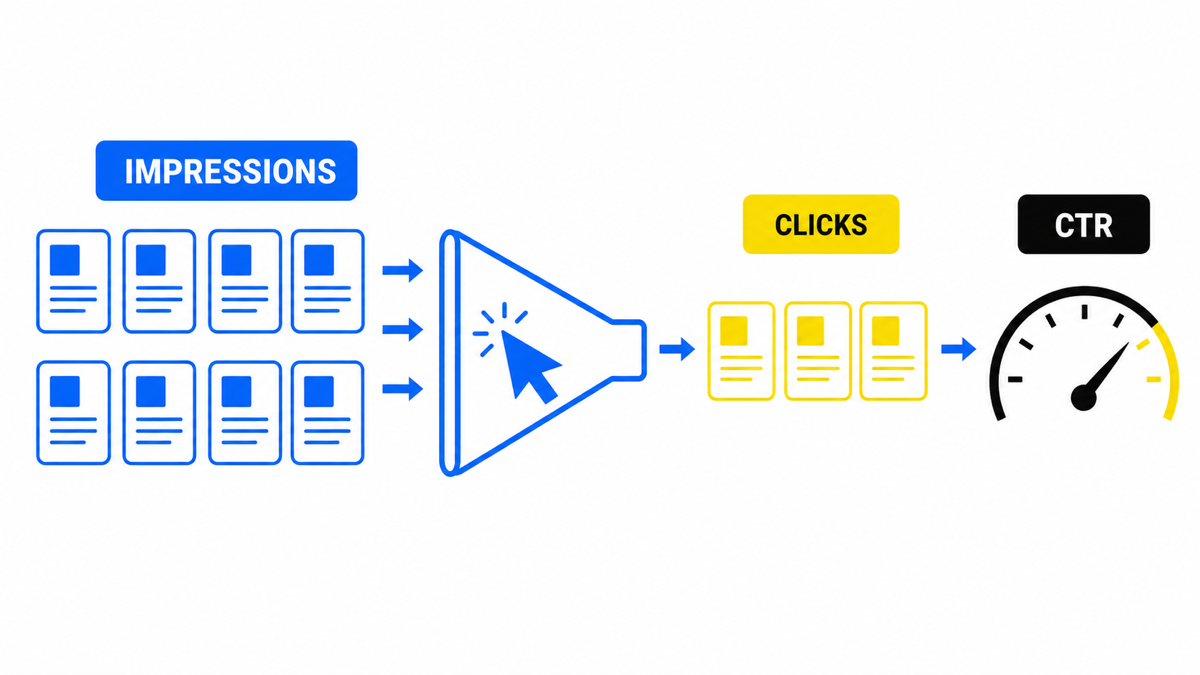
One number owners keep staring at in Google Ads is CTR. That is click-through rate: how many people saw your ad and what share of them clicked. It is shown as a percentage:
What does a Google Ads click cost, and what CTR is normal in your industry?
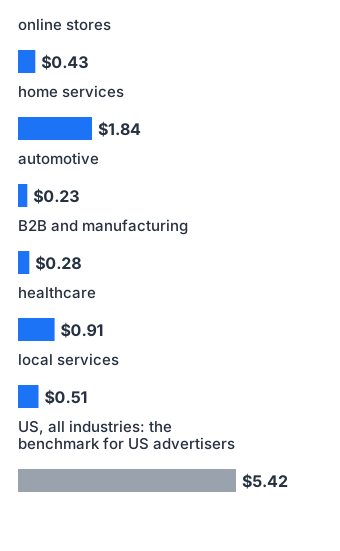
In the US, the typical (median) search click costs about $5.42 with a 6.64% CTR, the share of impressions that get a click (WordStream/LocaliQ 2026, April 2025 to March 2026); in the industries closest to our six categories it ranges from about $4.14 (Shopping, Collectibles & Gifts) to about $8.33 (Home & Home Improvement). In our real ad accounts, mostly in Eastern Europe, the median click costs $0.23 to $1.84 by category: a benchmark only if you advertise there. Where the figures come from ↓
Real accounts = ad accounts managed by Igor Ivitskiy's team, mostly in Eastern Europe.
Figures in this block are for 2025 to 2026; the article below may mention prices from other years.
Estimate clicks for your industry
| Category | Cost per click | CTR | Cheapest and priciest measured month | Mobile share | US: industry, cost per click, CTR |
|---|---|---|---|---|---|
| online stores | $0.43 · 2025 | 12.43% | October $0.25 / July $0.40 | 82.6% | Shopping, Collectibles & Gifts · $4.14 · 8.28% |
| home services | $1.84 · 2025 | 4.57% | January $1.32 / October $6.84 | 77.4% | Home & Home Improvement · $8.33 · 6.47% |
| automotive | $0.23 · 2026 | 10.60% | April $0.14 / June $0.39 | no data | Automotive: Repair, Service & Parts · $4.35 · 5.56% |
| B2B and manufacturing | $0.28 · 2025 | 6.62% | June $0.19 / March $0.39 | 64.4% | Business Services · $5.87 · 6.10% |
| healthcare | $0.91 · 2025 | 9.83% | August $0.31 / November $1.07 | no data | Physicians & Surgeons · $4.76 · 6.61% |
| local services | $0.51 · 2025 | 5.28% | June $0.41 / July $0.48 | no data | Beauty & Personal Care · $4.62 · 6.75% |
Where the figures come from
Panel: the open “Ivitskiy Ads Lab Google Ads Panel & Benchmark Compilation 2026” dataset (version 1.0, CC BY 4.0) on Hugging Face and GitHub; real managed ad accounts, mostly Eastern Europe (business country is not recorded in the primary data); a convenience sample, not a market norm; dollar amounts at a fixed mid-2026 exchange rate.
Seasonality: medians by calendar month, 2022 to the first half of 2026; some categories are not measured in every month. Devices: median per-advertiser share of spend by device, 2024 to the first half of 2026, only categories with a sufficient sample.
US: WordStream/LocaliQ “Google Ads Benchmarks 2026” report, medians across LocaliQ client search campaigns (called averages in the report), Google and Microsoft combined, April 2025 to March 2026; a conversion there can be a call, a form or a purchase.
Updated: 2026-09-24 · release r1
Hugging FaceGitHubDownload the values (CSV)CTR = clicks / impressions × 100%.
Example: 100 impressions and 10 clicks means a 10% CTR.

Why CTR matters in Google Ads
You watch CTR because a low figure is often an early warning, not a decoration on the dashboard:
- Your ads are not relevant to the search queries that trigger them. The fault is in the copy, the keywords, or the negative keywords.
- Your ads rarely show at the top of the page because the bid is too low, so people simply never see them.
- That pattern can hurt Quality Score as a diagnostic signal and push cost per click up.
A high CTR is not proof of profit. It does usually mean the query-to-ad match is stronger than weaker variants in the same account.
How you can raise CTR
In Search, CTR moves first with copy and ad assembly:
- Drop jargon most people never use. “Residential mortgage origination” loses to “home loan”. “Equipment leasing solutions” loses to “finance a car” or “lease a truck” depending on the offer.
- Be specific. Vague praise is weaker than numbers: price, promo, specs, delivery, warranty. Compare:
“Great space heater” vs “10 kW heater for a 100 sq ft room”.
“Quality cleaning service” vs “Trusted by thousands of customers”.
“Fast cleaning” vs “Full clean done in 3 hours”.
- Use the customer’s language: their pain, their words, the way they describe the job.
- Use ad assets: images, sitelinks, callouts, structured snippets. They make the ad larger and easier to notice.
Display-style formats (Performance Max, Display, Demand Gen, YouTube) play a different game. There is less text, so the creative has to stop the scroll visually: clear offer, contrast, one idea per asset.
Ad testing to raise CTR in Google Ads
The practical habit that compounds: always test two ad versions. Run two different sets of headlines and descriptions in the same ad group and keep the winner. Specific numbers in the copy often lift response, because the searcher can tell faster whether this is the result they wanted.
Why a high CTR does not convince me on its own
I never read CTR in isolation. I line it up with Quality Score as a diagnostic, query relevance, conversion rate and cost per result. An ad can collect a lot of curious clicks and still make the campaign economics worse.
Google explicitly treats Quality Score as a diagnostic tool, not a KPI, in its Quality Score guidance.
Keep the stronger ad, pause the weaker one, then challenge the winner with a new variant. Add detail, assets, a different angle. Every cycle, stop the loser and push budget toward the winner until the account economics look acceptable.
Example loop:
- Create and test Ad 1.1 and Ad 1.2.
- If 1.2 has the higher CTR, pause 1.1.
- Create Ad 2.1 and test it against 1.2.
- If 1.2 still wins, pause 2.1.
- Create Ad 3.1 and test it against 1.2 again.
Repeat: two options, keep the stronger, introduce a new challenger.
Once you can read CTR and improve it with tests, the next useful step is understanding how weak click-through quietly raises what you pay per click in $.
Tags and reports matter when they show payback. My e-book “19 Google Ads Secrets” shows how to get the most out of Google Ads without draining your budget, drawn from real campaigns and tests.
See the book →Where to find CTR for your ads
In Google Ads you can read CTR at several levels:
- campaigns;
- ad groups;
- ads;
- keywords.
For diagnosis, the ad level is usually the most useful: open Ads and assets, add the CTR column if it is missing, and set a date range long enough to mean something.
What CTR numbers look like a normal range
Average CTR depends on several things:
- Business category: niches differ a lot.
- Competition: how many advertisers sell the same thing.
- Campaign type: Search versus media formats (Performance Max, Display, YouTube, Demand Gen).
The useful benchmark is your niche and your own best queries, not a global “average CTR on the internet”.
For many local and service businesses in Search, these bands are a workable orientation:
- Under 5%: something is clearly off.
- 5% to 8%: barely acceptable, already worth diagnosing.
- 8% to 16%: often a healthy working range for commercial Search; ads are good enough to keep improving.
- Around 40%: excellent creative and/or thin competition. About 4 out of 10 people who see the ad click.
- Up to 60%: rare, most often on brand queries.
Read CTR with other columns in the same report:
- Search impression share;
- top of page / absolute top impression share;
- conversion rate.
Always analyse CTR as a set, not a single number. Keep an eye on the search terms that trigger the ads and cut irrelevant ones with negatives. A “fine” campaign CTR can hide waste on specific queries.
What to do when Search CTR is low
If Search CTR sits under 8% on your usual commercial queries, diagnose before you rewrite everything. People usually fail to click for one of two reasons:
- They do not see the ad because it is not landing in the top 3-4 slots. Those top slots take most of the clicks and, later, most of the leads. Check top of page impression share. A useful bar: 80% or higher. If that number is low, you often need a higher bid (or better ad quality) to show up where people actually look.
- If top of page impression share is already above 80%, the problem is almost certainly relevance. People see the ad and still do not click. Typical causes below.
- Wrong keywords: ads trigger on neighbouring queries, especially with phrase and broad match. Clean with negatives and tighter structure.
- Right queries, weak copy. Write what the searcher expects to see after that query, not what sounds impressive inside your company.
A fix algorithm for low CTR
- Check CTR.
- CTR above 8%: for many niches this is already workable; next look at conversions.
- CTR below 8%: find the cause.
- Check top of page impression share.
- If under 80%, people often never see the ad: raise bid / quality so you show higher more often.
- If 80% or more, the issue is ad and query relevance.
- Inspect the search terms that got impressions.
- If terms are not relevant, fix keywords or add negatives.
- If terms are relevant, rewrite ads and test new variants.
Frequently asked questions about CTR in Google Ads
Takeaways on CTR in Google Ads
While Search CTR stays low without a clear reason, the ads are almost certainly underperforming: you pay more for harder clicks and you miss people who never see you. The business spends $ and gets a thinner stream of interested visitors.
When CTR rises because relevance improved, not because the promise got wider, more of the right people notice and open the offer. Conversion on the site and in the CRM still has to finish the job. CTR is an early signal that you are visible and matched to the query, not the final score of the campaign.