
The main trap for an immigrant entrepreneur appears when early customers from a familiar language community seem to prove that the business model already works in the new country. Those customers may trust the owner and arrive through personal referrals, while the wider local market still cannot see the offer, understand its value, or justify its price.
Google Ads can help test demand beyond the diaspora, but a campaign cannot replace positioning or sound economics. Three entrepreneurs in Toronto, Sydney, and Prague reveal different parts of the same journey. The broader acquisition logic is explained in this guide to diagnosing clicks without leads for a service business.
Alidzhan Soluyan: a familiar community is not the whole market
After moving to Canada, Alidzhan Soluyan bought vehicles for premium tours to Niagara Falls and around Toronto. He had substantial business experience, yet the new market proved harder than he expected. Its niches were narrow and firmly divided. His passengers were mainly Russian-speaking and Ukrainian-speaking acquaintances, while customers from the other local communities he hoped to reach were absent.
«I noticed that only Russian-speaking people travel with me»
Alidzhan Soluyan
When Alidzhan raised the price, newer immigrants began declining the service. A discount might reduce resistance temporarily, but it could not explain the value of a premium experience. His conclusion was direct: «you can’t live in endless discount mode».
His task changed after training. Instead of treating advertising setup as the entire solution, Alidzhan focused on developing his own voice, making the owner the face of the business, and using AI systematically. At the time of the recording, he described a change in his vision and marketing strategy, not a numerical result. That boundary matters. Promoting a premium tour is premature if a local customer still has no clear reason to choose it.
Tatiana: search captured demand for roof repairs in Sydney
Tatiana opened a roof repair and maintenance business serving the whole of Sydney. Social media did not work well for this service. She tried to understand the advertising account herself and with help from ChatGPT, but the advice did not match the current interface she could see.
«We tried social media, but for this business it doesn’t work as well as Google Ads»
Tatiana
Short screen-based lessons helped her connect the instructions to the live account. Her interface was in English and the explanation was in Russian, but she could see where to click. During the three months after launching advertising, the business gained clients, its work was booked well ahead, and Tatiana reduced the budget.
This outcome is not a promise to another roofing company. It demonstrates a fit between the channel and a situation in which people already search for a specific local service. Search can reveal that demand more directly than a channel where the owner must first interrupt someone and create interest.
Oleg Kuzyk: local demand still needs continuous filtering
Oleg Kuzyk runs a small local business in Prague. He initially launched advertising himself after watching short videos, but the campaign did not produce enough conversions. After training, regular optimisation around actual results became the central mechanism.
«I turn off the keywords that don’t sell and focus more on the words that do sell»
Oleg Kuzyk
Oleg reported that his tracked conversion metric and website income doubled. The mechanism matters more than the figure. He did not treat the initial launch as finished work. He separated keywords that brought sales from those that did not. For an entrepreneur abroad, this is a way to discover how local customers express demand instead of relying only on assumptions formed inside a familiar community.
The shared mechanism behind the three stories
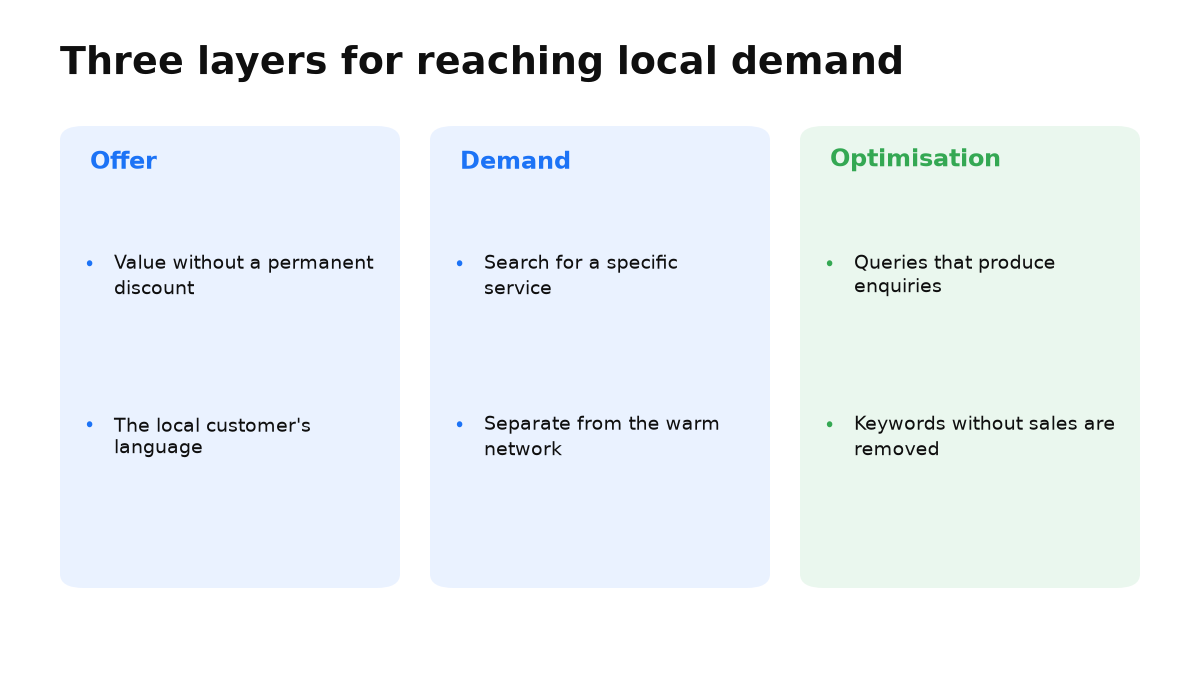
| Layer | Owner’s question | What the story demonstrates |
|---|---|---|
| Offer | Why should a local customer choose us without a permanent discount? | Alidzhan reconsidered the owner’s role, the business voice, and the marketing strategy |
| Demand | Where are people already looking for our service? | Search suited Tatiana’s Sydney roof repair business better than social media |
| Optimisation | Which queries produce conversions rather than visits alone? | Oleg removed keywords without sales and focused on the ones that sold |
What to do when building a business in a new country
- Separate your warm network from the local market. Mark which customers arrived through acquaintances and which independently found the service.
- State the offer in the customer’s language. Explain the service, coverage area, reason to trust the business, and value without relying on a permanent discount.
- Test search intent. Group keywords around specific services and customer needs instead of advertising only the general business category.
- Measure enquiries. Track the action that genuinely moves a prospect toward a sale, so a website visit is not mistaken for customer demand.
- Optimise regularly. Remove keywords without results, review how the offer is expressed, and strengthen the areas that produce relevant enquiries.
When this does not apply
Search advertising cannot create demand where people do not search for the service. It also cannot repair an offer that local customers neither understand nor value. Advertising does not replace checks on licensing, local rules, or the business’s ability to serve its chosen area. If every sale depends on a discount, revisit the product, price, and reasons for trust before scaling traffic.
Questions from immigrant entrepreneurs
Should I stop serving customers from my own diaspora?
No. It is a real segment and can provide valuable support at the beginning. The problem arises only when the owner mistakes a familiar network for the entire available market and never builds a separate route to local customers.
Where should I start if advertising is already running?
Separate keywords by service, identify which ones produce enquiries, and compare each ad with the actual offer on its page. This reveals whether the weak link is demand, the message, measurement, or ongoing optimisation.
If the business already has support from its familiar community but cannot attract the wider local market consistently, a structured review of the offer, conversions, and keywords can identify the weak link.
The technical side of entering another market is covered separately: running Google Ads for the US and Europe.