

An online school should not build its entire Google Ads strategy around video. Start by mapping what happens after someone discovers the instructor: which material they engage with, what indicates genuine interest, which action becomes a qualified enquiry, and how the school reconnects with people who are not ready to decide immediately.
How much does Google Ads cost for an online school, and is it worth it?
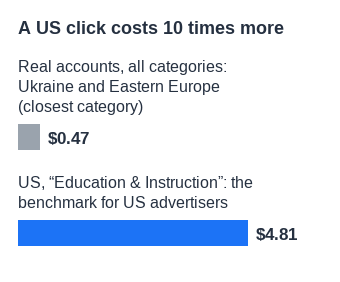
In the US, the median search click in the “Education & Instruction” industry costs about $4.81 (WordStream/LocaliQ 2026). Our real accounts, mostly in Eastern Europe, have no cell for this niche; across their six categories a click costs about $0.47: a cheaper market, relevant only if you advertise there. Figures in this block are for 2025 / the first half of 2026; the article below may mention prices from other years. Where the figures come from ↓
Real accounts = ad accounts managed by Igor Ivitskiy's team, mostly in Eastern Europe.
A $1,500 monthly budget → about 310 (240–560) clicks → about 40 (15–75) conversions at this industry's US median of 13.14% (a call, a form or a purchase).
To get about 30 leads a month (a practice rule: with that many, Google's automated bidding runs more steadily), you would need about $1,098 a month.
An estimate, it may not hold.
Estimate your budget
A rule from Igor Ivitskiy's practice: automated bidding needs about 30 conversions a month to have enough data. A scenario, not a measurement or a promise.
| Metric | Real accounts (mostly Eastern Europe) | US (WordStream/LocaliQ 2026) |
|---|---|---|
| Cost per click | $0.47 | $4.81 ($2.68–$6.23) |
| CTR (clicks per impression) | no data | 7.56% |
| Leads (conversions) per 100 clicks | no data | 13.14% |
| Cost per lead | no data | $77 |
- For a typical advertiser in the “local services” category (median), about 29.6% of tracked search spend goes to queries without a single conversion (2023 to 2025). Before raising the budget, review your search terms and cut the useless ones.
- In the US, a click in the “Education & Instruction” industry moved from about $2.68 in 2022 to about $4.81 in 2026, according to WordStream/LocaliQ reports.
Where the figures come from
Panel: the open “Ivitskiy Ads Lab Google Ads Panel & Benchmark Compilation 2026” dataset (version 1.0, CC BY 4.0) on Hugging Face and GitHub; real managed ad accounts, mostly Eastern Europe (business country is not recorded in the primary data); a convenience sample, not a market norm; dollar amounts at a fixed mid-2026 exchange rate.
Unit of observation: advertiser; the general benchmark combines the medians of six categories, with no separate measurement for this niche.
US: WordStream/LocaliQ “Google Ads Benchmarks 2026” report, medians across LocaliQ client search campaigns (called averages in the report), Google and Microsoft combined, April 2025 to March 2026; a conversion there can be a call, a form or a purchase.
Updated: 2026-09-24 · release r1
Hugging FaceGitHubDownload the values (CSV)Video can explain an idea and establish a human voice. Search can meet existing demand. Remarketing can continue the conversation with someone who already knows the school. These jobs belong in one measurable system. If the account produces activity but few useful enquiries, begin with a diagnosis of the path from click to lead, not another video by default.
Two online education cases, one strategic gap
Yuri Varlan: turning a complicated platform into a sequence
Yuri Varlan had been an entrepreneur for many years and already understood why advertising mattered. Yet he could not configure Google Ads effectively for his online school. The platform felt too complicated, and the spending did not produce a useful sense of control.
The change did not come from a single clever setting. Yuri followed modular training in which each block relied on the previous one and real examples replaced abstract theory. This structure matters in online education advertising. A new campaign cannot compensate for an undefined conversion, and a new audience cannot repair a broken path on the site.
«I achieved severalfold growth in traffic to my website, growth in conversion and, of course, overall ROI»
Yuri Varlan
Yuri reported growth in traffic, conversion, and overall return on investment without giving specific figures. The responsible lesson is therefore not a benchmark for another school. It is the order of work: make the system understandable, then improve the parts while watching their effect on the business.
Igor: looking beyond inherited video campaigns
Igor managed marketing for educational products about trading in the US stock market. Other teams had worked in the advertising account before him. The project had tested YouTube advertising and different funnels, but the accumulated setup lacked a coherent outside view.
«the guys course-corrected us and showed us that a strong side of our business could be something like remarketing»
Igor
An audit mapped the account, included a video review, and examined the educational niche rather than treating the work as a list of interface errors. The strategic emphasis changed. The team identified remarketing as a potential strength and moved beyond relying only on video. Igor corrected most of the account errors and left with a stepwise plan he could use.
Why video alone leaves the student journey unfinished
A course is rarely understood from one exposure. A prospective student may need to inspect the curriculum, decide whether the instructor is credible, compare the format with their constraints, and resolve doubts about applying what they learn. A view records contact with a message. It does not prove that these questions were answered.
Remarketing addresses the gap between discovery and decision. It lets the school communicate differently with people who have already interacted with useful material. It is not a shortcut to trust and does not make a weak course more relevant. Its value is simpler: a warm prospect no longer has to be treated like a stranger at every contact.
| Journey stage | Owner’s question | Advertising job |
|---|---|---|
| Discovery | Does the person recognise the problem and the course promise? | Introduce a relevant idea, instructor, and approach |
| Active interest | Which content or page indicates serious consideration? | Separate warmer visitors from new reach |
| Return | Which doubt prevents the next action? | Continue the message through remarketing |
| Conversion | Which action is genuinely connected to enrolment? | Measure useful enquiries rather than views alone |
Where an online school owner should begin
- Map the student journey. Write down what a person sees from the first ad through course information, enquiry, and purchase.
- Define a meaningful conversion. A video view can signal attention, but it should not automatically carry the same value as an application or sale.
- Separate new and warm audiences. A newcomer needs context. A returning visitor may need an answer to a specific concern and a clear next action.
- Audit inherited decisions. If several teams have managed the account, identify the purpose of each campaign, conversion, audience, and funnel before adding another format.
- Connect advertising with sales. Evaluate not only traffic but also the quality of enquiries, purchases, and return on investment.
When this does not apply
Remarketing cannot fix an unclear course, an unconvincing page, or missing conversion measurement. It also cannot create initial demand when the school has no eligible audience to reconnect with. In that situation, the first priorities are a clear offer, relevant initial traffic, and reliable measurement.
This does not mean that online schools should abandon video advertising. Video can be the right format when its role is explicit and the subsequent journey is measured. The warning applies when views become a substitute for qualified enquiries and sales in the owner’s decisions.
Questions from online school owners
Should YouTube be the first campaign?
There is no universal launch order. It depends on existing demand, the school’s content, and whether the next useful action can be measured. Video may introduce the instructor without becoming the only acquisition campaign.
Is remarketing enough?
No. It needs prior interest, an eligible audience, a relevant course, a persuasive destination, and a meaningful conversion. Without those elements, repeated exposure only repeats the unresolved problem.
What should I check in an inherited account?
Identify why each campaign exists, what its conversion represents, which audience it reaches, and how the result connects to sales. Then rank corrections before launching something new.
If your school already has videos, traffic, and funnels but no coherent view of how they produce enrolments, the useful next move is an account diagnosis followed by a prioritised correction plan.
My e-book “19 Google Ads Secrets”: how to get the most out of Google Ads without draining your budget, drawn from real campaigns and tests.
See the book →