
There is one option in Google’s list that is selected by default, and most accounts live on it for years. I looked at a slice of 32 real accounts I have reviewed (mostly subscription and SaaS models): the median advertiser puts 89.7% of budget on a single bid strategy, and 15 of the 32 hand one algorithm more than 90% of the money. The numbers show where money sits, not motives. But when I ask owners why that particular strategy, there is usually no answer: nobody revisited it after launch.
The question this article answers is not “which automated strategy is best”. It is: what decision exactly did you hand over, and what stayed yours afterwards. The full map of strategies and the decision tree live in the main guide, Google Ads bid strategies; here we take apart the automation itself.
Start with the split that removes most of the confusion: automated strategies come in two very different families, and mixing them up is expensive.
Two families of automated strategies
Volume strategies optimize what is easy to count: clicks and impressions. Maximize Clicks brings the most traffic the budget allows. Target Impression Share keeps you at the top of the page. These strategies know nothing about your leads and promise nothing about them. They are honest: you asked for traffic, you got traffic.
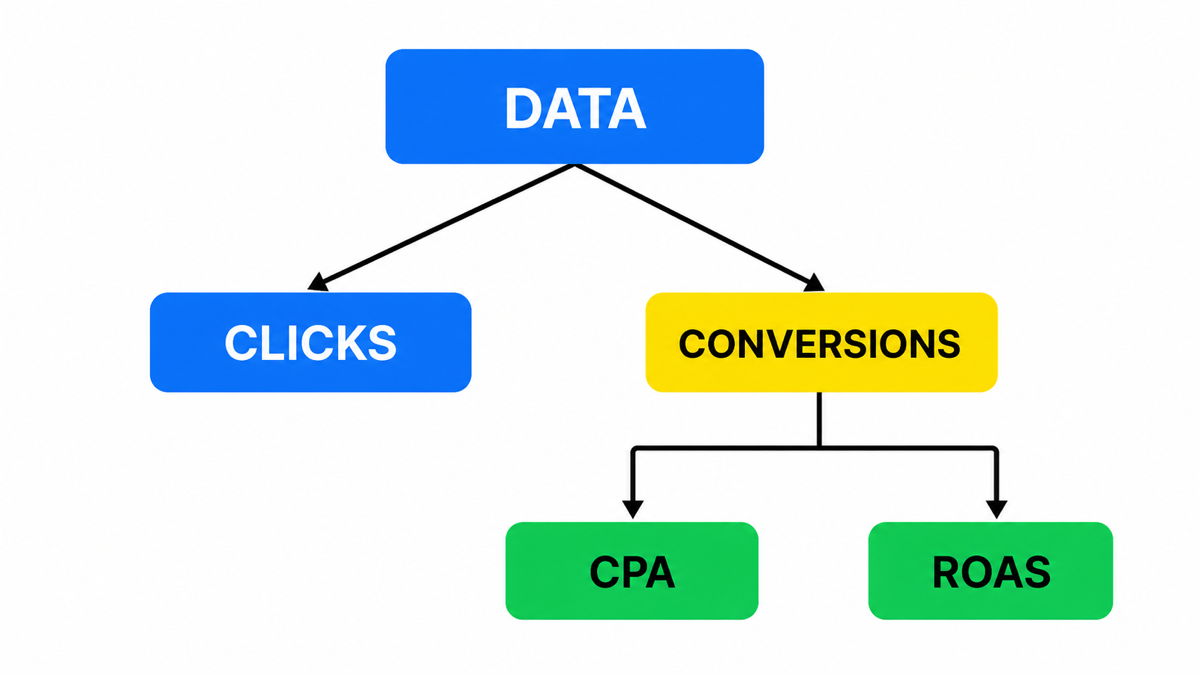
Outcome strategies (this is what Smart Bidding refers to) optimize toward conversions: Maximize Conversions, Target CPA, Maximize Conversion Value, Target ROAS. They only work when you pass the system conversion data. No correct measurement, no smart strategy: the algorithm will optimize toward whatever you labelled a conversion, even if that is an accidental button click.
| Automated strategy | What the algorithm decides | What stays yours |
|---|---|---|
| Maximize Clicks | The bid in each auction, chasing traffic volume | The CPC limit, the queries, ad relevance |
| Target Impression Share | The bid, chasing position on the page | Which share, on which campaigns, the CPC ceiling |
| Maximize Conversions | Who to show to and what to pay, spending the whole budget | The size of the daily budget, your only circuit breaker |
| Target CPA | The bid, holding an average cost per lead | The target number itself and what counts as a conversion |
| Maximize Conversion Value | The bid, chasing total value rather than count of actions | Passing the real value of each order correctly |
| Target ROAS | The bid, holding a return per dollar | The return bar and how trustworthy your values are |
The right hand column is worth rereading. No automated strategy takes away your responsibility for what counts as a conversion, which queries you buy, and whether your landing page keeps the promise the ad made. The algorithm controls the bid. Everything else stayed yours after the switch to automation.
Official thresholds: how many conversions you need
The advice “you need at least 15 conversions a month” travels from article to article as a universal rule. There is no universal rule: thresholds differ per strategy and even per campaign type.
| Strategy and campaign type | What Google officially requires |
|---|---|
| Maximize Conversions | No hard requirement; recommended baseline from 15 conversions in 30 days |
| Target CPA | No conversion history required at all |
| Target ROAS, Search and Shopping | At least 15 conversions in the past 30 days |
| Target ROAS, Display | At least 15 conversions with values in 30 days across all campaigns combined |
| Target ROAS, Video Action | At least 30 conversions in the past 30 days |
| Target ROAS, Demand Gen | At least 50 conversions in 35 days, 10 of them in the past 7 |
A separate word on Maximize Conversions, because it is the most common entry into automation and the most common source of unpleasant surprises. Google’s help states directly that the strategy is designed to spend the full daily budget. It is not looking for savings, it is looking for the maximum number of actions your money can buy. Which means your only circuit breaker is the budget itself, and setting it high “just in case” is a bad idea here.
My e-book “19 Google Ads Secrets”: how to get the most out of Google Ads without draining your budget, drawn from real campaigns and tests.
See the book →What happens after you switch
Moving to automation is not a switch, it is a period. Google calls it “Learning” status, and during it the campaign behaves differently from how it will behave later.
Per the documentation, calibration can take up to 3 weeks or 1 to 2 conversion cycles, faster when there is plenty of data. Four things trigger the status: a new or reactivated strategy, a change to its settings, a composition change (campaigns, ad groups or keywords added or removed), and in some cases an ad group target change in Shopping campaigns.
That last item catches the most people. You never touched the strategy, you simply cleaned out two hundred irrelevant keywords in one day, and that is already a composition change. Formally you did a good thing, in practice you restarted learning. So big clean-ups are better done in one pass before a deliberate restart, rather than in small doses every Tuesday.
And one more detail from the same page that almost nobody mentions: the algorithms keep learning even after the “Learning” status has disappeared from the interface. The label going away does not mean the system reached a stable state.
Does this mean automation won
Where the real money runs, effectively yes. In accounts spending over a million dollars, 72.7% of spend goes to target based strategies, 3.6% to manual and enhanced CPC, and 1.5% to targetless Maximize Conversions.
One more thing worth flagging: from 17 August 2026 Google changes how target based strategies behave for budget limited campaigns, pulling them more consistently toward the target you set. If your campaign hits its budget ceiling and has been beating its target, that gap may close.
Read the figures above carefully though. They show where money goes, not what works better. Manual bidding did not lose a fair fight with automation, it stopped being the default. And here is what genuinely follows for an owner: if everyone around you is on automation, your edge is no longer which strategy you picked. It is the quality of the signal you feed that strategy.
Frequently asked questions
Which automated strategy is best
The question is framed wrong: strategies do not compete with each other, they answer different jobs. The right question is how many conversions you have and whether they are measured correctly. The answer to that decides the strategy, step by step in the decision tree in the main guide.
Can I run an automated strategy without conversion tracking
Volume strategies (Maximize Clicks, Target Impression Share) will work, they do not need conversions. Outcome strategies must not be switched on without correct measurement: they will optimize toward a false signal, and they will do it consistently and efficiently.
Why did results drop right after moving to automation
That is expected behaviour during the learning period: calibration takes up to 3 weeks or 1 to 2 conversion cycles. The most expensive mistake here is reverting to the old strategy on day five, because that restarts learning and wipes what the system had already worked out.
Is manual bidding still needed in 2026
As a permanent mode for most businesses, no. As a tool for launch and diagnosis, yes: manual gives you a clean picture of the auction without algorithmic interference, and it is the fastest way to learn the real cost of a click in your niche.