The “Learning” status on a Google Ads bid strategy means you changed the strategy, and the system is now adjusting bids. The campaign can keep serving, but key metrics may move around a little.
This is not an ad disapproval and not an account suspension. It is the normal state of an automated strategy after a change. How Google Ads bid strategies work is covered separately.
What it means
In the help article on bid strategy statuses Google says that after a change, bids may fluctuate a little while Google Ads optimizes them, and a “Learning” status may appear. Ads keep serving.
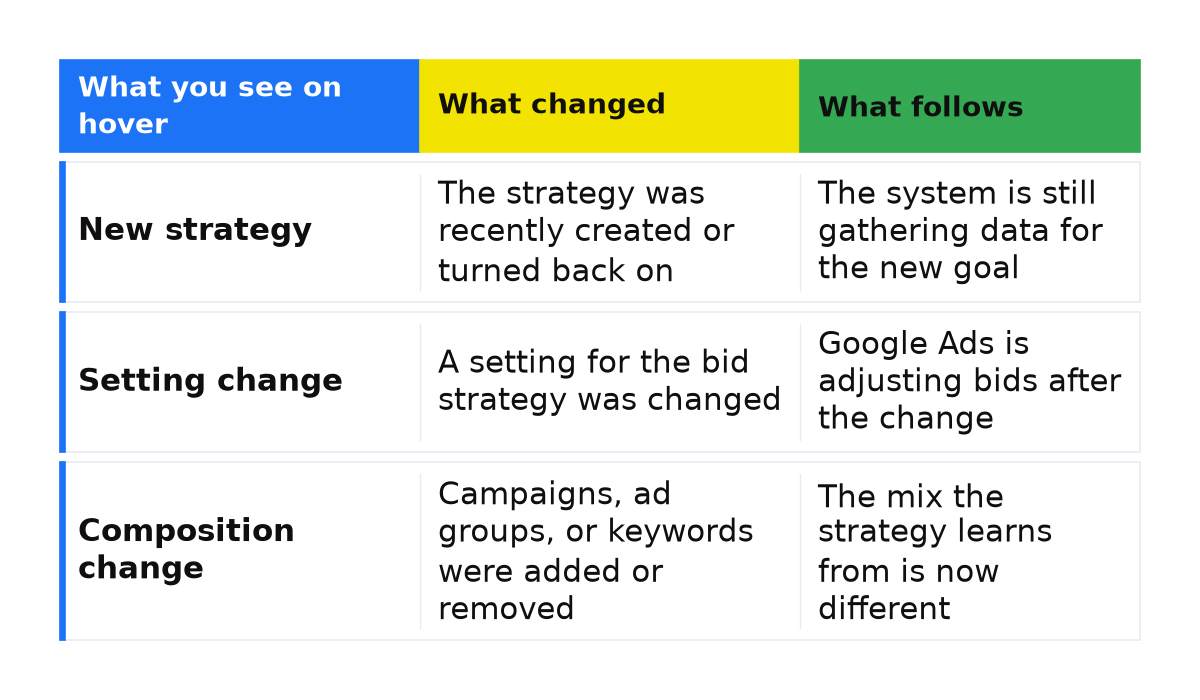
For a single campaign, open Campaigns in the Campaigns menu and check the Status column. The Bid strategy type column shows that campaign’s strategy. For a portfolio strategy, open Bid strategies in the Tools menu and find the Status column. Hover the status: Google shows the reason.
| What you see on hover | What changed | What follows |
|---|---|---|
| New strategy | The strategy was recently created or turned back on | The system is still gathering data for the new goal |
| Setting change | A setting for the bid strategy was changed | Google Ads is adjusting bids after the change |
| Composition change | Campaigns, ad groups, or keywords were added or removed | The mix the strategy learns from is now different |
The same page lists Active, Limited, and Misconfigured. Limited may point to limited search volume, bid limits, or budget. Misconfigured relates to a shared budget or conversion settings. Those are separate states, not “Learning”.
What is at stake
The status itself does not stop ads. An owner may see CPA jump, decide the strategy is broken, and start changing settings. But a new strategy, a setting change, or a composition change can bring “Learning” back. Read the hover reason before you change anything.
Google’s next step is to keep using the account as usual, but remember that key metrics may vary, so you may not want to measure performance until learning ends. Spend can continue. “I’ll wait a week and pause it if it hasn’t worked” is the wrong frame: days alone do not tell you the period is over.
The article on how long the learning period lasts ties duration to conversion volume, the click-to-conversion cycle, and the bid strategy itself. Calibration can take around 50 conversion events or 3 conversion cycles, and can be faster with enough data. Earlier campaign data shortens the start. Manual CPC has no learning period.
What to do
- Find the campaign’s strategy in the Bid strategy type column. If you do not see it, select the columns icon above the table, choose Modify columns, then choose Bid strategy type under Attributes.
- Check the current status and hover it to read the reason. If it is Limited or Misconfigured, deal with that limit or error; do not wait for learning to end.
- Leave the strategy, its settings, and the mix of campaigns, ad groups, and keywords alone while “Learning” is showing. Use the account as usual. Do not judge CPA until the status moves on.
- Measure readiness in conversions, not on a calendar. Google’s marker is about 50 conversion events or 3 cycles from click to conversion. If a booked call lands well after the click, three cycles stretch.
- When the status becomes Active, read results over a window that covers your conversion cycle. On Maximize Conversions, without a steady stream of conversions the algorithm has little to learn from.
- If “Learning” is still showing, read the hover reason again. Match it against recent changes to the strategy, its settings, or its composition, and against your conversion volume.
What not to do
- Do not pause the campaign only because CPA spiked while “Learning” is showing. A pause cuts the data the strategy is learning from.
- Do not jump to another automated strategy “to reset learning”. A new strategy opens the same status again.
- Do not time the period on a calendar. “A few days passed, so it is broken” does not follow from how Google counts it.
- Do not dump keywords, ad groups, or campaigns “to speed it up” while “Learning” is showing. That is a composition change, and adjustment starts again.
When this does not apply
If you set bids yourself with Manual CPC, the learning period does not apply. Cost-per-click swings are then ordinary auction noise, not an algorithm calibrating.
This is a bid strategy status. You can also check it in the campaigns table. For Limited and Misconfigured, use the explanation of that limit or error. If you are still choosing a strategy, start with automated bid strategies in Google Ads.
If after these steps the “Learning” status does not change, we can look at the account together: we will check the status reason, recent changes, and conversion data.
My e-book “19 Google Ads Secrets”: how to get the most out of Google Ads without draining your budget, drawn from real campaigns and tests.
See the book →Questions and answers
How long does “Learning” last?
Google does not give a duration in days. Calibration can take around 50 conversion events or 3 conversion cycles, faster with plenty of data. Watch the Status column: while it says “Learning”, the period is still running.
Can I pause the campaign while this status is showing?
Google’s advice is to keep using the account as usual and not to measure results until the period ends. Pausing cuts the data. If the plan was “wait a week”, you are on the wrong clock.
Why do I not see “Learning”?
Learning may already have ended: for example, the strategy shows Active. Manual CPC has no learning period at all. Make sure you are checking the bid strategy status, not an ad status, using the campaign or portfolio path above.