
You are preparing to advertise and ask an agency or a marketer how much to budget for Google. The honest answer, “it depends on the industry,” is not very useful on its own. The difference is real: businesses in Ukraine may face upper bids from $0.34 to $3.38 for a click. Educational courses, not legal services, were the most expensive category in this July 2026 Google Keyword Planner snapshot. Below, I show the full set of 18 industries, the method, and a budget formula.
How much does a Google Ads click cost in Ukraine in 2026, by industry?
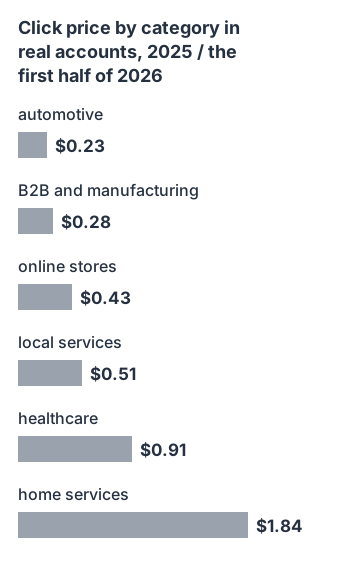
The median search click price across real ad accounts, mostly in Eastern Europe, in six categories for 2025 / the first half of 2026: from $0.23 to $1.84, about $0.47 in the middle. Across all US industries the median click costs about $5.42 (WordStream/LocaliQ 2026): a different market. Find your category in the table and estimate a budget in the calculator. This is the actual cost per click (what was charged), not the top-of-page entry bid in the article's table below: the bid is always higher. Figures in this block are for 2025 / the first half of 2026; the article below may mention prices from other years. Where the figures come from ↓
Real accounts = ad accounts managed by Igor Ivitskiy's team, mostly in Eastern Europe.
A $300 monthly budget → about 640 (165–1,305) clicks → about 19 (3–65) leads, if 3% of clicks turn into leads.
To get about 30 leads a month (a practice rule: with that many, Google's automated bidding runs more steadily), you would need about $470 a month.
An estimate, it may not hold.
Estimate your budget
A rule from Igor Ivitskiy's practice: automated bidding needs about 30 conversions a month to have enough data. A scenario, not a measurement or a promise.
| Metric | Real accounts (mostly Eastern Europe) | US (WordStream/LocaliQ 2026) |
|---|---|---|
| automotive | $0.23 · 10.6% · 2026 | no data |
| B2B and manufacturing | $0.28 · 6.62% · 2025 | no data |
| online stores | $0.43 · 12.43% · 2025 | no data |
| local services | $0.51 · 5.28% · 2025 | no data |
| healthcare | $0.91 · 9.83% · 2025 | no data |
| home services | $1.84 · 4.57% · 2025 | no data |
- For a typical advertiser in our accounts (median), about 39.4% of tracked search spend goes to queries without a single conversion (2023 to 2025): a general benchmark, not your niche. Review your search terms before raising the budget.
Where the figures come from
Panel: the open “Ivitskiy Ads Lab Google Ads Panel & Benchmark Compilation 2026” dataset (version 1.0, CC BY 4.0) on Hugging Face and GitHub; real managed ad accounts, mostly Eastern Europe (business country is not recorded in the primary data); a convenience sample, not a market norm; dollar amounts at a fixed mid-2026 exchange rate.
Unit of observation: advertiser; the general benchmark combines the medians of six categories, with no separate measurement for this niche.
US: WordStream/LocaliQ “Google Ads Benchmarks 2026” report, medians across LocaliQ client search campaigns (called averages in the report), Google and Microsoft combined, April 2025 to March 2026; a conversion there can be a call, a form or a purchase.
Leads per 100 clicks for Ukraine: ITForce, median search conversion rate about 2.98% (small and mid-size businesses, July 2025 to June 2026); Guild of Marketing, 3 to 5% for dentistry (April 2026). A benchmark from open sources, not a measurement from our real accounts.
Updated: 2026-09-24 · release r1
Hugging FaceGitHubDownload the values (CSV)First, a useful distinction. Google does not sell a fixed month of advertising. It auctions individual clicks, and you pay when someone clicks your ad. The original question therefore becomes two questions: what does a click cost in your industry, and how many clicks do you need to generate one lead? If you run a clinic, repair company, legal practice, or another service business, the basic setup is covered in my guide to Google Ads for service businesses. Here, the focus is the money.
The table gives you a market reference point. Your exact budget will still depend on the city, the website, and the competitors bidding on your specific searches. The useful next step is to combine the industry range with your own conversion rate rather than treating any table as a quote.
What determines the cost per click
Google Ads has no fixed price list. Each click is priced by an auction at the moment of a search. The system weighs your bid, Ad Rank, and the quality of your ad and landing page. That is why the actual cost per click is usually below your maximum bid. You pay only enough to beat the nearest competitor.
Two money-saving lessons follow from this auction. First, there is no minimum entry price or mandatory starting budget. Second, Quality Score means a relevant ad with a fast landing page can pay less than a competitor with a higher bid and weaker relevance. The auction rewards a combination of money and quality.
Bids across 18 Ukrainian industries in July 2026
This Google Keyword Planner snapshot shows the bid range associated with appearing near the top of the search results in Ukraine. Each industry uses two or three typical commercial queries. The lower figure reflects cheaper searches within the category, while the upper figure reflects competitive, high-intent searches. These are auction entry estimates, not your future average CPC. Your actual click price is usually lower.
| Industry | Top-of-page bid, $ |
|---|---|
| Educational courses | 0.52-3.38 |
| Accounting services | 0.64-2.94 |
| Home renovation | 0.61-2.23 |
| Freight transport | 0.35-1.97 |
| Beauty and cosmetic services | 0.32-1.78 |
| Legal services | 0.57-1.75 |
| Security systems | 0.17-1.27 |
| Private healthcare | 0.39-1.19 |
| Auto repair | 0.27-1.06 |
| Cleaning services | 0.28-1.03 |
| New-build property | 0.21-0.96 |
| Water delivery | 0.29-0.93 |
| Custom furniture | 0.14-0.86 |
| Veterinary services | 0.20-0.65 |
| Clothing and footwear ecommerce | 0.08-0.46 |
| Wedding services | 0.14-0.44 |
| Air conditioning | 0.07-0.41 |
| Windows and doors | 0.07-0.34 |
| Dental services | Data limited by Google because this is a medical topic |
| Psychologists and psychotherapy | Data limited by Google because this is a medical topic |
Where the figures came from and why dental data is missing
These are forecast top-of-page bids from Google Keyword Planner on July 19, 2026, collected through the API with Ukraine selected as the location. Each industry contains a group of commercial searches. For educational courses, examples include the Ukrainian equivalents of “English courses Kyiv” and “programming courses.” Google returned the bids in dollars, so the table keeps those values directly.
Google Keyword Planner did not return bid figures for dental services or psychologists because medical topics fall into sensitive categories. The boundary depends on the query. General private-clinic searches may show data, while treatment queries and searches for specific practitioners may be hidden. I tested seven different searches across these categories and received no figures. A blank cell is more useful than a precise-looking number that cannot be supported.
What surprised me in this snapshot
I expected legal services or medicine to lead the table. Educational courses came first at $3.38 per click, 9.9 times the upper bid for the least expensive industry. My explanation is simple. Course providers with high transaction values and disciplined unit economics entered the auction and pushed prices up faster than traditionally expensive professions. Prestige does not make an industry costly. A dense group of competitors able to pay does.
Here is a two-minute practical check. Take the upper bid for your industry and multiply it by 100-200 clicks. For freight transport, that produces an initial test range of $197-$394. If that figure is uncomfortable, it is better to learn it before running a month of advertising without enough data.
You now have both the industry benchmark and a defensible size for a first test, so the next step is to connect them to the number of leads your business needs.
Ready-made ad copy brings clicks; bookings come from the whole chain up to the call. My e-book “19 Google Ads Secrets” shows how to get the most out of Google Ads without draining your budget, drawn from real campaigns and tests.
See the book →How to estimate a monthly budget
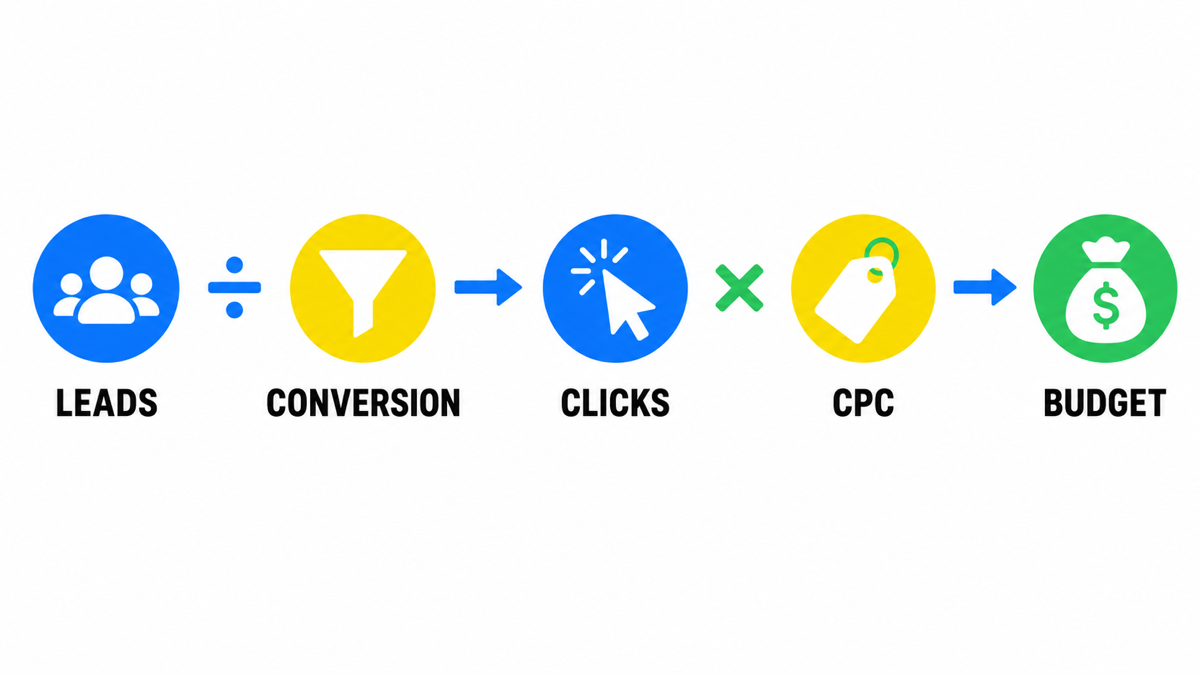
Monthly budget = required leads divided by website conversion rate, multiplied by cost per click. Suppose you want 30 leads and use a 3% website conversion rate for the example. You need 1,000 clicks. Using the dollar figures that correspond to the median lower and upper entries in the table, the planning range is about $0.27-$1.06 per click, or $270-$1,060 for the month. This is an entry estimate, not a promise of your future CPC. Your account will determine the actual price.
The formula has three moving parts, and click price is only one of them. Doubling your website conversion rate from 1.5% to 3% halves the cost per lead without negotiating a cheaper click. This is one of the most overlooked budget levers.
What minimum budget is meaningful
Google sets no technical minimum. The Google Ads budget is entered as an average daily amount, and you can choose a very small figure. The practical minimum is different. In my experience, judging performance before the first 100-200 clicks is guesswork. At a 1-5% conversion rate, a smaller sample may produce zero to two leads and prove very little. Using the $1.06 upper figure around the middle of the table, that test is about $106-$212. A smaller budget is not inherently ineffective. It simply may not produce enough evidence for a decision.
The beginner tax: why your click may cost more
No bid table shows the most important difference between accounts. In my research set of $133.5 million in spend, six companies in one competitive SaaS category bought the same search query. Two market leaders paid $0.99 and $1.11 per click. The weakest advertiser paid $2.95, almost three times more for the same click at the same time.
I call this the beginner tax. It is an illustration of the mechanism, not a universal multiplier, so your industry will show a different gap. The mechanism is consistent: a new account with little history, generic ads, and a slow page loses on quality. The auction charges it a premium. The gap normally shrinks as the account builds history and the ads and landing page improve.
Budget also behaves differently at different scales. In the large accounts in my dataset, each with at least $1 million in spend, campaigns lost 61% of impressions because Ad Rank was too low and almost none because of budget. At that scale, quality was the constraint. For a small advertiser, the budget itself may still be the immediate ceiling. The decision is the same in both cases: check quality before adding money. Across the global dataset, median CPC differed by 8.4 times between industries, so this gap is a basic feature of the auction rather than a temporary peculiarity of Ukraine.
What Google Ads management costs in Ukraine
Public price lists from July 2026 show that Google Ads management at Kyiv agencies costs noticeably more than the typical freelancer service. The better question is not what the specialist costs, but what a lead costs with and without that person. A weak provider can waste more than the fee. If an agency or freelancer already manages your account, use numbers to assess the work. I show the process in how to evaluate a Google Ads provider.
Five ways to pay less per click
- Start with precise, high-intent searches in your industry, not broad terms. Review actual search terms every week and add irrelevant ones as negative keywords.
- Make each ad relevant to its query group and keep the landing page fast. Quality reduces the actual click price in the auction.
- Limit targeting to the cities and radii that produce real customers. Clicks from places you do not serve are wasted budget.
- Do not launch every campaign type at once. Begin with Search for high-intent queries, then expand after leads become consistent.
- Track leads and calls before launch. Google conversion-based bidding optimizes for what it can measure. When the system sees real enquiries, it can optimize for business outcomes instead of clicks.
Frequently asked questions
Which is cheaper, Google Ads or Facebook Ads?
Click prices are not directly comparable. A person on Google is already looking for a solution, while a social ad interrupts the feed. Compare the cost per lead. In my experience, Search often produces a cheaper lead for established, urgent demand. For a new product that nobody is searching for yet, social media may be the only practical starting point.
Can I start with $100 per month?
Technically, yes. Google does not require a minimum budget. In the median industry in this snapshot, $100 buys roughly 95 clicks. That may be enough to test one or two queries, but not enough to judge the entire channel. A more defensible plan funds 100-200 clicks at the bid level for your industry.
Why is my click more expensive than the table suggests?
Three common causes are the beginner tax, coverage that is too narrow, and ads or landing pages that do not match the search. A fourth appears regularly in audits: the account quietly buys extremely expensive searches from another industry that have nothing to do with the business.
My conclusion
I consider “what does a click cost?” a secondary question. A click is an input, while the business lives on cost per lead. The cheapest click inside a weak system can create the most expensive lead. Use the table as an industry benchmark, fund at least 100-200 clicks with the formula, and invest in precise queries, relevant ads, a fast page, and honest lead measurement. Google rewards that relevance consistently. The lowest click prices in an industry are often earned through quality, not simply bought with a higher bid.