
Advertising does not become profitable because someone clicked the right button in Google Ads. You need to understand the economics, build the acquisition system, give Google’s algorithms accurate data, and improve performance consistently.
When campaigns are launched on instinct, the budget becomes tuition. There may be impressions, clicks, and recommendations from Google, but sales are scarce or too expensive. This course is designed to show exactly where profit breaks down and what to do about it.
What this Google Ads course covers
Igor Ivitskiy’s flagship course treats Google Ads as a business growth system. The program covers fast setup from scratch, budget and profit modelling, the ad auction, Search, Display, Performance Max, video, remarketing, optimization, and troubleshooting.
The sequence is deliberate: thinking, economics, campaign architecture, then management. Google Ads stops being a collection of interface tabs and becomes a controllable customer acquisition model.
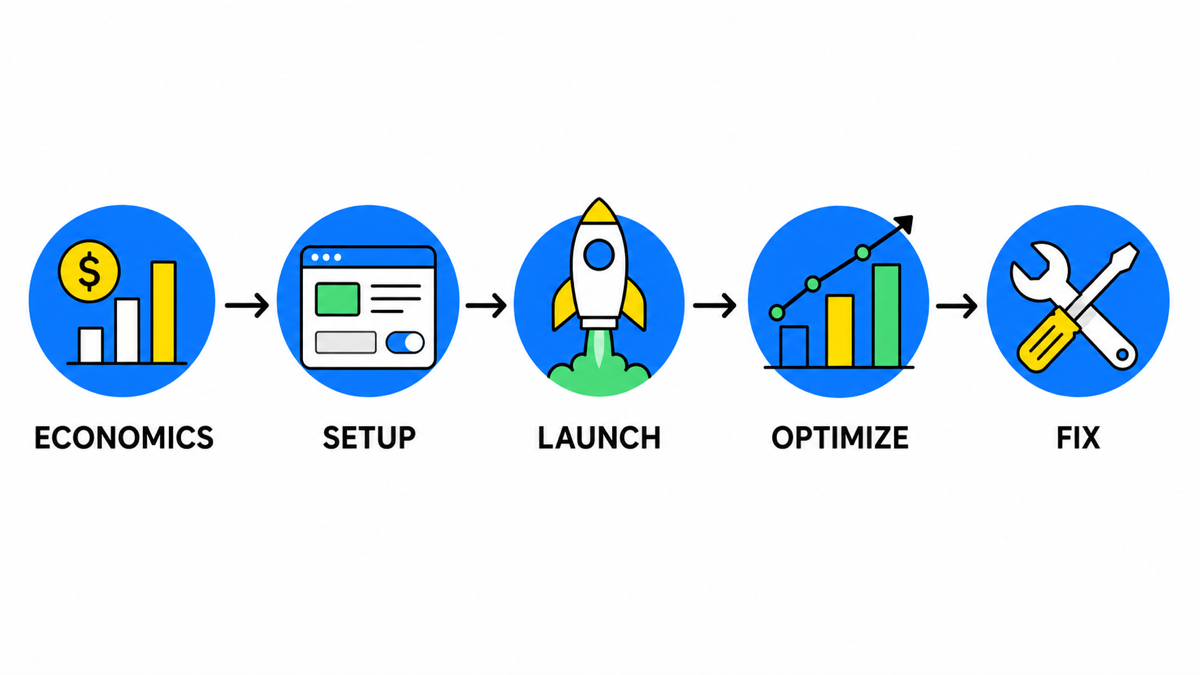
What is inside the course
- Effective advertising thinking. A rapid launch method tested on budgets from $500 to $5M, ways to delegate up to 80% of routine work to Google’s AI, and the process for building a first campaign.
- The components of profitable advertising. Decomposition, budget calculation, profit forecasting, and auction mechanics, including why one advertiser can pay $1 per click while another pays $0.10 under otherwise similar conditions.
- Sales focused Google Search advertising. Search results anatomy, buyer intent keywords, and ads that motivate action.
- Display, Performance Max, video, and remarketing. Audiences, precise targeting, and adaptable creative for different campaign types.
- Campaign management, optimization, and troubleshooting. A step by step model from the first launch to becoming number 1 in a market. Improving performance by 1% each day can compound to 4x over a year. The module covers problems ranging from no impressions to no sales.
The format is designed for busy people: short lessons, a clear structure, notes for every lesson, small assignments, and plain language explanations of complex ideas. Students receive 1 year of access and can join group question and answer sessions with Igor.
What I teach before opening the interface
Since 2006, I have built Google Ads training around measurement and economics. First we define the valuable action, the acceptable acquisition cost, and the path to profitability. Only then do we launch a campaign. The interface changes, but this foundation remains.
Google’s official learning paths and certifications are available through Google Skillshop.
My e-book “19 Google Ads Secrets”: how to get the most out of Google Ads without draining your budget, drawn from real campaigns and tests.
See the book →Who the course is for
- Business owners who want to understand why advertising is or is not profitable instead of accepting a contractor’s explanation that the algorithm simply works that way.
- Marketers who need a repeatable Google Ads launch and optimization system.
- PPC specialists who want a stronger framework for budgeting, testing, and campaign management.
- Advertisers with previous experience who cannot identify whether money is being lost through keywords, ads, audiences, bids, the website, analytics, or offer economics.
Who the course is not for
This course is not for anyone waiting for a magic money button. Google Ads rewards people who calculate, test, read data, and calmly fix weak points. Watching lessons without working on campaigns, assignments, and real performance data will not produce the intended result.
Why learn from Igor Ivitskiy
- PhD in mathematical modelling.
- Ranked number 6 in the global Top 50 PPC list.
- 19 years in advertising.
- Creator of the Magic of Google 4.0 course.
- Named Europe’s best PPC speaker by Adworld Experience.
- More than 4,000 business owners have increased sales after taking his courses.
- Igor’s clients generate $50 million in monthly profit from Google advertising.
- More than 2,000 student reviews.
Igor teaches advertising as an engineering system. The goal is not to copy settings. It is to understand why a method works, where the model stops working, and what to do when actual performance differs from the forecast.
How to choose a course package
There are 3 packages: Standard, Pro, and Top. Prices and terms may change, so check the course landing page for current details.