
Google Ads for a coding school should begin with a clear answer to two questions: whom does the school want to attract, and why should that person choose this course? When clicks are coming in but the wrong people inquire, buying more traffic simply scales the original mismatch.
Eduard faced that situation at ProStep, an IT school and IT company. His experience shows why an owner should assemble the business context and validate the offer before increasing advertising activity. The broader guide to diagnosing clicks without leads explains how to inspect the complete path from an ad to an inquiry.
What was happening before the new approach
Eduard’s problem was not a lack of marketing activity. Traffic could be purchased, people visited, and the team used AI to create copy. Yet those elements did not form a predictable route to a qualified inquiry. Marketing had become a collection of disconnected actions, while the usefulness of each new text or offer felt difficult to reproduce.
Eduard distinguished buying traffic from improving conversion and attracting suitable prospects: the latter require a deliberate marketing process.
That distinction matters for coding courses. A visit does not show that someone has the required starting level, understands the learning format, or is prepared to take the next step. If the ad promises one thing, the course page explains another, and the content speaks to an audience that is too broad, additional clicks do not close the gap.
What Eduard changed
During the “AI system: marketing” workshop, Eduard shifted the emphasis from crafting an isolated AI prompt to building the context in which AI completed the task. That context covered the DNA of the business, its audience, goals, constraints, and examples. The team also defined its own tone of voice so that each piece did not sound as if it came from a different, unrelated author.
The other important change was the order of operations. The offer was checked before advertising began. This can expose a weakness before the school pays for visits: whether the learning outcome is clear, whether the intended audience recognizes its situation, and whether the promise matches the actual program.
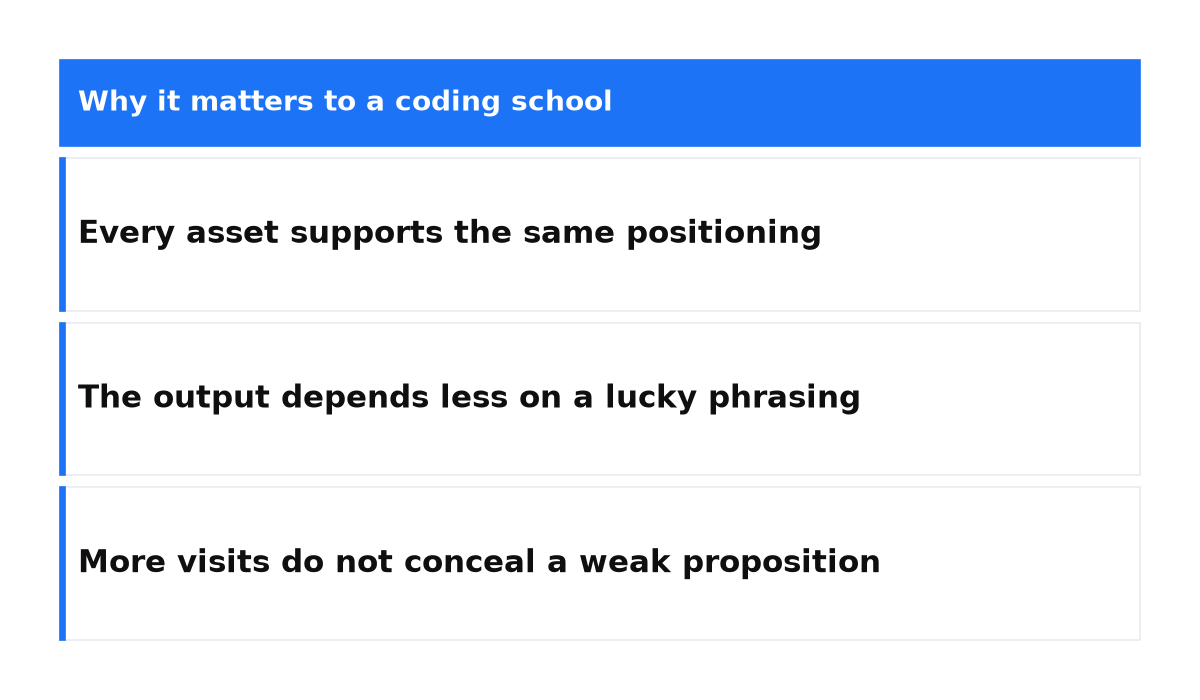
| Previous situation | Change | Why it matters to a coding school |
|---|---|---|
| Disconnected marketing actions | Assemble the business context and goals | Every asset supports the same positioning |
| Polished copy without repeatability | Add the audience, constraints, examples, and voice | The output depends less on a lucky phrasing |
| Use paid traffic to test the offer | Check the offer before launching ads | More visits do not conceal a weak proposition |
After adopting the process, Eduard reported fewer revisions, greater precision, and more stability. Posts began receiving a response regularly. That outcome should not be turned into a claim about revenue or lead growth because the case contains no such figures. Eduard summarized the actual result more carefully: “This is not ‘we got lucky today,’ but a manageable process.”
How to apply the mechanism to coding course ads
- Describe a specific prospective student. Do not target everyone interested in technology. Define the person’s starting point, goal, doubts, and constraints, then use that frame in the ad, course page, and content.
- Form the offer before building the campaign. A visitor should quickly understand what they will learn, whom the program suits, and which next step the school expects.
- Give AI context, not just a request for ad copy. Include the school’s identity, audience, goals, constraints, examples of suitable work, and tone of voice.
- Check the continuity of the journey. The search intent, ad promise, course page, and inquiry form should describe the same program for the same audience.
- Review lead quality separately from traffic. The marketing team needs feedback about who inquired and why a person was not suitable. Without it, the process can respond to visits while remaining blind to the students the school actually wants.
When this does not apply
Better AI context cannot repair a weak program, an undefined audience, or a promise the school cannot fulfill. Checking an offer in advance does not guarantee Eduard’s result either. If the team never returns information about inquiry quality to marketing, the system cannot distinguish a suitable prospective student from an accidental visitor. Align the product, audience, and definition of a qualified inquiry first.
Questions and answers
Why does more traffic not solve a lead quality problem?
Traffic brings more people into the journey that already exists. If the ad and page speak to the wrong audience, additional visits repeat the same error on a larger scale.
Can AI find the right course offer by itself?
AI can help formulate and examine options, but it needs boundaries: the real program, audience, goals, constraints, and examples. The business remains responsible for deciding what the school can genuinely promise.
If you want to turn coding school advertising from a set of disconnected tasks into a system, start with the business context, offer validation, and a clear definition of a qualified inquiry.
My e-book “19 Google Ads Secrets”: how to get the most out of Google Ads without draining your budget, drawn from real campaigns and tests.
See the book →