
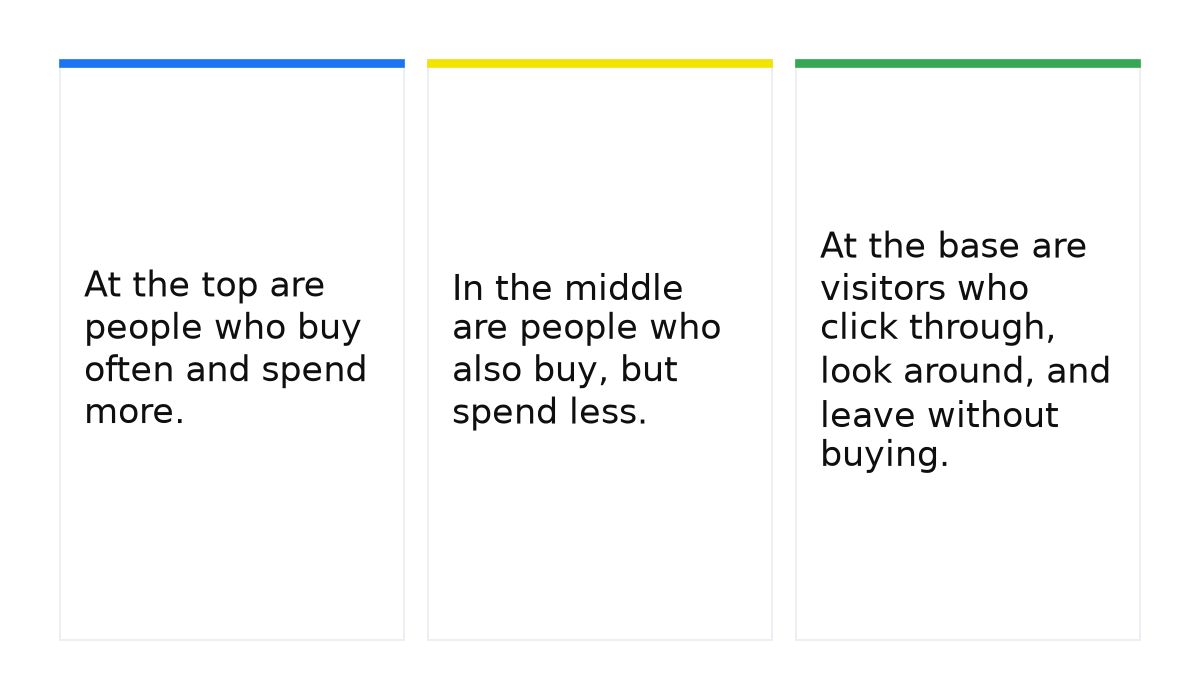
Website visitors do not all have the same value to your business. To explain the risk of choosing Maximize Clicks, I picture them as a simple pyramid with three groups.
- At the top are people who buy often and spend more. These are the customers a business owner most wants to attract.
- In the middle are people who also buy, but spend less.
- At the base are visitors who click through, look around, and leave without buying. They add visits without adding revenue.
This is an illustration, not a measured breakdown of Google users. It highlights the risk: with Maximize Clicks, you can attract a large number of visitors who never become customers.
How Maximize Clicks works
Imagine you own a shop and ask a promoter to bring in as many people from the street as possible. In this imaginary arrangement, the promoter must pay each person to step inside. The amounts are illustrative:
- One group will come in for $1 per person.
- People with very little spare time will only agree for $100.
- People with plenty of time and no intention of buying will come in for 10 cents.
The promoter has a $100 budget and a target based on visitor numbers. An easy way to meet that target is to bring in 1,000 people at 10 cents each. They enter, look around, and leave. The promoter has delivered the visits, but the shop has earned nothing.
The shop represents your website, and the promoter illustrates the job you give the bidding system. In Google Ads, you pay for a click; you do not pay the visitor. Maximize Clicks sets bids automatically to get as many clicks as possible within your budget. Leads and purchases are not the goal it uses to choose those bids. Cheap traffic can therefore leave you without the conversions your business needs.
The unpleasant surprises to watch for
Even if total visits increase, look at what the clicks cost and whether they produce results. The strategy’s name does not mean every click will be cheap.
When I set a bid limit for Maximize Clicks
I set a maximum CPC bid limit to keep the cost of exploring traffic under control. I am not trying to manage every auction manually. Before launching, I check whether that limit is cutting off most of the available impressions. If the campaign stops bringing in a useful range of visits, I reconsider the limit before deciding that the strategy does not work.
The option to set a bid limit, along with its limitations, is explained in Google’s guide to Maximize Clicks.
To illustrate the financial risk, imagine $100 of spending broken down like this:
- Many cheap clicks cost a combined $1.
- One expensive click costs $99.
If none of those visitors enquires or buys, the whole budget has been spent without a conversion. This is a hypothetical example of an expensive click’s impact, not a prediction of how spending will be distributed. The business concern is that automatic bidding can make a different decision from the one you would make about an acceptable click cost. A CPC bid limit helps you control click costs; it does not make the strategy optimize for conversions.
When Maximize Clicks can be useful
One use I see is a brief diagnostic run. Suppose you have tried different bidding strategies but still cannot work out why the campaign gets no impressions. You can use Maximize Clicks for a strictly limited period to see whether traffic starts arriving.
If clicks appear, you have established that the ad can serve and attract visitors. Revisit the campaign’s financial settings, then return to choosing a strategy around the business objective. The arrival of clicks alone does not establish that the campaign will generate leads or profit.
My view on Maximize Clicks
For a business that needs bookings or sales, I would not judge advertising by visit numbers alone. Uncontrolled use of Maximize Clicks can consume the budget without producing a commercial return. Consider strategies that account for conversions, or manual CPC bidding where that level of control fits the job.
If Maximize Clicks is the only strategy you have tried and you are happy with it, there may still be room to improve. Compare it with approaches that use a target cost per action or target return on ad spend. Judge the options by leads, sales, and what those results cost. A change of strategy does not, by itself, promise a severalfold improvement in performance.
Explore the bidding strategies
- Google Ads bidding strategies.
- Automated bidding strategies.
- Manual CPC bidding.
- Maximize Conversions.
- Target CPA.
- Target ROAS and Maximize Conversion Value.
- Target Impression Share.
- Maximize Clicks.
When this does not apply. Increasing traffic with Maximize Clicks does not, on its own, solve the problem of generating leads at an acceptable cost. The caution about ongoing use still leaves room for a brief diagnostic run: new clicks answer a question about serving, but not about profitability.
Understanding the difference between a visit and a valuable business action helps you choose the right advertising objective. The next step in learning Google Ads is to connect your bidding strategy, budget, and conversions to what your business needs.
My e-book “19 Google Ads Secrets”: how to get the most out of Google Ads without draining your budget, drawn from real campaigns and tests.
See the book →