
A business adds a cookie banner, then sees fewer Google Ads conversions even though calls, bookings, or CRM leads have not fallen in the same way. The first reaction is often to change bids. Start with measurement instead. When a visitor declines cookies, Google can lose the direct connection between that person’s ad click and the later inquiry.
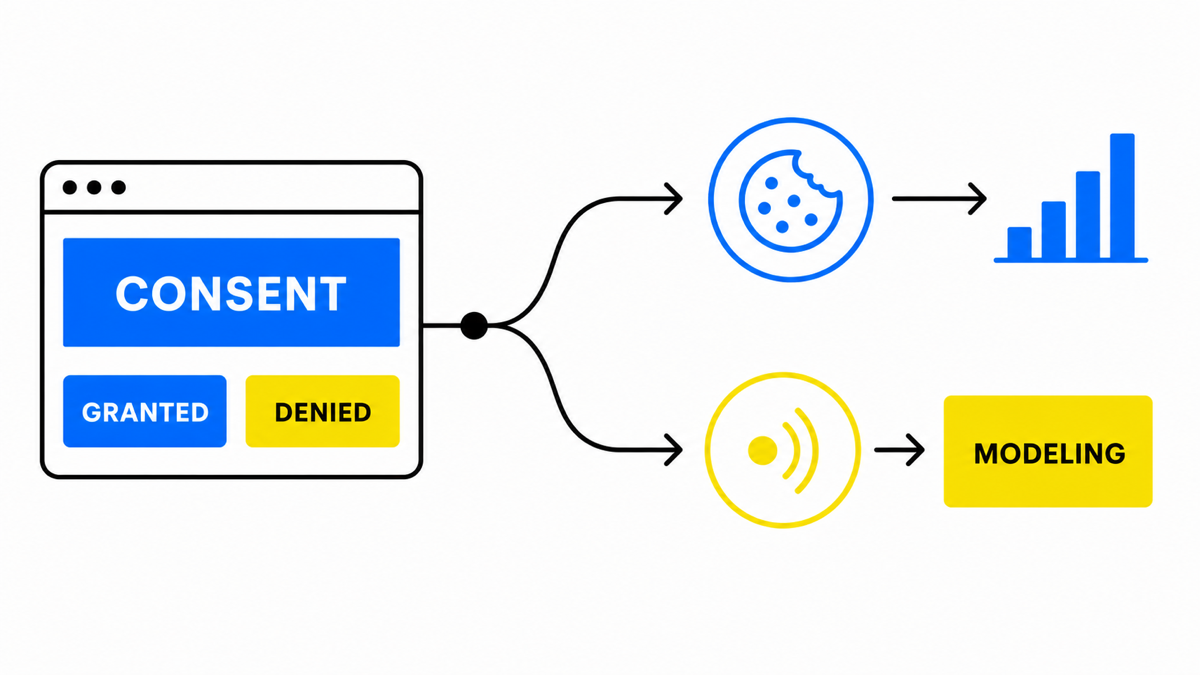
Tags wait for consent and send nothing after refusal.
Cookieless pings can support advertiser-specific modeling.
Implementation and active modeling are different states.
Separate the consent banner from Consent Mode
The banner asks for a choice and records the response. Consent Mode communicates the consent status to Google so that tags can adjust their behavior. Consent Mode does not provide the banner or consent widget itself. A polished Accept cookies window therefore does not prove that Ads and Analytics are receiving the status they need.
Inspect the signal, not the appearance. Confirm the default state before the visitor decides, the update after the visitor responds, and the implementation status in conversion diagnostics. A banner without that handoff may satisfy an interface requirement while leaving the measurement chain incomplete.
Understand the basic and advanced implementations
The business difference between basic and advanced is not the label. It is whether Google tags load before the banner response and what signal remains available after a refusal.
| What changes | Basic | Advanced |
|---|---|---|
| When Google tags load | Blocked until the user interacts with the banner | Load when the site opens, with consent denied by default unless configured otherwise |
| What reaches Google before a response | Nothing, including no default consent status | The default denied consent status and cookieless pings can be sent while the banner awaits a response |
| What happens after refusal | No data is sent and tags do not fire | Tags do not write cookies but can send cookieless pings |
| Conversion-modeling basis | A general, less detailed model | An advertiser-specific, more detailed model |
This comparison comes from Google’s Consent Mode overview. Google notes possible regional differences in the EEA, Switzerland, and the UK. A company serving customers in Britain, Canada, or the United States should still validate its own legal obligations and CMP configuration rather than copying another market’s setup.
From a measurement perspective, advanced provides more calibration signal without writing advertising cookies after denial. Basic stays silent before the response and after refusal, so its model has less advertiser-specific information. That technical advantage does not decide what is legally appropriate. Your counsel and consent provider must answer that question.
Map each consent signal to what Google can do
The table below is a measurement map for owners and agencies, not a legal checklist. It shows what remains technically possible when a visitor declines storage.
| Signal or situation | What Google can do | What Google cannot do under that state |
|---|---|---|
| Consent granted | Run related tags normally with cookies and complete measurement data | Consent Mode cookie restrictions do not apply to the granted state |
| ad_storage denied | In advanced, send cookieless pings, truncate IP, and use coarse signals for modeling | Write new advertising cookies or read existing first-party advertising cookies |
| analytics_storage denied | Send cookieless Analytics pings for subsequent modeling | Read or write first-party analytics cookies |
| Cookieless pings after refusal | Communicate consent state, a key-event signal, and limited technical information | Track an individual across sites, build remarketing lists, or create profiles |
| No direct click → conversion link | Estimate attribution through conversion modeling when eligibility conditions are met | Guarantee recovery of every conversion hidden by the consent gap |
The Consent Mode reference documents behavior under denied storage, while the modeling guide explains cookieless pings. Trying to evade a refusal with a clever tag defeats the purpose of the system. The job is to measure within the permitted state.
Know when modeled conversions become available
Without cookies, Google cannot observe the full user path. Consent Mode conversion modeling, available to eligible advertisers since April 2021, uses observable data and patterns to estimate attribution for unconsented paths. Modeled conversions enter the Conversions column and reports built from it, so automated bidding can also use them.
The model addresses whether an ad click led to a conversion, not whether a sale existed in the business at all. Google’s modeled online conversions guide says the reported numbers can take up to 5 days to stabilize. Observed and modeled conversions appear together in the reporting column.
Activation depends on three conditions:
- Consent Mode or IAB TCF v2.0 is implemented correctly.
- The account reaches 700 ad clicks in 7 days for a particular domain × country grouping.
- The model has time to learn. Installing the signal does not create modeled conversions immediately.
In the account, follow Goals → Conversions → Summary → conversion action → Diagnostics. “Consent mode is implemented” means Google detected the setup but modeling is not yet active. “Consent mode is implemented and modeling is active” confirms the next stage. Google’s verification guide says the status can appear within 48 hours and, in some cases, take up to 2 weeks.
Google also reports that users who grant consent are generally 2-5 times more likely to convert than those who decline. This is why the drop in a report does not necessarily match the refusal rate on the banner. It is a general Google observation, not a benchmark for your sector. Evaluate your own gap after modeling becomes active.
Audit measurement before changing bids
- Verify both parts of the setup. Use Tag Assistant to inspect default denied and the update after the banner response, then check conversion Diagnostics.
- Identify the implementation type. Basic and advanced give the model different inputs. Align an advanced setup with legal counsel and your CMP.
- Do not treat the first reporting drop as a bidding problem. Allow 7 complete days, check thresholds, and look for modeling status. Impact results can display for 4 weeks after the modeling start date.
- Test every page where tags matter. A missed campaign landing page or confirmation page creates a local measurement gap.
- Compare Ads with operational records. Fewer reported conversions can mean less cookie attribution, not fewer calls, consultations, or signed customers.
If the banner appears but Diagnostics remains silent, ad-copy changes will not repair the measurement chain. The sensible next step is to review the handoff among the CMP, tags, conversion action, and reporting before making another campaign decision.
My e-book “19 Google Ads Secrets”: how to get the most out of Google Ads without draining your budget, drawn from real campaigns and tests.
See the book →When this does not apply
Frequently asked questions
Why did Ads conversions fall while CRM leads stayed stable?
The CRM can still record a submitted form or completed call. After a visitor declines cookies, Google Ads may lose the direct link between that inquiry and the ad click. Check Consent Mode and modeling before changing the campaign.
Should a service business use basic or advanced?
Advanced supplies cookieless pings for advertiser-specific modeling after denial. Basic sends nothing before the response and stays silent after refusal. That measurement difference does not settle the legal question, which depends on jurisdiction, counsel, and CMP configuration.
Why is conversion modeling still inactive?
The domain × country group may not have reached 700 clicks in 7 days, the implementation may be less than 7 complete days old, or Diagnostics may still be updating. Status can take 48 hours and occasionally up to 2 weeks.
Can I preserve tracking by ignoring a refusal?
No. Under denied consent, advertising cookies should not be written. The compliant measurement path is a correct consent signal, permitted cookieless pings, modeling when thresholds are met, and CRM or offline imports for sales completed away from the website.