
An attribution model does not reveal the single true source of a customer. It tells Google Ads how to assign conversion credit across ad interactions. Business owners now have a practical choice between data-driven attribution and last click, so the important decision is how consistently the chosen rule is used in reporting.
Credit is distributed from account conversion data.
All credit goes to the last clicked ad and keyword.
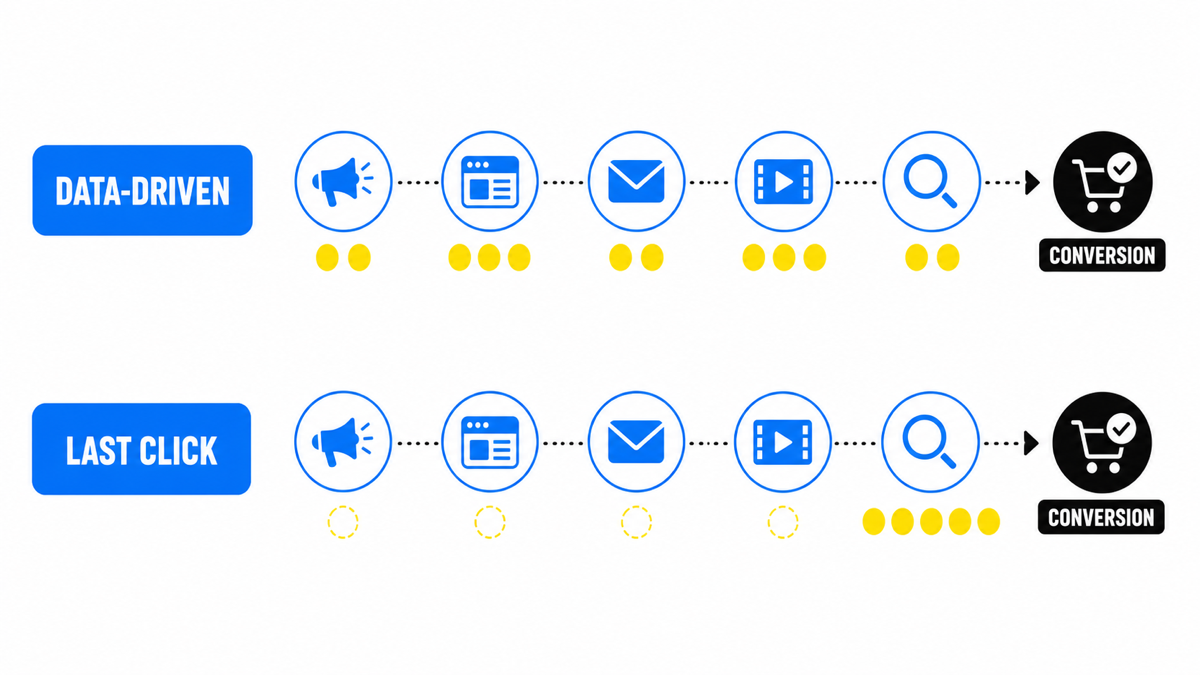
Treat attribution as an accounting rule, not ground truth
A prospective customer might first see a YouTube ad, later click a search ad, and finally return directly to book a consultation. There is no neutral way to give one touchpoint all the credit. Attribution is the rule used to divide credit among the advertising interactions a platform can see.
This is why apparently conflicting reports can all follow their own logic. Google Ads applies one rule, an analytics platform may apply another, and your CRM records the lead or closed sale. Adding every platform total together can count one customer more than once.
For an owner, the useful move is to document which attribution model guides Google Ads decisions and which CRM report represents actual business outcomes. That turns a debate about dashboards into a discussion about performance.
Know which Google Ads models still exist
Google Ads currently provides data-driven attribution and last click for conversion actions. Data-driven attribution is the default for most new conversion actions. Google explains the current options in its guides to attribution models and data-driven attribution.
First click, linear, time decay, and position-based attribution are no longer available. From June 2023, advertisers could not select them for new conversion actions. From September 2023, Google discontinued them for existing conversion actions and moved those actions to data-driven attribution. Actions whose owners opted out of that switch moved to last click. The timeline appears in Google’s official attribution update.
Older advice also refers to minimum data thresholds. Google removed those volume requirements for data-driven attribution, making it available to most conversion actions. A proposal based on restoring linear attribution or meeting the old thresholds is built on an outdated version of Google Ads.
Compare how each model assigns conversion credit
| Model | How credit is assigned | What tends to look stronger | Status |
|---|---|---|---|
| Data-driven | Compares converting and non-converting customer paths, then estimates the contribution of ad interactions using account data | No fixed winner, because Google’s model determines the allocation | Available and the default for most new actions |
| Last click | Gives all credit to the last ad the customer clicked and its associated keyword | Brand search, remarketing, and other interactions close to the enquiry or purchase | Available |
| First click | Gave all credit to the first interaction in the path | Video, display, and other discovery campaigns | Retired in 2023 |
| Linear | Split credit equally among every interaction in the path | Middle interactions that last click did not recognise | Retired in 2023 |
| Time decay | Gave more credit to interactions nearer the conversion, using a 7-day half-life | Later interactions without entirely removing early ones | Retired in 2023 |
| Position-based | Gave 40% to the first interaction, 40% to the last, and split the remaining 20% among the middle interactions | Discovery and closing interactions at the same time | Retired in 2023 |
The practical reading is straightforward. Last click will make the ad that finished the journey look decisive. Data-driven attribution can distribute credit across several Google ad interactions. The retired models remain useful only for interpreting old reports and advice, because you cannot choose them for current conversion actions.
See what the two available models change in your report
Data-driven attribution compares the paths of customers who converted with those who did not, then estimates the contribution of each advertising interaction. It can account for interactions with Google ads across Search, YouTube, and Display. It does not turn organic search, social media, referrals, or other activity outside Google into a complete view of the customer journey.
Last click uses a simpler rule. The last ad click and its corresponding keyword receive all the credit, while impressions without a click receive none. Owners can understand the logic easily, but the rule consistently favors advertising that appears near the booking, enquiry, or purchase.
Google reported that advertisers switching to data-driven attribution from another model saw about 6% more conversions on average. That is an average reported by Google, not a forecast for your account. A model change first changes the measurement rule, so a different campaign split does not by itself prove that demand or ad quality improved.
Set up a reporting rule your team can follow
- Document the model. State which attribution model is used when the team evaluates Google Ads.
- Compare like with like. If the model changed, do not treat the earlier and later reports as a clean performance comparison.
- Keep the CRM as the control. Your CRM holds actual enquiries and sales, while the ad report assigns credit among interactions.
- Do not turn Google’s average into a promise. The reported average of about 6% does not guarantee the same result for a local service company or B2B firm.
- Remove retired choices from the meeting. First click, linear, time decay, and position-based models are no longer settings you can select.
A useful next step is to place the selected Google Ads model beside your CRM lead and sales totals, then review campaign decisions using that same measurement rule each time.
My e-book “19 Google Ads Secrets”: how to get the most out of Google Ads without draining your budget, drawn from real campaigns and tests.
See the book →When this does not apply
Frequently asked questions
Why do channel leads add up to more than our CRM total?
Advertising and analytics platforms can apply different rules and credit the same customer to different interactions. Use the CRM to control the actual number of enquiries and sales.
Which attribution model is the correct one?
No model is universal ground truth. Choose a rule whose limits you understand, document it, and use it consistently when comparing performance.
Can we switch back to first click or linear attribution?
No. Google retired those models in 2023. Data-driven attribution and last click remain available for conversion actions.
What should an owner include in a performance review?
Show the selected model, Google Ads results measured with that model, and actual enquiries or sales from the CRM. This keeps attributed credit separate from business outcomes.
Why did campaign credit move after changing the model?
The system began dividing conversion credit differently. That can change the report even when customer behavior and advertising performance have not changed.