
To view a competitor’s ads for free, open Google Ads Transparency Center, choose a location, enter the advertiser or website name, and inspect the available ads. You can narrow results by date and targeted location.
Allow 5 minutes for a basic check of one competitor. That is enough to try the domain and name, apply filters, and open several creatives. The center still does not tell you whether those ads make money. That conclusion requires cost and sales value, which the guide to ROAS in Google Ads explains.
What Google Ads Transparency Center shows
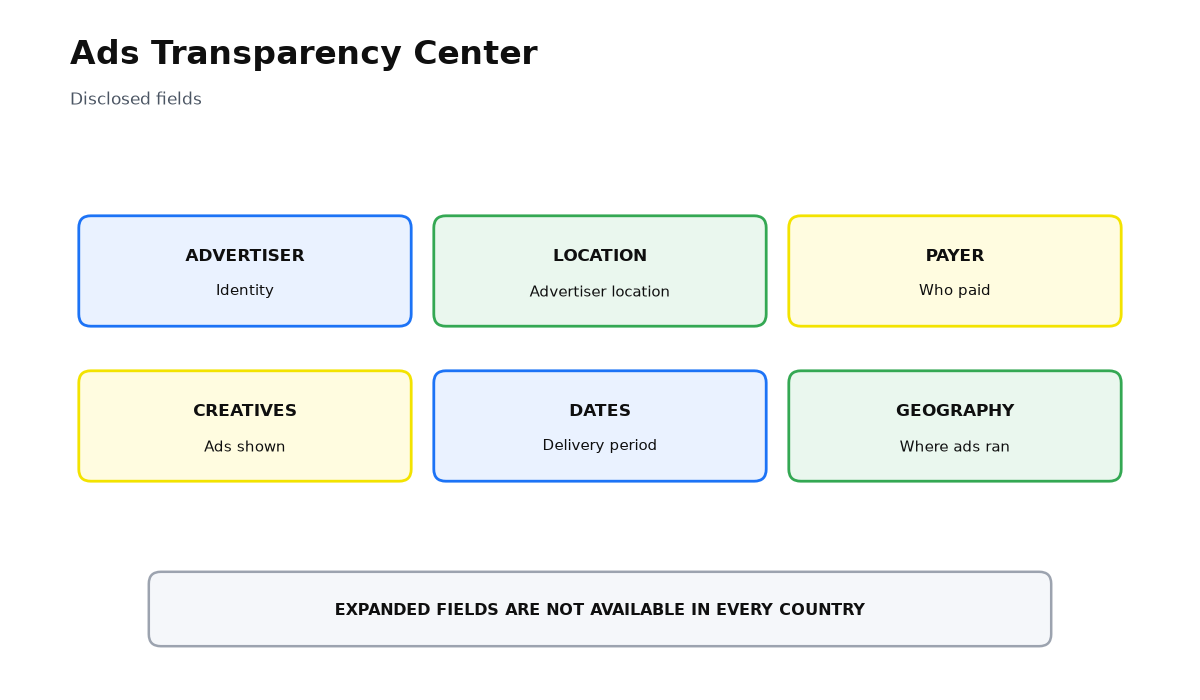
Google describes Ads Transparency Center as a searchable repository of advertisers and ads served on Search, Display, Gmail, and YouTube. Its advertising transparency policy describes the disclosed set: basic fields include the advertiser, location, payer, ads served during a period, and dates and locations of delivery, while the expanded set is available only for certain countries and regions.
| What you can see | How to use it | What it does not prove |
|---|---|---|
| Ad text, image, or video | Understand the offer, tone, and format | That this specific creative produces sales |
| Advertiser, location, and payer | Check who stands behind the advertising | Who actually manages the campaign |
| Delivery date and location | See where and when a message appeared | How much was spent in that market |
How to find a competitor’s ads
- Open Ads Transparency Center and select the geography you want to investigate.
- Search for the competitor’s domain first, then try the brand or legal business name.
- Apply date and targeted location filters to remove irrelevant markets.
- Open several ads and note repeated promises, proof, formats, and landing pages.
- Repeat the search later. A single snapshot shows creative, but not which ads survived sustained testing.
Google supports searching by advertiser or website name. When the brand produces no result, the domain can help resolve a mismatch between the trading name and the name associated with the advertiser or payer.
How to interpret the results carefully
A repeated offer is evidence of a competitor’s hypothesis, not evidence that the offer is profitable. A long running ad can be a useful clue, but the center cannot distinguish a winning creative from a neglected campaign.
Under Google’s advertising transparency policy, ads served in certain countries and regions include additional targeting information, recipient counts, and subject labels. Do not expect those fields in every result. Google also outlined the basic experience in its official Ads Transparency Center announcement.
What is absent from the disclosed set
Google’s official disclosure list names the advertiser, payer, location, creative, and delivery dates and locations, with extra fields in certain markets. Bids, budgets, and keywords are not listed in this described set.
That is an observation about the published fields, not a quotation in which Google says it does not show bids, budgets, or keywords. The center supports creative research, but it cannot reconstruct a competitor’s account structure or economics.
When this does not apply
- The competitor advertises under another legal name, domain, or payer identity, while you search only for the brand.
- You need bids, budget, keywords, conversions, or profit. The disclosed set does not provide those metrics.
- You want proof that a particular ad performs well. The presence of creative is not a performance report.
You can now find a competitor’s creative, filter the relevant market, and avoid assigning undisclosed data to the tool. The next useful move is to turn observed offers into hypotheses and test them against your own customer response and economics.
An audit finds the leaks; steady leads come from the system around your ads. My e-book “19 Google Ads Secrets” shows how to get the most out of Google Ads without draining your budget, drawn from real campaigns and tests.
See the book →Questions and answers
Is Google Ads Transparency Center free?
Yes. It is a public Google search tool and does not require a paid competitive intelligence subscription.
Why does a brand name return no ads?
The disclosure may use a different advertiser or payer name. Try the website domain, legal business name, and alternative forms of the brand.
Can I see a competitor’s keywords?
Keywords are not named in Google’s described disclosure set. Ad copy may suggest a topic, but it does not prove which search query or keyword triggered delivery.