
Advertising on Google Maps is one of the cheapest, most effective, and most overlooked customer acquisition channels for local businesses. Many owners do not treat Google Maps as an advertising platform. They may underestimate the value of high intent local traffic or simply not know where to set up and track this type of campaign.
That creates an opportunity. In a competitive market, neglected channels are often worth testing first. Ads connected to your Google Business Profile can win customers that nearby competitors miss.

Why Google Maps is a powerful but overlooked source of customers
Most businesses rely on familiar channels such as Search campaigns, paid social on Instagram and Facebook, or affiliate marketing. Google Maps can influence the decision at the moment when someone is ready to act.
Imagine a driver searching for the nearest repair shop, clinic, or store. The first relevant result on Maps can become the destination. The journey is short: search, result, directions, visit.
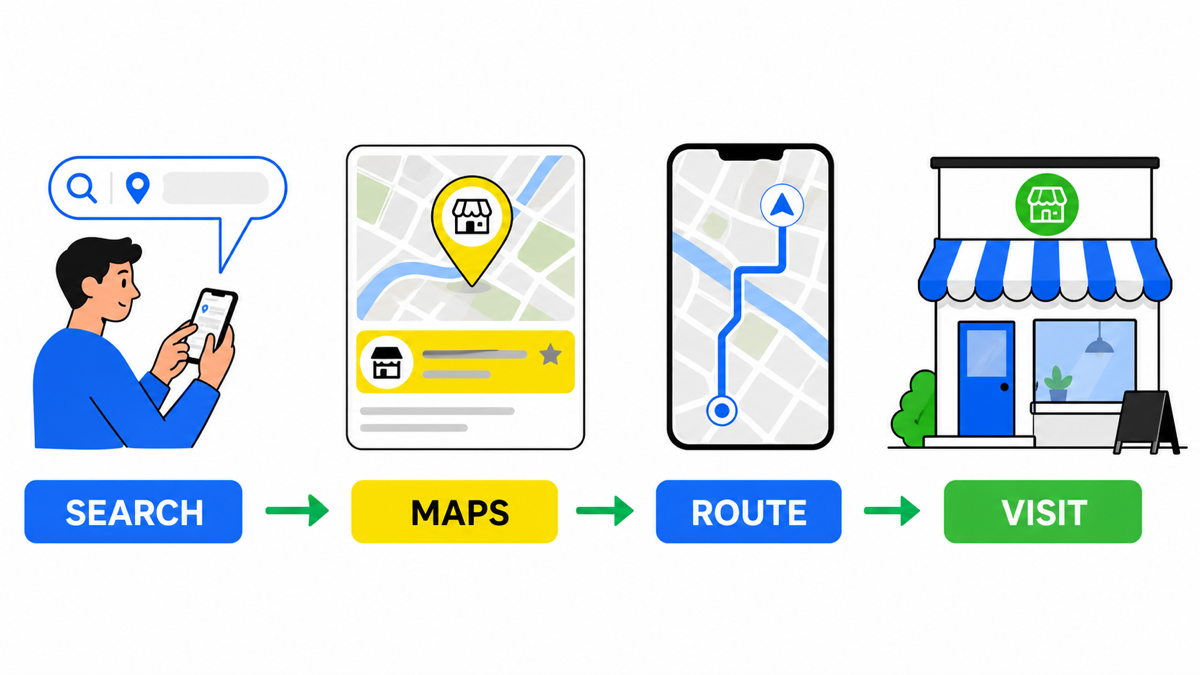
Benefits of advertising on Google Maps
What I check before advertising on Maps
I do not start with the bid. I first check who the location setting makes eligible to see the ad. For a business that only serves nearby customers, I review the presence setting because the default can also include people who merely show interest in the area. Then I use the location report to separate real service areas from searches made by people who are far away.
Google’s official documentation explains the difference between physical presence and interest in a location.
- Lower competition. Fewer businesses actively use this channel, so click and campaign costs can be lower than Search or video advertising in some local markets.
- High intent traffic. A person searching for a notary near me while planning a route has stronger immediate intent than someone researching which notary is best.
- A compounding effect. Visits can generate reviews, while reviews and ratings strengthen the profile’s reputation over time.
- Flexible targeting. You can account for location, search intent, time of day, and the preferred action, such as a call or an in person visit.

Who should advertise on Google Maps
The channel suits businesses that customers can call, walk into, or drive to for a product or service. This includes more than conventional storefronts. Consultants, shops, salons, law firms, and repair businesses can all benefit.
- notaries, attorneys, and legal services;
- accountants, therapists, and tutors;
- beauty salons, hair salons, and barbershops;
- clinics;
- tailors and alteration services;
- cafes and restaurants;
- auto repair and electronics repair shops;
- florists.
Examples and cases
After launching ads on Maps, some of my students and businesses whose campaigns I managed increased sales several times over. For one law office, we split campaigns by service group and saw a significant increase in inquiries.
Another example came from my own search for a tailor. I researched nearby businesses in advance and chose one. When I was ready to leave, I discovered that it was closed on Saturday. I immediately searched Google Maps for a tailor near me, selected a business that was open, and drove there. Maps delivered a customer who had not originally planned to visit that company.
To capture these last minute visits, a business needs to be prominent near the top of the results. Registering a map listing alone may not be enough when competitors are actively advertising.
My e-book “19 Google Ads Secrets”: how to get the most out of Google Ads without draining your budget, drawn from real campaigns and tests.
See the book →Myths about advertising on Google Maps
- You need hundreds of reviews. A business can start with 0 reviews or a very small number. Maps can then help the company build reviews over time.
- It only works in major cities. A small town may have fewer competitors and less customer choice. A prominent position can still be valuable.
- Results cannot be tracked. Performance Max can serve ads on Maps alongside other Google properties, which can make placement level attribution difficult. Smart campaigns may offer different controls and reporting depending on what is available in the account.
- It is difficult and expensive. Local promotion can be simpler than other forms of Google advertising when the Business Profile, location settings, and conversion tracking are prepared correctly.
Conclusion
Local businesses should treat Google Maps as a complete advertising channel, not merely as a pin on a map.
- It can be affordable even with a modest budget in dollars.
- Setup can be quick and results can be tracked.
- Strong local intent increases the likelihood of a call, route request, visit, or purchase.