
Board took place in London, United Kingdom, on October 17, 2025, as an in-person business talk followed by a live discussion. The speaker was Igor Ivitskiy, an entrepreneur and former mathematical modelling researcher who applies systems thinking to advertising and marketing.
The talk, “The AI Era in Advertising and Marketing: How an Entrepreneur Can Build 5x Leverage”, connected AI-assisted management, synthetic customer perspectives, generative-search visibility and the changing economics of paid media. Its common thread was that the old craft of keyword research for Google Ads now sits inside a wider problem: supplying algorithms with useful context and trustworthy business signals.
AI multiplies context, not judgement
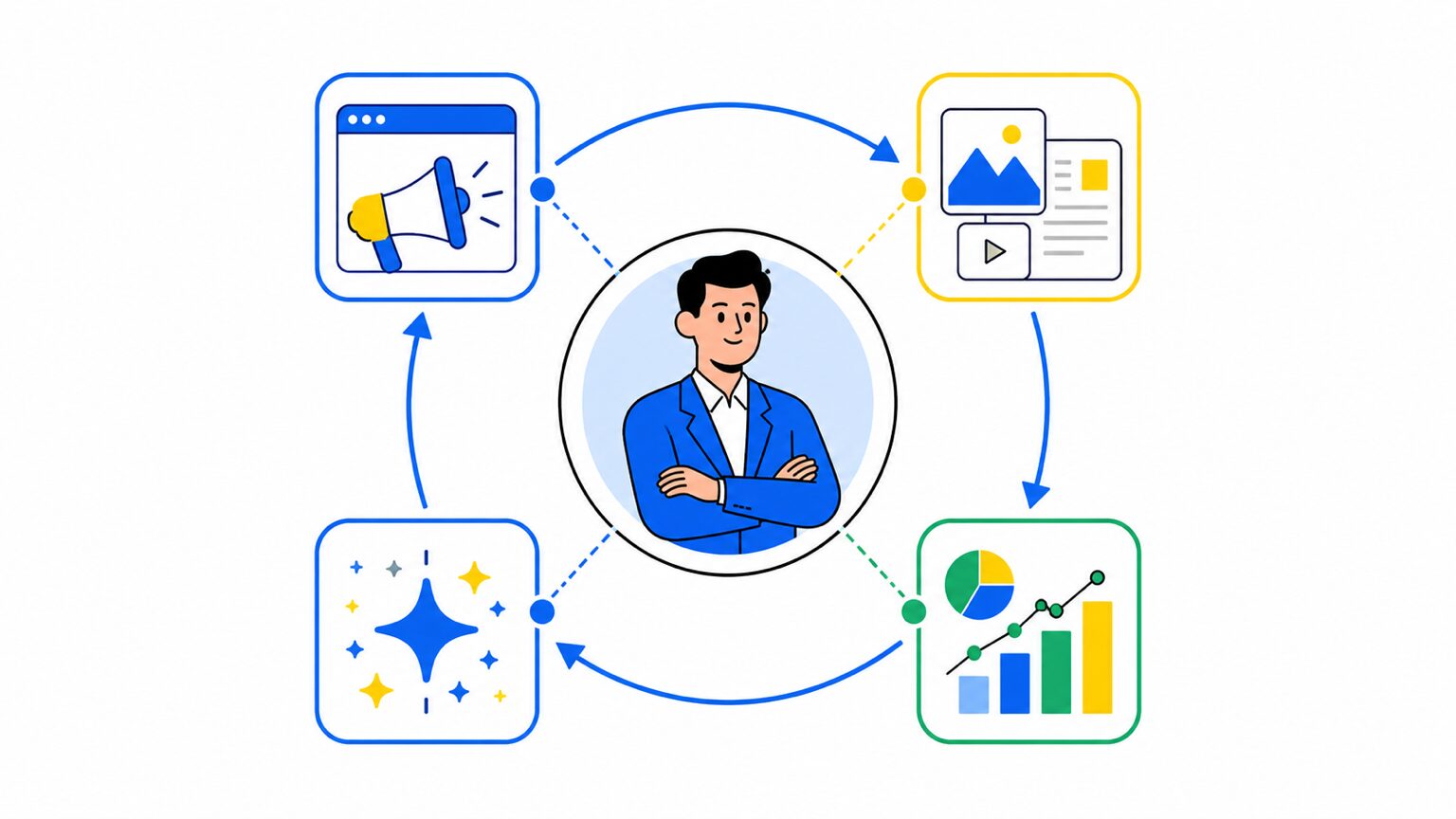
Igor framed AI as a mirror. A generic instruction tends to return generic management advice because the model has no reason to understand the company’s positioning, audience, constraints or definition of a good result. The same model becomes more useful when it works with a coherent business context and receives corrections from someone accountable for the decision.
This explains why apparently similar AI projects can produce opposite reactions. One company sees a stream of plausible but irrelevant text; another sees a useful second opinion before committing money or time. The difference is less about finding a magical prompt and more about whether the system has a clear role, reliable reference material and a feedback loop.
The principle also sets a boundary. AI can widen the field of options, compare evidence and preserve organisational memory, but a person still defines the standard and owns the consequence. That is especially important when a decision affects customers, money, health, law or reputation.
Use business context to challenge operational and strategic choices before resources are committed.
Turn research, feedback and first-party data into sharper questions about what customers value or reject.
Prepare for a market where generative answers, search pages and ad algorithms increasingly shape the same journey.
My rule for AI-assisted decisions
I treat an AI system much as I treat broad match in Google Ads: it can expand the field I can see, but it still needs a clear business goal, good signals and a human who knows what must be rejected.
This way of thinking is also relevant to training: the durable skill is not memorising one interface, but learning how to frame a business problem, test an answer and keep responsibility with the decision-maker. The school’s programmes develop that same analytical discipline in advertising and marketing.
My e-book “19 Google Ads Secrets”: how to get the most out of Google Ads without draining your budget, drawn from real campaigns and tests.
See the book →Key insights
- Context is the real multiplier. A model reflects the company description, evidence and constraints it receives; a generic request produces a generic answer.
- One assistant should not become every department. Strategy, marketing, finance and execution require different perspectives because prolonged work in one area shifts the context of the conversation.
- Synthetic customer perspectives are a pre-test, not market proof. They can reveal missing explanations and hidden assumptions before launch, but real customer behaviour remains the judge.
- First-party data becomes more valuable as tracking narrows. Google’s official Customer Match overview confirms that advertisers can use information customers shared with them across eligible Google properties.
- Generative visibility rewards a coherent expert identity. Breadth of independent mentions helped establish the entity; depth of specialist material helped connect that entity to a narrow question.
- Automation still needs a human arbiter. The model can suggest and compare, but it cannot safely invent the company’s standard for a good legal, financial, medical or customer-facing outcome.
Key moments from the talk
From an oracle to a business mirror
Igor opened with a tension familiar to almost every management team. One group sees AI as a near-universal answer; another dismisses it after a few shallow outputs or a failed automation. His analogy was the Delphic oracle: the value did not come from a supernatural answer detached from the visitor, but from a process that drew out and reorganised what the visitor brought. On stage he compressed the point into one line: “AI, по суті, це лише дзеркало” (AI is, in essence, only a mirror). A model can expose options and contradictions at unusual speed, but it also reflects weak assumptions, missing evidence and vague goals. That makes the quality of the interaction a management issue rather than a software feature.
The talk then moved from metaphor to organisational design. Igor described an AI adviser that holds the stable context of a business and helps examine strategic or operational choices. The important part was not the name of the tool. It was the separation between a broad decision perspective and specialist perspectives for marketing, finance or execution. If one conversation spends weeks on landing-page copy, its attention becomes biased towards marketing; if it lives inside contracts, it starts seeing every idea through legal risk. A useful system therefore preserves distinct lenses and lets a person arbitrate between them. Igor’s summary was blunt: “Різний контекст призводить до різних результатів.” Different context produces different results.
A customer model before the market test
The second major idea concerned the customer. Instead of starting with a chatbot that replaces support, Igor argued for using AI behind the scenes to understand customers more carefully. Research, reviews, sales conversations and first-party data can be organised into several plausible customer perspectives. Those perspectives can then challenge a landing page, an offer or an advertisement before money is committed. One may notice that the language is too technical; another may see that a supposedly obvious condition was never explained. This does not predict conversion with certainty. It creates a disciplined rehearsal that surfaces the business owner’s blind spots before a live test supplies the verdict.
That distinction matters because an algorithm learns from whatever response it is given. In paid media, weak or false leads can teach the platform to find more people who resemble the wrong outcome. A large exclusion list does not by itself solve that upstream problem, just as negative keywords alone do not eliminate advertising waste. The strategic task is to improve the quality of the signal returning to the system. The same logic applies to customer service. AI can answer routine questions or enrich a report, but frustration, uncertainty and unusual cases need a clear path to a human. Efficiency is useful only while the customer still feels understood.
When search, recommendations and ads converge
The final movement of the talk joined generative discovery with paid advertising. Igor had spent about a year building a consistent public footprint around a narrow combination of expertise: Google Ads and mathematical thinking. He spread corroborating mentions across the web, published material that demonstrated depth, and connected the evidence to a clear identity. When an American prospect said ChatGPT had recommended him, Igor asked roughly 70 friends in different countries to repeat the narrow query; about 90% saw Igor in the answer. He presented that result as support for a hypothesis, not a universal guarantee. At the same time, ad platforms are becoming more automated and search pages are becoming answer surfaces. Google’s own guidance on steering AI-powered Search ads reflects the same balance between machine scale and business direction. Yet the stable destination remains the company’s own site. As Igor said, “Люди все одно заходять, люди все одно читають, люди все одно заповнюють форму і залишають заяву.” People still visit, read, complete a form and make an enquiry. AI changes discovery, but it does not rescue a page that fails to make the offer clear.
The full recording of this talk is included in the bonus pack for students.
Key takeaways
AI becomes useful when a company gives it context, evidence and a standard for correction.
The strongest applications in the talk supported decisions, sharpened customer understanding and prepared marketing for generative discovery.
The human role did not disappear: it moved towards framing, judgement and responsibility.