
Every agency report has the same trophy line: “added 500 negative keywords this month.” It sounds like work. It sounds like savings. Across 31 accounts and $133M in spend, the length of the negative list was one of the weakest signals of a healthy account I found.
That near-zero number is the whole argument. Whether an account ran a short list or tens of thousands of negatives, the block-list length did not decide how much budget leaked to searches that never converted.
Why list size does not save you
Negative keywords do useful work: they can block future searches that match the exclusion. Their limit is specific. Negatives do not match close variants or broader expansions, so new wording, plurals, and synonyms keep passing through. A static list ages while the machine keeps generating fresh queries, and the leak reopens.
The waste does concentrate, though. Across 9.46M search-term rows, a small set of recurring word families each accumulated between $0.4M and $2.6M in zero-conversion spend. In the sample the eight heaviest were code, pdf, free, how, for, test, generator, and online. Treat those as review flags, not automatic negatives: some are informational, but a “generator” or “pdf” search can still match a real buyer.
What to monitor instead
Not the size of the block list. The habit of reading the search terms report. A short list reviewed weekly beats a giant list reviewed never, because only regular review catches the irrelevant wording the existing negatives miss.
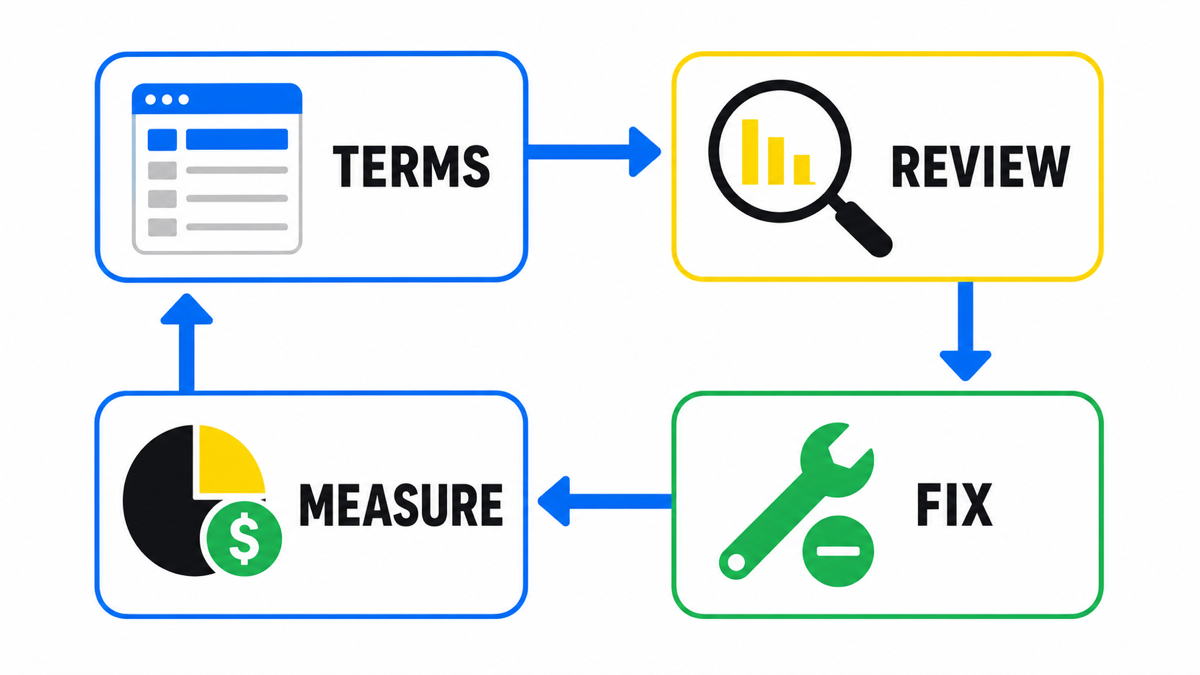
- Open the search terms report, sort by cost, read the top 20. Count how many are actually about your product.
- When a query is clearly irrelevant or persistently uneconomic, add it as a negative, and include the singular, plural, and synonym variants, because negatives do not match close variants.
- Watch the share of spend on zero-conversion terms month over month. That trend, not the list length, is the scoreboard.
- Before adding thousands of negatives, ask why the query became eligible at all: keyword theme, match type, conversion tracking, or bid strategy. Fix the cause, not just the symptom.
The researcher’s take
A big negative keyword list is a comforting artifact. It shows effort. It does not show control. The account that wastes the least is not necessarily the one with the longest block list, because list length measures accumulated exclusions, not current query efficiency. Measure the leak month over month, not the number of buckets you own.
FAQ
So negative keywords are useless?
No. They are necessary but not sufficient. They clean up known bad queries. What they cannot do is substitute for regular review or for correct match types. The failure mode is treating list length as the goal.
How often should I review search terms?
Weekly for active accounts, sorted by cost, top down. The waste that hurt the accounts in this sample built up quietly over months while nobody was reading the report.
My e-book “19 Google Ads Secrets”: how to get the most out of Google Ads without draining your budget, drawn from real campaigns and tests.
See the book →