

Here is how notaries, attorneys, agencies, and law firms can advertise their services. I will walk through what is different about legal marketing and give a working plan for promoting legal services online.
How much does Google Ads cost for a law firm, and is it worth it?
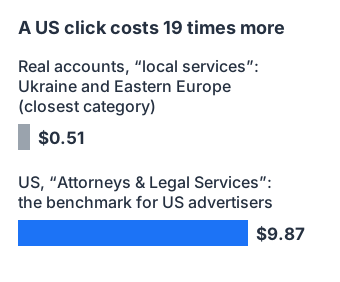
In the US, the median search click in the “Attorneys & Legal Services” industry costs about $9.87 (WordStream/LocaliQ 2026). In our real ad accounts, mostly in Eastern Europe, a click in “local services” costs about $0.51 (2025 median): a cheaper market, relevant only if you advertise there. There is no separate measurement for this exact niche: this is the closest category in our real accounts. Figures in this block are for 2025; the article below may mention prices from other years. Where the figures come from ↓
Real accounts = ad accounts managed by Igor Ivitskiy's team, mostly in Eastern Europe.
A $1,500 monthly budget → about 150 clicks → about 8 conversions at this industry's US median of 5.55% (a call, a form or a purchase).
To get about 30 leads a month (a practice rule: with that many, Google's automated bidding runs more steadily), you would need about $5,335 a month.
An estimate, it may not hold.
Estimate your budget
A rule from Igor Ivitskiy's practice: automated bidding needs about 30 conversions a month to have enough data. A scenario, not a measurement or a promise.
| Metric | Real accounts (mostly Eastern Europe) | US (WordStream/LocaliQ 2026) |
|---|---|---|
| Cost per click | $0.51 | $9.87 |
| CTR (clicks per impression) | 5.28% | 5.87% |
| Leads (conversions) per 100 clicks | no data | 5.55% |
| Cost per lead | no data | $132 |
- For a typical advertiser in the “local services” category (median), about 57.7% of tracked search spend goes to queries without a single conversion (2023 to 2025). Before raising the budget, review your search terms and cut the useless ones.
- In the “local services” category a click is usually cheapest in June (about $0.41) and most expensive in July (about $0.48): monthly medians over the whole observation period.
- Data covers only some months of the year.
- In the US, a click in the “Attorneys & Legal Services” industry moved from about $8.46 in 2022 to about $9.87 in 2026, according to WordStream/LocaliQ reports.
Where the figures come from
Panel: the open “Ivitskiy Ads Lab Google Ads Panel & Benchmark Compilation 2026” dataset (version 1.0, CC BY 4.0) on Hugging Face and GitHub; real managed ad accounts, mostly Eastern Europe (business country is not recorded in the primary data); a convenience sample, not a market norm; dollar amounts at a fixed mid-2026 exchange rate.
Unit of observation: advertiser; median across advertisers in the category for the year (6 advertisers in “local services” over the whole period).
US: WordStream/LocaliQ “Google Ads Benchmarks 2026” report, medians across LocaliQ client search campaigns (called averages in the report), Google and Microsoft combined, April 2025 to March 2026; a conversion there can be a call, a form or a purchase.
Updated: 2026-09-24 · release r1
Hugging FaceGitHubDownload the values (CSV)Marketing for law firms and attorneys
Marketing in a legal business covers the company strategy, how the firm sits on the market, the ad channels, and the rules of contact with a client.
Before you promote legal services, lock the strategy:
- Whom you serve: companies, individuals, residents, non-residents.
- Whether you offer any free legal help. A free first step can be the door into a paid consult.
- The range of services and practice areas.
- Whether you handle urgent legal help or longer, more complex work that needs you to stay in the person’s field of view.
- Whether the firm already has a site, whether it is one page or many, and whether it needs a rebuild or a start from scratch.
Those details decide the promotion methods and the way you advertise legal services.
A website as a way to promote legal services
A landing page is enough if the goal is a call or a consult request. Then the site can stay thin: visible contacts, a logo, the practice area, working hours, and a form for an online request.
The more services you offer, the more the site has to branch. Separate pages need to hold:
- the team;
- documents that allow legal practice;
- reviews;
- cases;
- a blog;
- each service with prices.
A blog raises interest in the site and makes your expertise visible. The quality of the legal site decides how well the ads work.
What is different about a Google campaign for legal services
Setting up search ads (PPC) in Google Ads for a law firm or a solo lawyer has its own rules. Keep these in mind:
- Build separate campaigns if you plan to run Search, the Display Network, YouTube, and Google Maps. Also split campaigns or ad groups by practice area: family, criminal, business.
- Set location with care. Most firms serve one city or one district, and the clients come from that same area.
- Pick the language based on who you want: locals, foreigners, or everyone.
- Choose keywords after you look at real queries. Use Google Ads, Serpstat, and Google Analytics. Ordinary people do not know legal terms well and do not see a clear line between a notary, an attorney, and a lawyer. In Search, a keyword is the phrase that makes Google show your ad. In the Display Network, keywords are phrases that appear in the content of an app or a site. Your banners will then show on legal sites and in directories.
- Legal ads have to follow the law: license, its number, date, place of registration, and the rest of the required details.
Ad text for legal services is a short pack of the facts that stop the scroll. Strong headlines, a clear next step, a focus on the benefit, and assets do the work. Add a call asset if you handle urgent legal help and want people to call without opening the site.
- Set the budget. If it is tight, do not start everywhere at once. Pick the services people ask for most, the priority practice areas, or the areas with less competition. Display is cheaper than Search, so use remarketing widely there.
- Segment audiences so an attorney, a lawyer, or a firm can show a closer, more useful ad.
- Optimize the legal campaigns. Before launch, connect Google Ads to analytics and to the YouTube channel. Create or update your Google Business Profile and set up call tracking if you need it.
You judge a campaign by how many calls and form submissions become conversions, what each conversion costs, and how those results differ by device, audience, and keyword. That analysis is how legal and attorney ads get cheaper and cleaner. Cut wasted visits by blocking irrelevant queries and adding negative keywords such as “free”.
Once search, location, and conversion tracking are in place, you can see which legal queries pay for themselves. The next layer is how people find you before they even search.
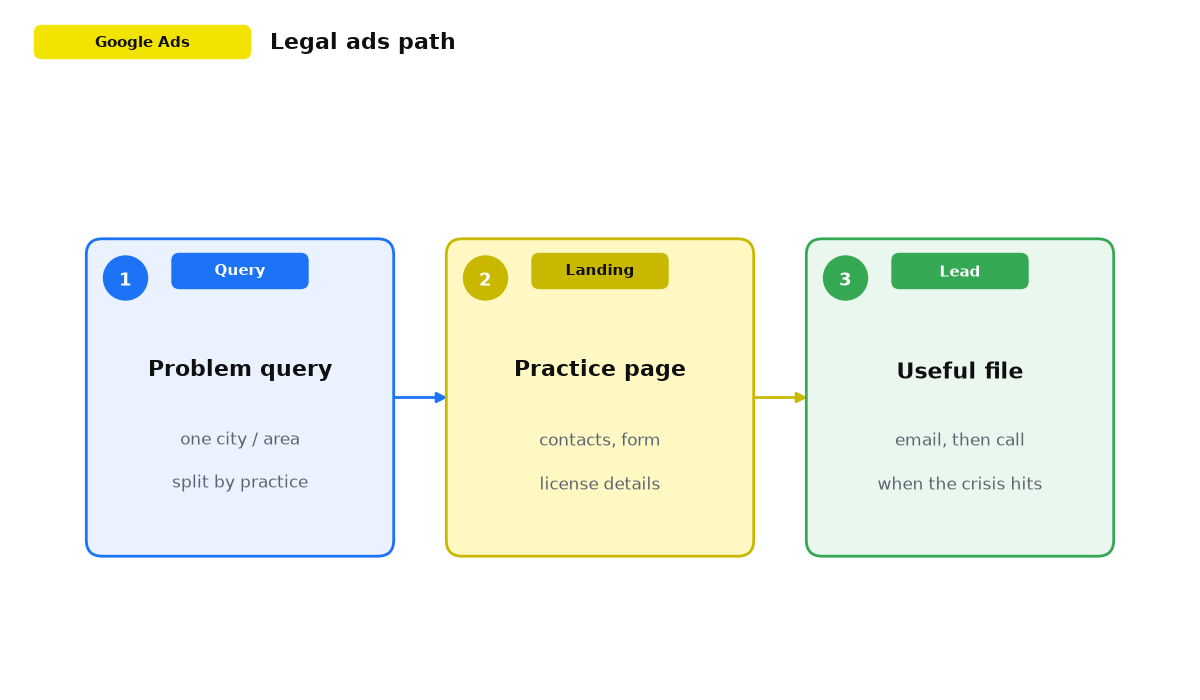
Ready-made ad copy brings clicks; bookings come from the whole chain up to the call. My e-book “19 Google Ads Secrets” shows how to get the most out of Google Ads without draining your budget, drawn from real campaigns and tests.
See the book →Where else a lawyer can find clients
One of the strongest ways to bring clients into a law firm, a practice, or an agency is social ads. A professional Facebook or Instagram account builds a personal brand. As an expert you can:
- give practical guidance;
- walk followers through new laws;
- explain hard points in plain language;
- invite people to events.
That grows trust in you as a specialist. You can also run targeted legal ads in social networks, join a community, and take part in the discussion.
Creative legal ads get remembered and pull more clients because they stand out. If you treat the ad as a piece of design, or you hire people who do, you get a stronger result.
These steps also help promote legal services:
- listing in local city directories;
- speaking at topical online webinars and offline events;
- partnerships with other businesses where a person may need a lawyer next;
- a call center that offers the services by phone.
A working strategy for attracting legal clients
Say you are a criminal lawyer. Your future clients are people who just ran into a legal problem. You can find some of them in Google Search with ads on those queries.
A person in that situation does not behave like a calm shopper. They may not search at all. It is much better if they already know you handle this kind of work and already have your number. People take in information better when they are calm than when they are in stress or feel they have no way out.
To set that up, prepare a lead magnet: a useful file that many people online will actually want. Put your contacts on it.
Lead magnets you can use to advertise legal services online
You know your field, so you know which information people need. A few examples of such a file for legal ads:
- 10 ways to avoid arrest.
- The most common reasons for an arrest.
- How to behave during a search.
- Legal reasons for a traffic stop.
- The 10 most important phone numbers if someone asks you for a bribe (contacts of anti-corruption departments in your country).
Make the file worth keeping:
- Use PDF or another clean format, and add strong images and infographics.
- Put a short ad for yourself or the firm on it: which legal services you offer, the logo, the phone number.
- Close with a line in this spirit: “If you run into trouble, reach out and we will help you handle the situation.”
People can take these files from your site for free if they leave an email or subscribe in a messenger. When a real legal crisis comes, they are likely to remember you first and ask for a consult. That is one way to grow a legal practice.
How to find clients and grow the flow into a law firm
Once you have a contact, remind the person that you exist. Split clients by what they asked about:
- criminal work;
- family law;
- economic crime;
- traffic and automotive matters, and so on.
If someone asked about cars, send a series such as “How to avoid traffic fines”.
It is better to build a separate lead magnet ad for each practice area. The person lands in a segment at the moment they download the file. TimeDigital CRM, SmartCentre, and similar tools can do that routing.
Takeaways on legal advertising
- For an attorney, job number one is to give future clients content they will remember when they need legal help.
- Your own brand in social networks, YouTube, the Display Network, and offline venues matters just as much.
- Retargeting is a solid way to bring a visitor back and improve the quality of the traffic.
- If the campaign is not working, the click is expensive, conversions are scarce, and you cannot bring clients to the lawyer, order an audit from a PPC specialist.