
Service business owners often copy advertising advice for online stores and wonder why it falls flat. Someone with toothache, a legal problem, or a need to book a therapist is not browsing a product catalogue and adding a service to a basket. They are looking for someone who can help, often nearby and often on their phone.
That changes how the campaign needs to work. Google Ads is one part of promoting a service online, and its job here is to turn relevant searches into calls and enquiries. Three things determine whether that path works.
Three foundations of advertising a service
Local intent
The customer wants a provider they can actually use, often one nearby.
Target your city or a realistic service radius, check the Presence location option, and use separate ad groups for searches containing a city name or “near me”.
An easy way to enquire
Someone dealing with a problem wants to contact you quickly.
Use a fast mobile page with clear buttons for calling or messaging.
Call and enquiry tracking
Service customers often call, complete a form, or send a message instead of paying on the website. If you do not measure those actions, a campaign can look unproductive even when it brings enquiries.
Track calls from ads and your website, record submitted forms, and send booking and payment outcomes from your CRM back to Google Ads.
How your mobile page loses enquiries
In the accounts I audit, the median mobile share of spend was 72%. That is a share of budget, not traffic. It is a reason to take the mobile page seriously, but not a reason to assume your account has the same split. Check your own device data: the balance varies between industries. For local services, a phone is often the screen on which an enquiry begins.
Speed is one practical factor you can check. In the data I analysed, higher mobile speed scores were associated with higher recorded conversion rates. That is an association, not proof that a speed improvement will produce a particular result for every business. Still, a polished design is little comfort if a prospective customer is waiting for the page to load before they can contact you.
Advertising across service industries
The foundations stay the same, but each industry has its own decision cycle, cost per enquiry, and search terms that can attract the wrong audience. Use the common framework, then check how it fits the service you actually sell.
The service areas covered in our industry guides include dentistry, therapy, legal services, medical services, and beauty salons. The practical question for each is the same: does the campaign connect a relevant search with a suitable provider and an easy way to make contact?
Where to start
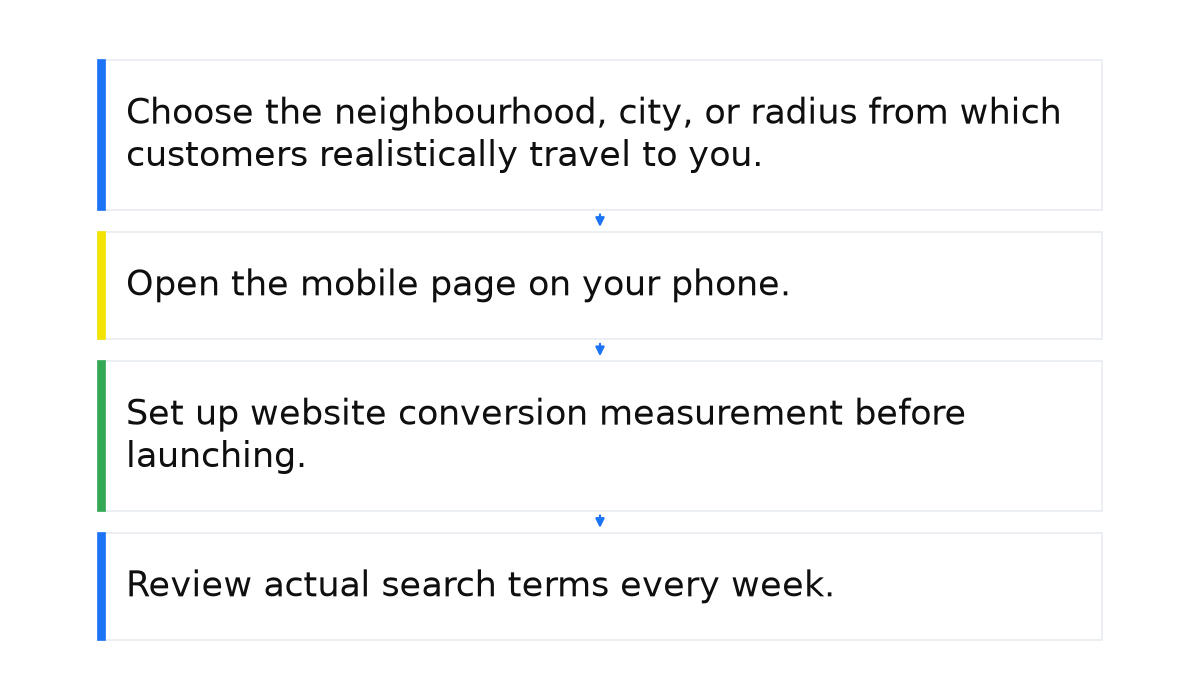
- Choose the neighbourhood, city, or radius from which customers realistically travel to you. Check your location options when setting geographic targeting, including the Presence setting.
- Open the mobile page on your phone. Check how quickly you can see the price and find a way to contact the business.
- Set up website conversion measurement before launching. Otherwise, some of the results may never reach your reports.
- Review actual search terms every week. Add clearly irrelevant phrases as negative keywords, but do not automatically exclude questions containing “how” or “why”.
In my free masterclass, I show the process of building a customer acquisition system for services, from the initial setup through to the enquiry.
Frequently asked questions
How much budget does a service campaign need?
A modest budget focused on a small area, combined with a quick response to enquiries, can outperform a larger budget spread across an entire city. The amount you need still depends on the cost per click, available search demand, and how many enquiries you want to generate.
Is Search or social media better for services?
Search advertising reaches people who are already looking for a solution. Social media can build awareness and demand before someone begins that search. If people already search for the service you offer, Search is usually the starting point.
Customers call, but Google Ads shows no conversions. Why?
A common reason is missing call tracking. The campaign brings enquiries, but the reports do not record them, leaving you to optimise without seeing the result. Set up measurement before launch, including tracking calls to a number on your website.
My conclusion
For a service business, precision matters more than a large budget or an attractive banner: reach the right area, provide a fast mobile page, and measure enquiries properly. Those foundations do not guarantee profitability. They reduce the risk of irrelevant spending and give Google Ads more reliable signals for optimisation. The details of your industry build on that foundation.
A student’s question: can one keyword be enough?
“We sell and install air conditioning. Our budget is 25,000 a month in local currency, our main keyword is ‘buy air conditioner’, and we pay 8.30 per click. Can we target just that one main keyword?”
You can. I see no reason why starting with one precise keyword would automatically be a mistake. The number of keywords does not make a campaign right or wrong, and you do not need to add dozens of variations just to make the campaign feel bigger.
But check whether other relevant terms describe the same buying intent. Being able to start with one keyword does not mean you should limit yourself to it forever. And remember that the budget and cost per click do not establish effectiveness on their own. The campaign’s results answer that question.
What should you check next?
If you suspect wasted spending, start with a Google Ads audit. If clicks are coming in but enquiries are not, work through the path from the search to the page and the contact action. If an agency or freelancer manages the account, review their work against the same foundations: relevant geography, a usable mobile page, and reliable measurement.
Industry case studies
Our industry case studies follow owners who set up advertising themselves and explain the mechanics behind their approach. They cover passenger transport, online auto parts stores, pools and heating equipment, mobile apps, online schools, and businesses operating abroad.
Further examples cover roofing, insect and rodent control, clothing manufacturing and fabric printing, yacht trips, and IT schools and programming courses. See also our guide to auto repair shop advertising. Use these business contexts to think through how the foundations apply to your own offer, rather than assuming every industry needs an identical campaign.
Once you have checked your service area, mobile page, and enquiry tracking, the next step is to bring them together into a working campaign. My free masterclass walks through that process so you can connect the setup to the enquiries your business needs.
Ready-made ad copy brings clicks; bookings come from the whole chain up to the call. My e-book “19 Google Ads Secrets” shows how to get the most out of Google Ads without draining your budget, drawn from real campaigns and tests.
See the book →