
A YouTube channel can help your business sell products and services, run workshops and build recognition. As your audience grows, it can also create opportunities for sponsorships, paid product promotion and monetization. The starting point is an audience that wants to watch your videos and come back for more.
How to get your first YouTube subscribers
Reaching your first 1,000 subscribers can be difficult. There are plenty of channels competing for attention, and a new creator has to give people a reason to choose theirs. I recommend building that audience through legitimate promotion from the beginning.
A small group of interested viewers is more useful than a large count of inactive accounts. Look at whether people watch, like, comment on and share your videos. The subscriber total alone does not tell you how much your audience values the channel.
The main paid approach is to promote a video that asks viewers to subscribe. Keep the channel focused on one area and publish regularly about different aspects of it. Your channel artwork should make the subject clear, so a new visitor can understand what future videos will offer.
Which videos help turn viewers into subscribers?
In-feed video ads are a format worth testing to attract viewers. In Google Ads, you can use a Video campaign with the Video views subtype. Check the available format settings while building the campaign; Google explains them in its Video views setup guide.
Review the videos already on your channel and start with the one that has the most organic views. Its subject, presentation and visual treatment have already attracted attention. You can add two more strong organic performers on closely related topics. Use organic performance for this selection, so previous advertising spend does not determine which video looks most popular.
Before you promote a video, prepare it for an audience that does not know you yet:
- Create an appealing thumbnail that communicates the topic.
- Write a title and description that attract interest. Include relevant keywords where they naturally describe the content.
- Use a short trailer or opening to explain what useful information viewers will get by staying to the end.
- Ask viewers to subscribe, share their opinion in the comments and turn on notifications. Include a subscription prompt in the description too.
- When you shoot, keep the presentation varied: change camera angles and add animation or helpful on-screen cues during editing.
You can make a worthwhile video on a phone if you have a good idea and know your subject. For a business that wants to publish consistently, I recommend setting up a recording space and investing in a camera, microphone and lighting. Prepare scripts and a content plan so that regular publishing is practical.
Give your channel’s search presentation some attention as well. Titles and tags should match the subjects you cover. You can revisit successful topics later, recording fresh versions that add detail and develop the ideas your audience already enjoys.
Working toward 1,000 subscribers on a small budget
You could start a test with a daily budget of $5 to $10. Treat that as an example of a testing budget, not the price of acquiring 1,000 subscribers. Set a daily budget to manage the pace of spending.
Review where your ads can appear. For this test, consider turning off delivery outside YouTube where network controls are available, and excluding TVs from the device settings. If your campaign offers frequency capping, you could test limiting delivery to one exposure per person per week or month.
Video views campaigns use cost-per-view bidding. Set the amount you consider acceptable as the bid for the ad group. A bid that is too low can restrict delivery; a higher bid can spend your budget quickly. See Google’s explanation of how CPV bidding works.
One bidding experiment is to start at $0.01, where the settings allow it, and gradually double the bid if the ads do not get impressions. Once the campaign is spending its daily budget and the bid is already above $0.01, you can cautiously test reductions of $0.01 per day. The aim is to balance delivery with an affordable cost per view. These amounts describe a test, not a universal bid for every channel.
Who should see your YouTube ads?
Decide who is likely to find the channel useful. You have several ways to approach audience selection.
- Demographics. Some channels serve a particular age group, parents, men or women. Reflect that focus in your targeting where relevant. If the information serves a broad audience, keep the demographic groups open.
- Interests and intent. Consider available audience segments interested in your topic or related subjects, such as cars, travel, cooking, beauty or sport. You can also consider people who are actively looking for the kinds of products or services you cover.
- Content. Where the campaign supports it, use keywords, topics or specific channels to guide ad placement. Look for a connection between what people are already watching and what your channel offers.
Other ways to grow your YouTube subscriber count
Advertising can support the other work you do to build an audience. Give people opportunities to discover the channel wherever they already interact with your business.
- Live streams. Live broadcasts let you talk directly to viewers, attract subscribers and, where supported, receive donations.
- Channel links. Add links to relevant website pages, Instagram and Facebook profiles, messaging channels and emails, including those you send through Gmail.
- Partnerships. Arrange mutual promotion with channels covering related subjects.
- Influencer advertising. Work with creators whose audience broadly matches the people you want to reach.
- Community activity. Use YouTube posts to share news and keep interested subscribers involved between videos.
- Participation on other channels. Follow creators in your field and leave useful comments on their videos. Thoughtful contributions can introduce you to people with similar interests.
What to focus on as your channel grows
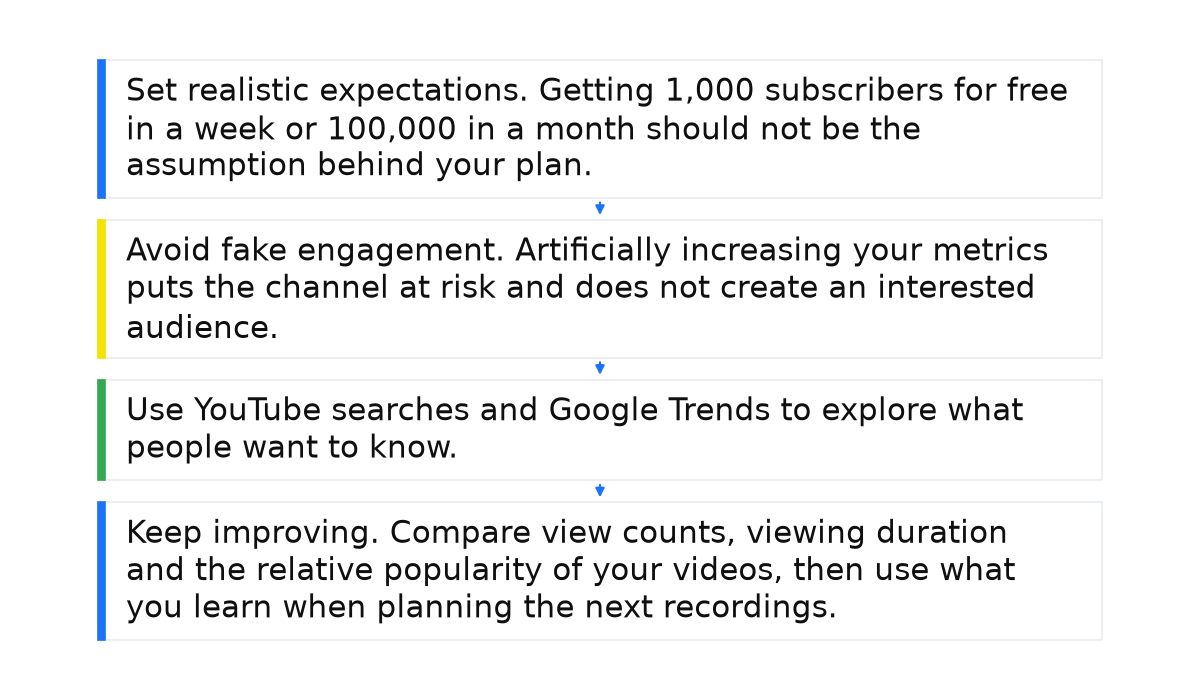
- Set realistic expectations. Getting 1,000 subscribers for free in a week or 100,000 in a month should not be the assumption behind your plan.
- Avoid fake engagement. Artificially increasing your metrics puts the channel at risk and does not create an interested audience.
- Use YouTube searches and Google Trends to explore what people want to know. Invest in useful information, engaging delivery and videos that give people a reason to return.
- Keep improving. Compare view counts, viewing duration and the relative popularity of your videos, then use what you learn when planning the next recordings.
When this does not apply. Advertising will not sustain growth if the channel lacks a clear focus, interesting videos or regular publishing. A low budget and a low bid do not secure subscriptions, and reaching 1,000 subscribers does not automatically unlock every monetization feature. You still need to meet the relevant YouTube Partner Program requirements.

Once you have a clear channel topic and videos ready to promote, bring the audience, bidding and budget decisions together in a manageable test. Learning how to use Google Ads will help you set up that test and understand the results for your own channel.
My e-book “19 Google Ads Secrets”: how to get the most out of Google Ads without draining your budget, drawn from real campaigns and tests.
See the book →