
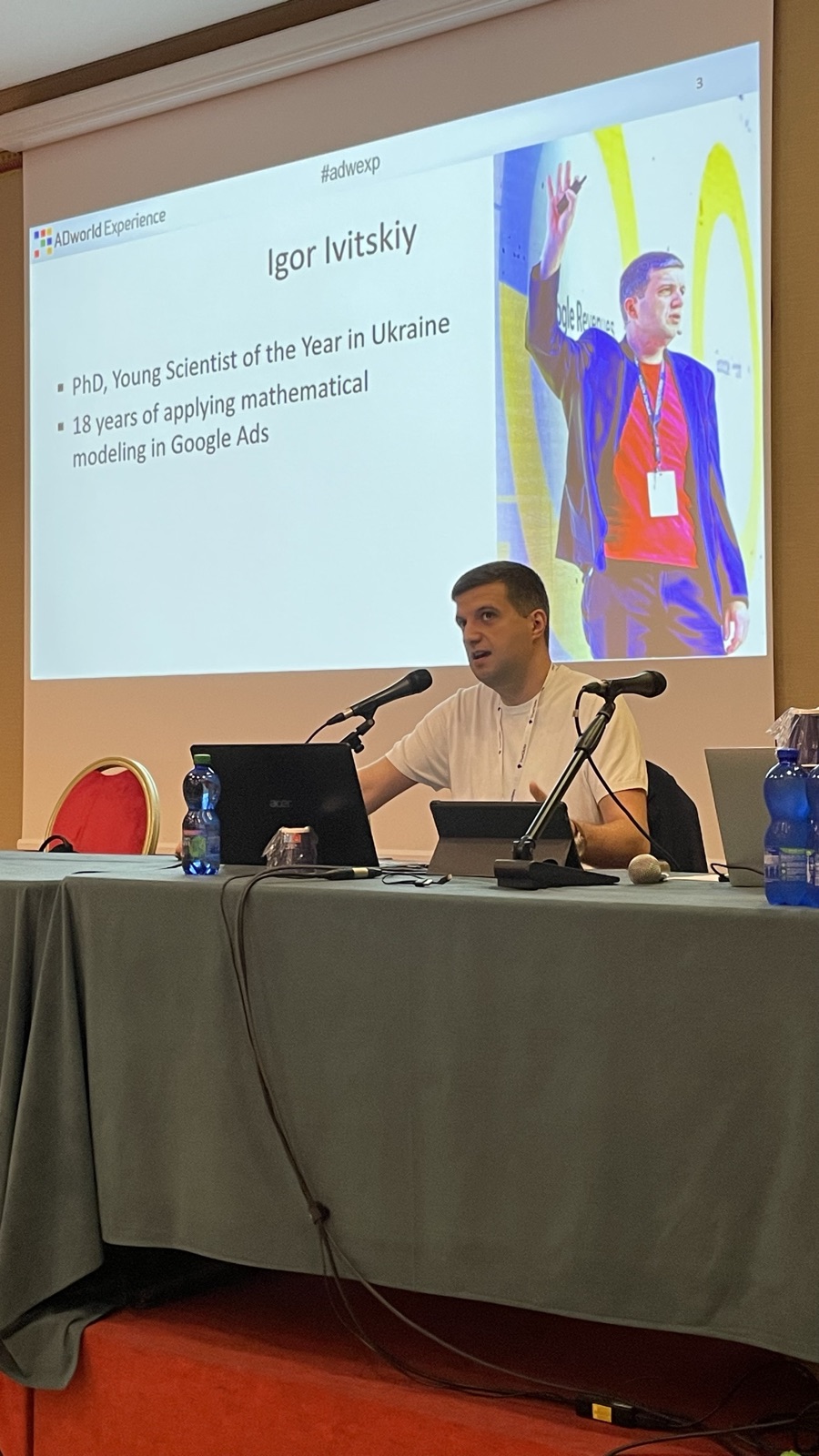
Adworld Experience 2024 took place in Bologna, Italy, on October 17-18, 2024. Igor presented this English-language PPC case at Europe’s largest conference of real PPC cases.
The case study, “30x Conversions for B2C SaaS Through In-Depth Keyword Research”, shows how word-level profitability analysis of search terms: n-grams, broad match and thousands of negative keywords, broke a two-year growth ceiling in one week. The speaker, Igor Ivitskiy, is a Google Ads expert and “The Google Ads Scientist”, a PhD mathematician who applies optimization science to Google & YouTube Ads.
How the n-gram method works
The starting hypothesis was that only a small fraction of potential users purposely search for services such as car-plate, phone-number or property-address reports, although the service can be useful to almost anyone. About 70% of search volume sits in the long tail: terms so rare that they barely show up in reports.
Instead of bidding on particular queries, Igor bid on the broad market and excluded irrelevant traffic with negative keywords. The analysis turns the search-term report into word-level profitability data, then uses the unprofitable words as negatives and the most profitable words as new broad-match keywords.
Export all search terms with their cost and profit data.
Break every term down into individual words, so each word becomes a unit of analysis.
For every word, total its contribution to cost and revenue, then sort by profitability.
Use unprofitable words as negatives, profitable words as broad-match keywords, then launch the broadest possible combinations.
How I filter negative keywords
I select negative keywords by money and by audience response, not by intuition. Spend and response determine whether a word stays, while the final decision follows the project’s overall profitability rather than the cosmetic appeal of any single metric.
This method works not as a one-off trick, but as a repeatable discipline of learning from the account’s own data. Our school’s free webinar is devoted to this same way of working.
My e-book “19 Google Ads Secrets”: how to get the most out of Google Ads without draining your budget, drawn from real campaigns and tests.
See the book →Key insights
- From 50 to 1,500 conversions per day in one week (30x). For two years, the client believed the market was capped at 50 conversions a day. Word-level profitability analysis broke that ceiling in the first iteration.
- 70% of the market hides in the long tail. Broad match reaches queries that appear too rarely to bid on directly; thousands of n-gram-derived negative keywords carve away the waste.
- The analysis is a monthly loop, not a one-off. Each month brings new search terms; another n-gram analysis keeps cutting CPA and growing conversions.
- Target CPA on broad match beat manual CPC on exact match in a head-to-head test inside the same account.
- Hands-on analysis reveals intent. Igor tried automated n-gram tools, but recommends working through the data in Excel for big budgets.
- Expensive products need financing. High-ticket items worked only with payments split into 12-18 instalments; without financing, they did not.
Key moments from the talk
The ceiling the client believed in
The case began with a B2C SaaS company selling information as a service: reports built from a car plate, phone number or property address. It had a mass-market product, yet for two years every agency, freelancer and in-house specialist had run into the same ceiling of 50 conversions a day. The client had come to treat that number as the natural size of the market. His request was therefore conservative: reduce the cost per conversion to 3-3.5 dollars and, if possible, add a few more conversions. Even the way the relationship started challenged that caution. An assistant had rejected the project as too small, but the client kept contacting Igor until they signed a contract. “Nobody ever said no before.” The remark mattered because the campaign that followed also began by refusing the client’s inherited assumption about what was possible.
Where the hidden demand was
The growth hypothesis came from a mismatch between usefulness and expressed demand. Only a small group deliberately searches for a service that checks a plate, phone number or address, although almost anyone could benefit from the answer. That left most demand hidden in three kinds of searches. The first came from people with implicit intent: someone researching car-sale scams before a purchase might need a vehicle-history report without naming that service. The second came from people who typed the data itself into Google, such as a particular plate or phone number. Every value created a unique query, so a conventional keyword list could never anticipate the whole market. The third came from people who did not know that such a service existed and therefore could not search for it directly. The strategic question was not how to win more of the small, obvious category, but how to reach all three without paying indefinitely for irrelevant traffic.
The method answered that question by changing the unit of the bet. Instead of bidding on selected queries one by one, the campaign bid on the broad market and used negative keywords to cut away waste. Those negatives were not chosen because a term looked strange or felt irrelevant. They came from the profitability of individual words across the project’s search traffic: spending and response supplied evidence, and total business profit decided what belonged. This made broad match a controlled way to discover demand rather than an invitation to buy everything Google could send. The distinction is important. The edge did not come from predicting the full range of rare queries in advance; it came from allowing the system to find them while a growing evidence-based exclusion layer protected the economics. The detailed spreadsheet procedure remains part of the talk, but the governing idea is simple: buy access to the wide market, then remove what the project’s own results identify as waste.
What the numbers changed
The change appeared within a week. Daily conversions rose from the supposedly immovable 50 to 1,500, a 30x increase, while both cost per click and cost per conversion fell. The long tail was cheaper because other advertisers were not bidding directly on those rare searches, and the negative-keyword layer kept the wider reach economically useful. The account was no longer limited to people who already knew the product category and used the expected language. It could meet latent intent, searches made from raw data and users discovering the service for the first time. After two years of failed attempts to cross the old ceiling, the client reduced the contrast to one question. “Yesterday there were 1,540 conversions. How did you do it?” The answer was not a larger bid on the old market, but a different definition of the market itself.
Several lessons survive the case. The analysis has to be repeated every month because new search terms continually reveal new negative keywords; the exclusion layer improves as the market supplies more evidence. In the same account, an automated target-CPA strategy on broad match beat manual bids on exact match, showing that tighter control at the query level did not guarantee a better business result. The larger data set then opened another level of optimization across audiences and demographics, including combinations of keywords, age, gender, household income and interests. Hands-on review also exposed intent that an automated report could conceal. “For big budgets I highly recommend working through the numbers yourself.” Finally, the method has a commercial boundary: expensive products worked only when financing divided the price into 12-18 payments. Broad reach can uncover demand, but it cannot remove the customer’s affordability constraint. Across all these lessons, the standard remains overall project profitability, not an isolated metric that merely looks efficient.
Full recording of this talk is part of our bonus pack for students.
Third-party traces
Key takeaways
The first iteration took the account from 50 to 1,500 conversions per day in one week.
Broad match found long-tail demand; n-gram negatives removed unprofitable traffic.
Repeating the analysis every month kept pushing CPA down and conversions up.