
Hero Conf took place in Brighton, United Kingdom, in April 2025, with this session delivered as a conference talk. The speaker was Igor Ivitskiy, a former mathematical-modelling scientist who moved into PPC and Google Ads.
“A Scientist’s Approach to PPC Optimisation” was about replacing borrowed best practices with account-level evidence. The talk connected scientific reasoning with practical PPC questions, from keyword research to bidding targets and campaign segmentation, without treating one account’s answer as a universal rule.
A scientific answer is local, not universal
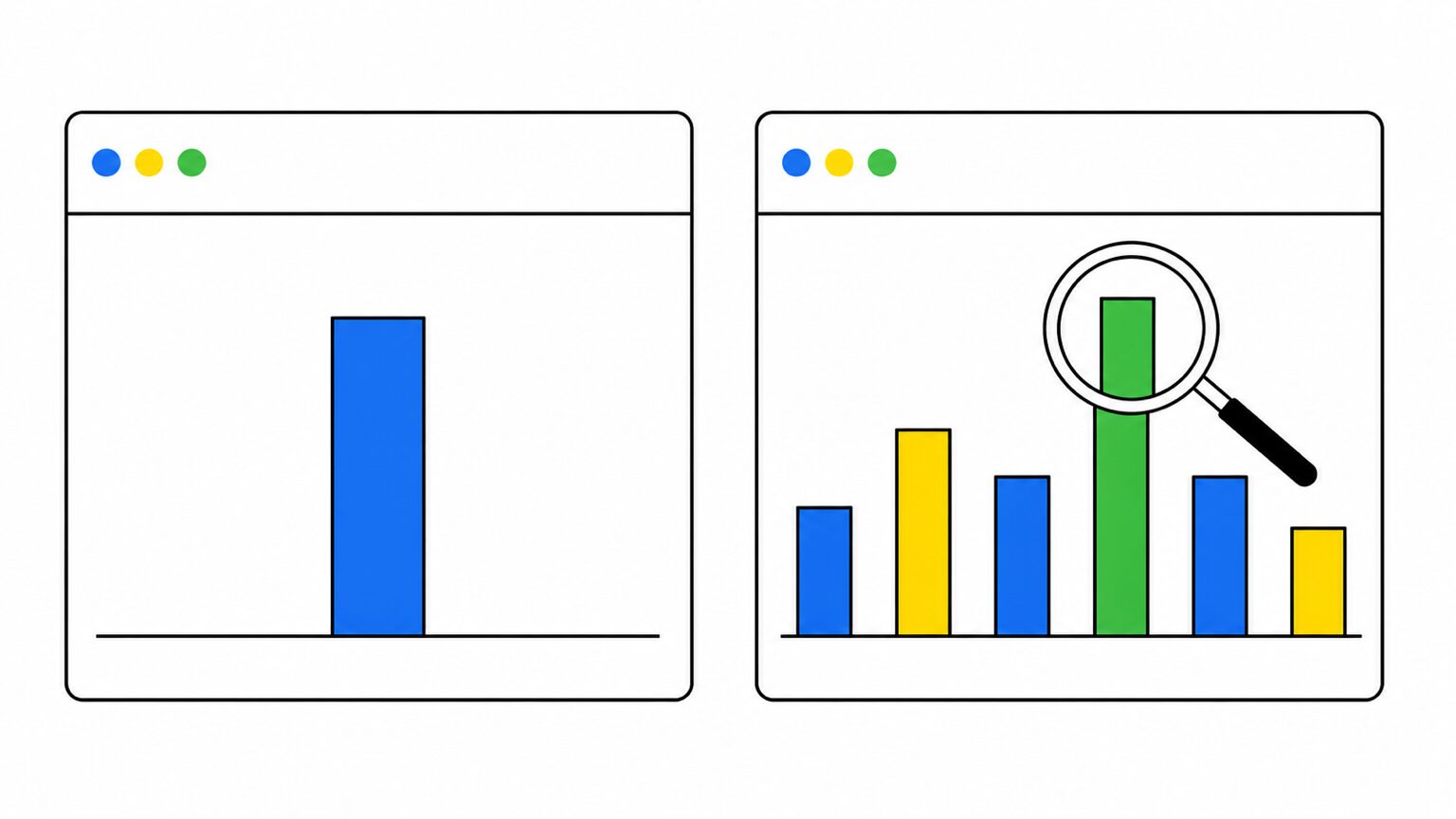
The talk began by challenging a familiar kind of slide: a large cross-account data set distilled into one recommended number. An average can mix countries, niches, business models, devices and price bands. Correlation can then be mistaken for causation, while the variables below the surface remain invisible. A benchmark may describe the sample and still fail to answer the decision facing one advertiser.
That distinction also applies to platform guidance. Google describes optimisation score as an estimate of how well an account is set to perform. Igor’s case showed why the score still needs a business test: after recommendations were applied, the account displayed a stronger score, but CPA was almost twice as high and ROAS almost twice as low. A platform signal and a commercial result are different measurements.
The alternative is not to reject automation or broad match by default. Google’s own explanation of Ad Strength presents it as feedback about an ad’s relevance, quality and diversity. The scientific stance is to treat that feedback as a hypothesis, then judge it against the account’s real profit. Igor had seen low-strength ads perform efficiently and found no dependable causal link between raising Ad Strength and raising business performance.
Binary choices should be resolved with evidence from the specific account, business and location.
The useful target is the one associated with the strongest profit, not the most comfortable-looking metric.
An unprofitable total may contain devices, locations or audiences with very different economics.
My standard for a useful PPC answer
I do not accept a setting because it is popular or because a platform rewards it with a stronger score. I look for the answer in the project’s own data and judge it by business profit.
This way of thinking also changes how practitioners approach negative keywords, bidding and campaign structure: each is a decision to validate, not a ritual to copy. The same evidence-first discipline is part of how our school teaches Google Ads.
A conference slot only fits the essentials. My e-book “19 Google Ads Secrets” shows how to get the most out of Google Ads without draining your budget, drawn from real campaigns and tests.
See the book →Key insights
- Averages can erase the decision context. Country, niche, device, match type and other hidden variables may explain the result behind one neat benchmark.
- Correlation is not causation. A better metric beside a changed setting does not prove that the setting produced the improvement.
- Platform scores are not business outcomes. In Igor’s case, applying recommendations improved the optimisation score while CPA nearly doubled and ROAS nearly halved.
- The right target is found on the profit curve. Revenue, conversion volume and a low CPA can each mislead when viewed without total profit.
- Segmentation can expose hidden profit. Breaking down one campaign by meaningful dimensions revealed a 290% ROAS segment inside an 85% overall result.
Key moments from the talk
Why polished benchmarks can mislead
Igor framed the talk through an unusual career transition. He trained as a scientist, earned a PhD in mathematics and worked on computational models for non-Newtonian fluid dynamics before moving into marketing. His first encounter with Google Ads came much earlier, in 2006, when he was trying to sell game-related products through a tiny online shop. The initial attempt lost money, and his immediate conclusion was that Google Ads did not work. A book by Perry Marshall helped him make a successful second attempt. That contrast became the origin of the talk’s central question: was the channel broken, or had one experiment produced a poor answer? Eighteen years of work and a reported $700 million in spend across accounts gave Igor a large evidence base, but he did not present that experience as a universal formula. He used it to argue for a better way of asking questions.
The first target was the confident benchmark slide. A claim about the ideal number of responsive-search-ad headlines can be built from a great deal of data and still be useless for a particular account. Igor illustrated the average problem with a joke about combining his net worth with that of a famous billionaire: the arithmetic can make both people look like multibillionaires while describing neither of them. He then separated correlation from causation and introduced the iceberg effect. Device, keyword insertion, match type, pinned headlines and other conditions may sit below a single reported number. Once those variables disappear, a tidy recommendation invites imitation without explaining what caused the outcome. His alternative was memorable: “Learn how to fish your own answers from your own data.”
Three principles instead of a list of settings
The first principle concerns binary choices. Search partners, automated options and creative settings are often discussed as permanent yes-or-no rules. Igor had projects where search partners produced the strongest return, even though common advice was to switch them off. His point was not that the option should always remain enabled. It was that an account, business and location can produce an answer that generic advice cannot. The optimisation-score case sharpened the distinction. Before platform recommendations, CPA was about $26. After the recommendations, the score looked excellent, yet CPA was almost twice as high and ROAS almost twice as low. The dashboard celebrated the account while its economics deteriorated. The same caution applied to creative diagnostics: “Ad strength is not equal to ad success.”
The second principle concerns continuous values such as a campaign target. Owners often test one affordable point, jump to a much higher point, see profit disappear and conclude that the original limit was correct. The talk showed a real campaign curve where the strongest profit sat between the two extremes. Igor described a scientific search method for narrowing that range, but the transferable idea is simpler than its procedure: measure profit at meaningful alternatives instead of treating one failed jump as the shape of the whole market. This also changes the meaning of scale. A broader market may cost more to reach, so the lowest CPA is not automatically the most profitable position. More conversions at a higher acquisition cost can produce more total profit, but only the business’s own measurements can establish that relationship.
The profit hidden inside an average
The final case made segmentation concrete. At the total level, a campaign showed 85% ROAS and looked like a candidate to stop. Its traffic did not behave as one market, however. Performance differed sharply by device; two US states absorbed a large share of spend without comparable results; and an observed search audience performed better than the rest. Looking across those dimensions exposed a profitable slice with 290% ROAS. The lesson was not a reusable list of exclusions or a fixed audience setting, because those belonged to one account. It was a warning against letting the total make the decision before inspecting the parts. Segmentation can reveal that the campaign diagnosis is wrong even when the aggregate calculation is correct. Igor closed the idea in five words: “Never trust the overall ROAS.”
The full recording of this talk is included in the bonus pack for students.
Third-party traces
Key takeaways
Borrowed benchmarks are hypotheses until the account’s own data confirms them.
Profit, not a platform score or an isolated efficiency metric, decides which value is useful.
Segmentation revealed 290% ROAS inside a campaign whose overall result was 85%.