
Manual CPC was once the main bidding tool for many advertising specialists. They adjusted click bids themselves and achieved good results through close attention to their campaigns. As a business owner, you need to understand both the value of that control and the time it takes to exercise it.
Why manual bidding can still be useful
Automated bidding reduces the work involved in managing individual bids. That does not make manual control irrelevant. Manual CPC can still be useful when someone is willing to examine performance closely and keep testing their decisions.
Selecting a manual strategy does not automatically improve the campaign. Any advantage comes from the work behind it: studying the numbers, adjusting bids and checking what happened afterwards. The approach offers several practical benefits:
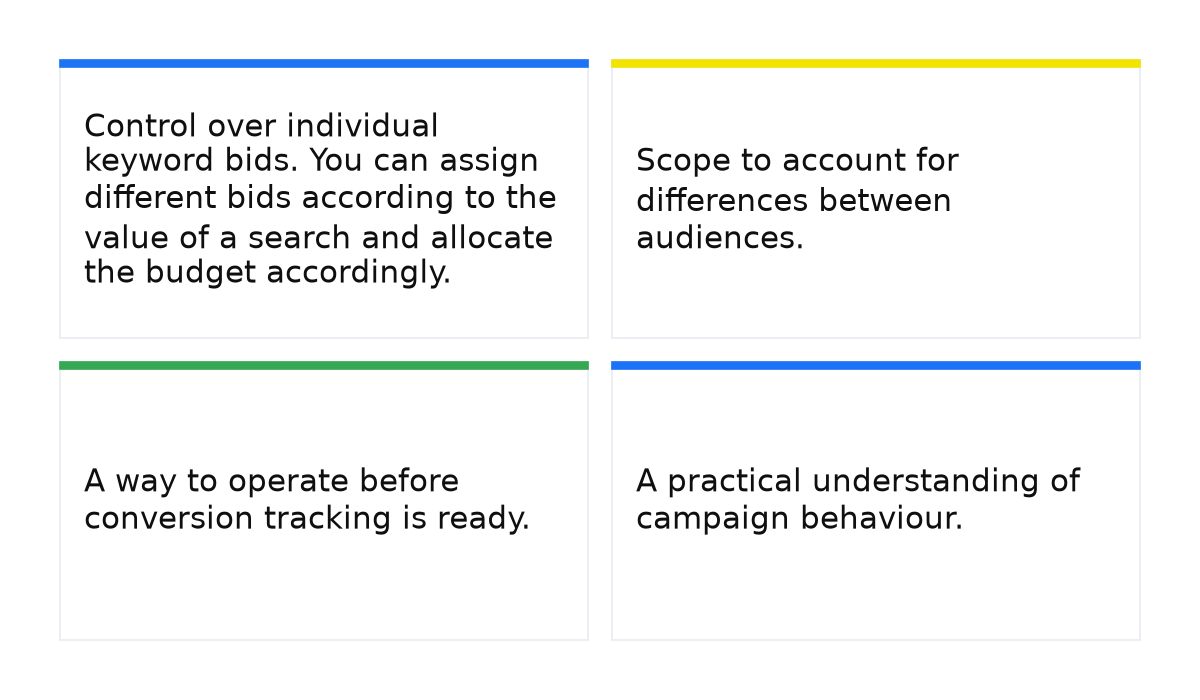
- Control over individual keyword bids. You can assign different bids according to the value of a search and allocate the budget accordingly.
- Scope to account for differences between audiences. Location, age, gender and previous website visits can inform decisions. Household income can also be relevant where that targeting is available.
- A way to operate before conversion tracking is ready. Manual bidding can be a temporary option while you fix measurement. Bidding focused on conversions needs reliable information about those conversions.
- A practical understanding of campaign behaviour. The specialist analyses results, makes adjustments, receives feedback and checks the next assumption.
When you compare campaign results with the time spent managing them, automation often becomes the more attractive option. A business has to account for the daily work required to maintain performance, as well as the cost of the clicks themselves.
How Manual CPC bidding works
You set bids yourself, including separate bids for individual keywords. For example, you might assign $1.50 to one keyword, $2 to another and $0.50 to a third. These figures illustrate the approach; they are not recommended prices for your market.
When I set bids manually
I use Manual CPC as a measurement tool when I want to test how segments with different intentions enter the auction under explicit constraints. I base the bidding logic on the value of that intent, rather than a desire to secure the same position for every segment. I frame each adjustment as a hypothesis. Manual management ends when it stops answering a new question and becomes routine.
The basic settings are explained in Google’s Manual CPC guidance. A bid specifies your maximum cost per click, while bid adjustments can change it under particular conditions.
Bid adjustments let you raise or lower a base bid for particular groups. For example:
- By device. You could bid more for mobile devices and less for computers if performance supports that decision.
- By audience. Age, gender or interests may inform adjustments where the relevant settings are available. An example would be increasing a bid for a younger audience by 20%, or reducing it for people aged 65 and over by 30%. Those are illustrations of adjustments, not a general recommendation about the value of different age groups.
Early in an advertising project, this work can help reveal what affects visitor behaviour. The findings can extend beyond bidding: you might discover that the mobile experience or the website itself needs improvement. One benefit of manual analysis is the broader view it can give you of the business’s marketing.
Recommendations for using manual bidding
Manual bidding takes time and a clear reason for each change. If you lack the time or expertise, I recommend considering automated bidding with a target cost per acquisition, or target CPA. Check that conversions are tracked correctly before making the switch. If measurement is not ready, you can stay on manual bidding temporarily, fix the tracking and then introduce bidding focused on conversions.
Bidding strategy guide
| Strategy topic |
|---|
| Google Ads bidding strategies |
| Automated bidding strategies |
| Manual CPC bidding |
| Maximize Conversions |
| Target CPA |
| Target Impression Share |
| Maximize Clicks |
When this does not apply. Manual CPC is a poor fit for a campaign that nobody has time to review. The ability to change bids is not an advantage unless someone analyses results and tests the reasoning behind those changes. It also does not replace conversion tracking: without that measurement, it is difficult to tell whether clicks lead to the actions your business needs.
Knowing when to keep manual control and when to automate starts with understanding the relationship between clicks, conversions and cost. That is a practical foundation for learning to manage Google Ads for your business.
Bid strategies work when the algorithm has the right goal and limits. My e-book “19 Google Ads Secrets” shows how to get the most out of Google Ads without draining your budget, drawn from real campaigns and tests.
See the book →