
Think of Target Impression Share in Google Ads as the peacock of bidding strategies: it wants to be noticed. For a business owner, the question is whether being more visible serves the campaign’s purpose and justifies the cost.
How Target Impression Share works
You choose the impression share you want and where you want your ad to appear. For example, you might aim to appear among the top ads in 90% of the opportunities available to your ad. Google then sets bids towards that goal. The percentage is a target, not a promised outcome, as explained in Google’s guidance on Target Impression Share.
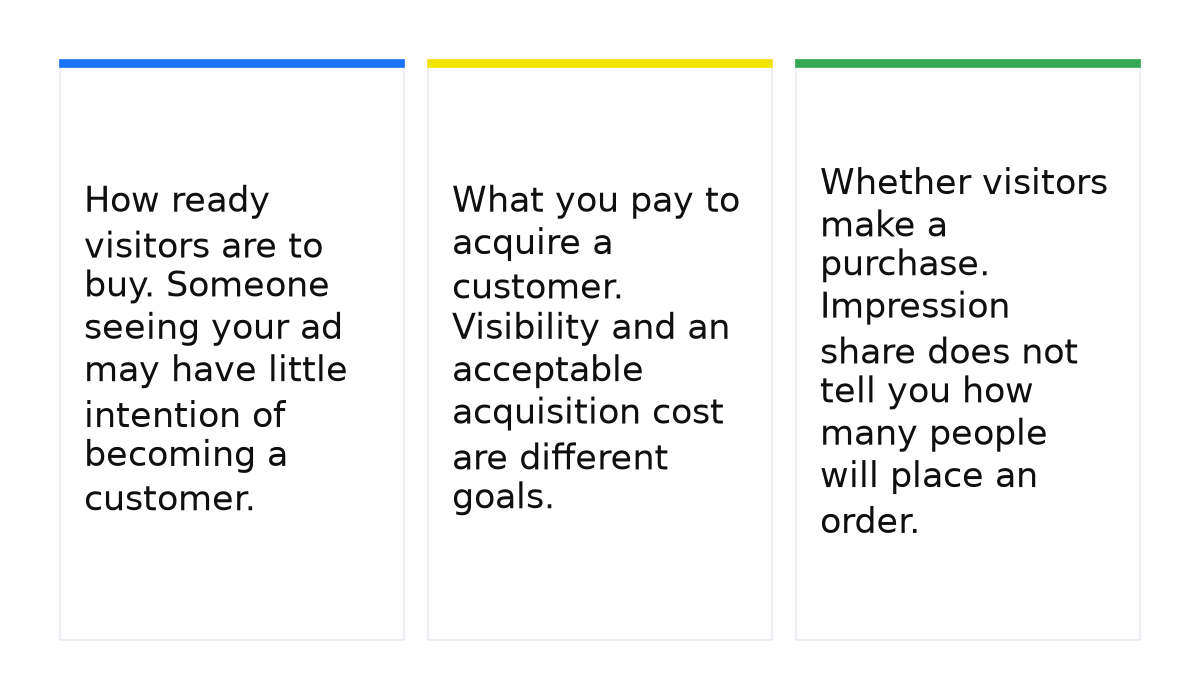
Choosing this strategy does not give Google a target for:
- How ready visitors are to buy. Someone seeing your ad may have little intention of becoming a customer.
- What you pay to acquire a customer. Visibility and an acceptable acquisition cost are different goals.
- Whether visitors make a purchase. Impression share does not tell you how many people will place an order.
Your audience can therefore include people who are not ready or able to buy. A visibility goal does not, by itself, filter out those visits. A campaign can attract plenty of attention without producing enough business to justify the spend.
Why clicks do not always become purchases
Consider the search “BMW price”. The person typing it could be:
- A curious teenager with no intention of buying a car for years.
- Someone comparing car brands who is still exploring the options.
- A buyer with the money ready who has sold their previous car and plans to buy a BMW within days.
The same search can represent very different levels of commercial intent. Bidding towards a target cost per acquisition, or target CPA, focuses on conversions. Bidding towards a target return on ad spend, or target ROAS, focuses on conversion value relative to spend. Target Impression Share has a different objective: getting the ad seen.
Maximize Clicks deserves the same caution. A large number of visits does not establish that those visits are valuable. If sales are the priority, do not judge the campaign only by its visibility or traffic.
When Target Impression Share can make sense
Some campaigns put building a market presence ahead of immediate acquisition efficiency. A new brand may want prospective customers to see it alongside established competitors. The owner may be willing to accept expensive clicks and conversions while working towards that visibility.
Example 1: launching a pizza delivery business
Imagine an established pizza delivery company dominates your local market, and you have just opened a competing business. You want people to discover your company and consider it alongside the familiar name. You are prepared to invest heavily in that awareness, even if the early clicks and orders are expensive.
Target Impression Share can support the effort to get noticed. You need a budget that matches that ambition. Appearing prominently in search is one part of competing for customers; it does not make the business a market leader on its own.
Example 2: an urgent service
Another possible use is a service that people choose quickly because they need an immediate solution. They may have little time for a lengthy comparison of providers.
Someone searching for a towing service, for instance, may click the first suitable ad to get help quickly. A prominent position can have practical value in that situation. Urgency does not mean the customer is indifferent to service quality, though, and a click is still not a confirmed booking.
What to monitor with Target Impression Share
Watch the searches that trigger your ads. When visibility is the objective, it is particularly risky to treat every impression as useful. A pizza delivery business needs to distinguish ordering intent from other searches around food, such as:
- “pizza recipe”;
- “how to make pizza at home”;
- “sushi delivery”.
These are examples to assess for relevance if they appear in your traffic. Keep control of keywords, match types and audiences so the budget supports the service you actually sell. Automated bidding does not remove the need to check whether the campaign is reaching suitable prospects.
The business decision
Consider Target Impression Share when you want a stronger presence in a market and can fund that objective. If your priority is acquisition cost or return on ad spend, consider bidding towards those outcomes instead. Start with the result your business needs, rather than the desire to see your ad above everyone else’s.
Bidding strategy guide
| Strategy topic |
|---|
| Google Ads bidding strategies |
| Automated bidding strategies |
| Manual CPC bidding |
| Maximize Conversions |
| Target CPA |
| Target Impression Share |
| Maximize Clicks |
When this does not apply. If you need leads at an acceptable cost and cannot afford to pursue visibility as a separate goal, Target Impression Share does not match your main objective. It also cannot solve irrelevant search traffic or turn every visitor into a buyer.

Choosing the right bidding strategy means connecting campaign settings to the cost of acquiring customers. That connection is a useful starting point for learning how to manage Google Ads for your business.
Bid strategies work when the algorithm has the right goal and limits. My e-book “19 Google Ads Secrets” shows how to get the most out of Google Ads without draining your budget, drawn from real campaigns and tests.
See the book →