
“Misrepresentation” in Google Ads is not a slap for one clumsy headline. It is the policy that bars ads and landing pages which hide or twist facts about the business, product, or service.
The same word in an email can mean a disapproved ad, or an account that is already suspended. If delivery has stopped across the account, start with what a Google Ads suspension means and what to do, then return to the section below.
What it means
Google’s Misrepresentation policy is one page with ten sections. Translations do not change the rules: English is the official version used for enforcement.
- Unacceptable business practices
- Coordinated deceptive practices
- Misleading representation
- Dishonest pricing practices
- Clickbait ads
- Misleading ad design
- Manipulated media
- Unreliable claims
- Unclear relevance
- Unavailable offers
A service business usually hits the everyday sections: the price in the ad does not match the page, the advertised offer is missing, or the headline promises a result the page does not support. That is still “Misrepresentation”.
What is at stake
| Section named in the email | What Google does |
|---|---|
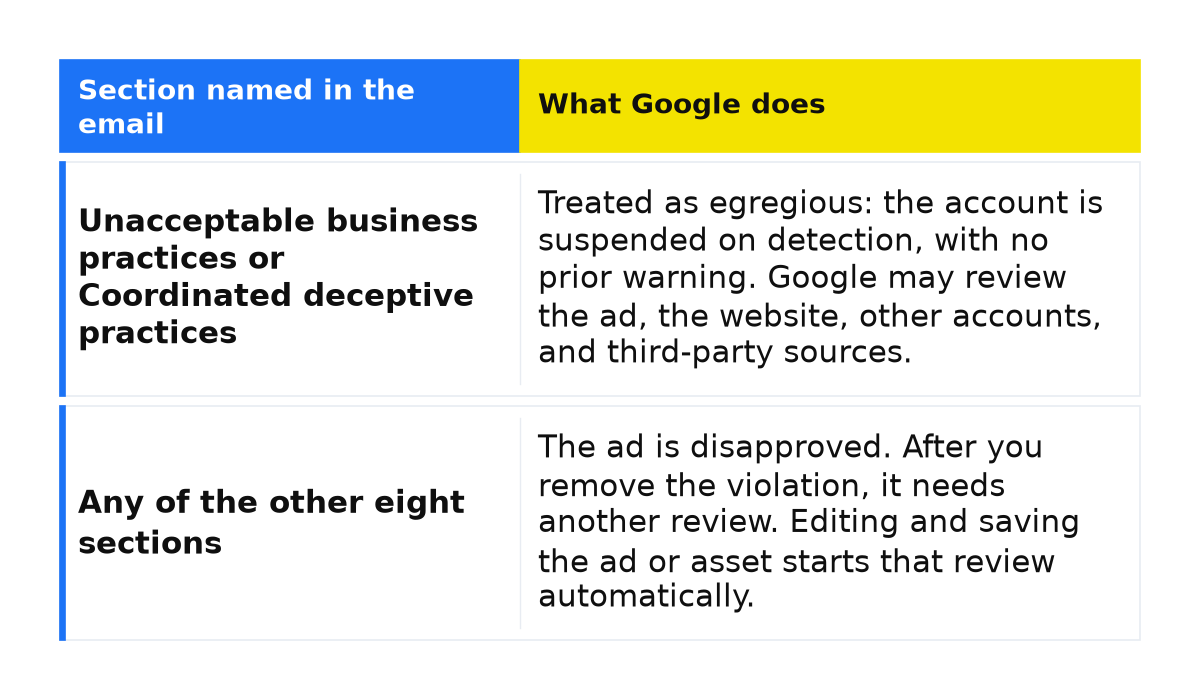
| Unacceptable business practices or Coordinated deceptive practices | Treated as egregious: the account is suspended on detection, with no prior warning. Google may review the ad, the website, other accounts, and third-party sources. |
| Any of the other eight sections | The ad is disapproved. After you remove the violation, it needs another review. Editing and saving the ad or asset starts that review automatically. |
An egregious violation is unlawful or poses significant harm to users. That is why the first two sections are treated separately: this is not “edit the copy”. I cover “Unacceptable business practices” on its own page, because you fix the practice and the site, not a headline: Unacceptable business practices in Google Ads.
For repeated ordinary violations, Google sends a warning with the issue and the remedy at least 7 days before a suspension. The first two sections do not get that window.
What to do
- Write down the exact section name. Open Ads, hover “Disapproved” in the Status column, and select “Read the policy”. The same detail is in Policy manager and in the email behind “View and fix policy issues”.
- If the account is already suspended. Complete advertiser verification first if Google asks for it; after 3 failed verification attempts, the appeal path is closed. In the notice at the top, select “Contact Us” and complete the appeal form. While under review, the account shows “Appeal pending”. The outcome arrives by email. Submit one appeal at a time. If the appeal is rejected, you can file again the same way.
- If only the ad is disapproved. Fix the violation in the asset, the ad, or the landing page. If you change the ad or asset, open it in Google Ads and select Save: that starts an automatic re-review. If you only fixed the landing page, appeal the ad. Both routes are in how to fix a disapproved ad or appeal a policy decision.
- Appealing a disapproved ad. Each ad gets 3 appeals. After three unsuccessful appeals on that ad, only support remains. Wait at least 24 hours between appeals on the same ads, or they count as duplicates. A bulk account appeal takes longer. Starting July 21, 2026, decisions older than 6 months can be appealed only through support.
- If an ad appeal was rejected or marked as a duplicate. First remove the violation. If that is already done, do not resubmit the same form. Make a small change to the ad text or the final URL and save, so the system scans again.
What not to do
- Do not open a new account in a friend’s name. Related accounts can be suspended with the old one, and the cause stays on the website.
- Do not file several account-suspension appeals at once. Abuse of those appeals pauses processing for 7 days.
- Do not send an apology instead of fixing the cause. Accounts are reinstated only in compelling circumstances.
- Do not leave a promise in the ad that the landing page does not keep: unavailable offers and mismatches between the ad and the page are sections of this policy.
When this does not apply
This walkthrough is not about the “Circumventing systems” line: that is a different policy, see ads disapproved for circumventing systems. It is also not about “Eligible (limited)”: the ad then complies with the policies but is limited by location, age, or device. “Coordinated deceptive practices” covers political, social, or public-concern content and hiding your country of origin, not a typical service-price mismatch.
If the status still does not move after these steps, we can look at the account: which section the email names, and whether the cause is on the site or in the ad.
My e-book “19 Google Ads Secrets”: how to get the most out of Google Ads without draining your budget, drawn from real campaigns and tests.
See the book →Questions and answers
Why was the ad disapproved if the account is still live?
Because one of the eight sections that are not marked egregious was applied. Google then stops that ad, not the whole account. Immediate suspension without warning applies only to “Unacceptable business practices” and “Coordinated deceptive practices”.
Is this the same as “Unacceptable business practices”?
No. “Unacceptable business practices” is one of ten sections inside “Misrepresentation”, and one of the two treated as egregious. If the email only shows the parent policy name, open Policy manager and find the subsection. That tells you whether you are editing an ad or recovering the account.
How long does an appeal take?
Google does not publish a review time in days. While a suspension appeal is open, the account shows “Appeal pending”, and the result arrives by email. For a disapproved ad, watch the appeal status in the Status column or in Policy manager.