
Adworld Experience 2025 took place in Bologna, Italy, on October 2 and 3, 2025; this was an English-language, 27-minute conference talk. The speaker was Igor Ivitskiy, a PhD and Google Ads practitioner who tests acquisition systems across information businesses and B2C SaaS.
The talk, “YT In-Stream Ads & Quality Leads,” examined what changed when Google began moving Video Action Campaigns to Demand Gen. Instead of treating YouTube as an isolated media-buying problem, Igor connected the ad to the page, the conversion signal and the revenue behind each lead. It is a different acquisition context from conventional keyword research for Google Ads: the viewer did not ask to see the offer, so every transition has to earn the next moment of attention.
Quality is a system property
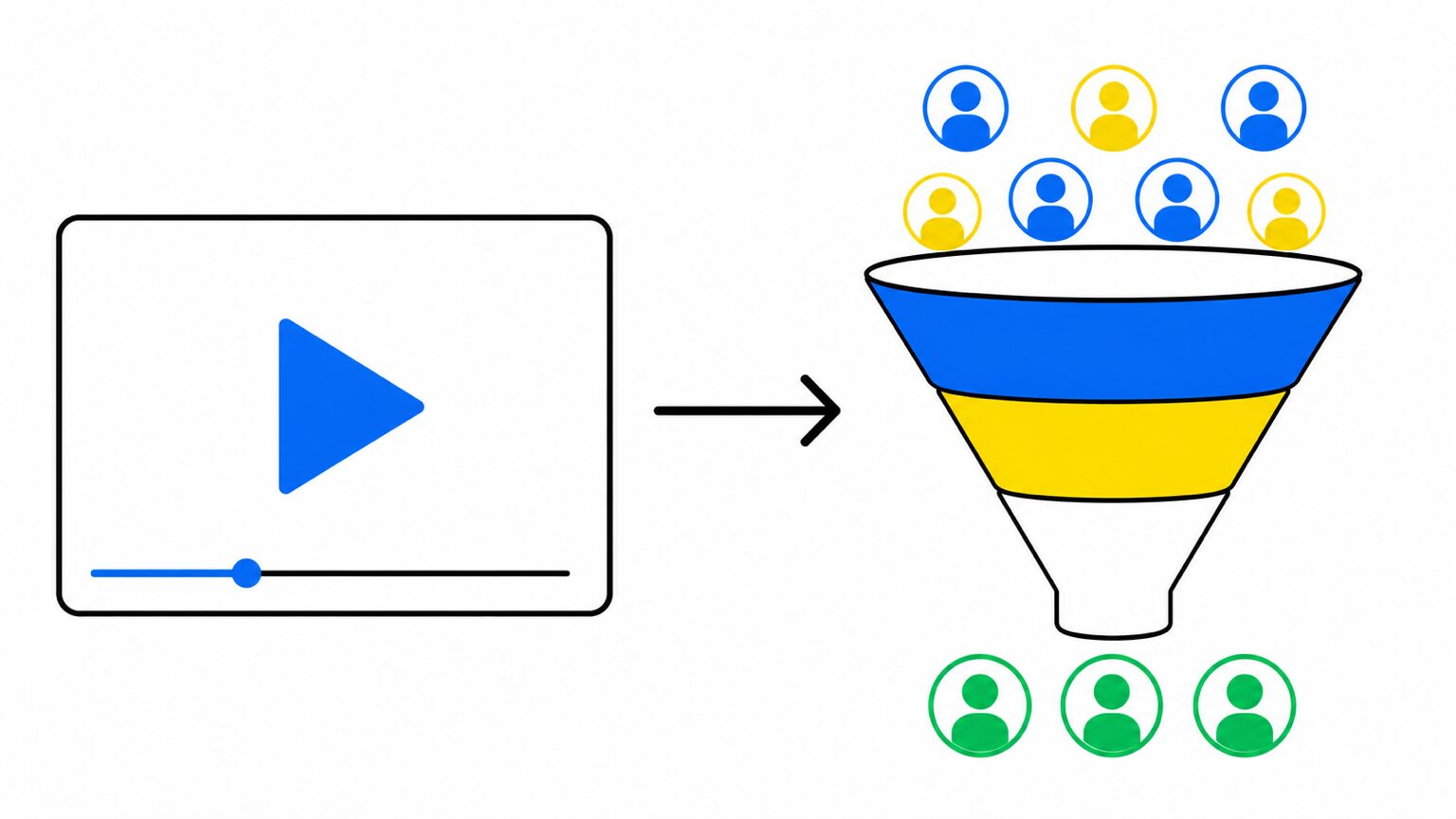
The main idea was simple: an in-stream campaign cannot be judged by the ad account alone. A person is interrupted while watching something else, lands without the intent of a search visitor and may submit a form before becoming a valuable customer. The ad, landing page and campaign therefore have to preserve one promise while removing reasons to disengage.
This logic resembles the discipline behind broad match, but the signals are different. Demand Gen can serve across several Google surfaces, including YouTube, Discover and Gmail, as described in the official campaign overview. The account needs enough separation to show what is working, yet enough data for the algorithm to learn. Structure is useful only when it improves that feedback.
Lead quality was the governing metric. Igor compared what leads eventually paid, not merely whether a form was submitted. That distinction also explains his attention to fake leads and poor placements: bad conversions do more than waste budget, because they teach the bidding system to find more of the wrong behavior. The placement exclusions play a role similar to an evidence-based negative-keyword discipline, while the final decision still belongs to business economics.
The landing experience continues the promise, establishes trust and protects the conversion signal.
The video earns attention, communicates the core idea early and remains coherent with the destination.
The account separates meaningful variables and gives optimization a cleaner view of performance.
How I judge lead quality
I do not stop at the form submission. I compare leads through the back end of the product and look at how much value they actually create. A cheaper lead is not better if the revenue data says otherwise.
This systems view also shapes how Google Ads is taught in the school: metrics are read in context, while the detailed operating procedure is reserved for practical learning materials.
A conference slot only fits the essentials. My e-book “19 Google Ads Secrets” shows how to get the most out of Google Ads without draining your budget, drawn from real campaigns and tests.
See the book →Key insights
- About $1.5 million went into the test base. The framework came from six months of client A/B tests after the move away from Video Action Campaigns.
- The landing page is part of the media system. In-stream traffic begins with interruption, so continuity, trust and low friction matter before campaign optimization can help.
- A form submission is not the final quality signal. Igor compared leads by downstream value and treated fake submissions as both wasted spend and contaminated training data.
- Creative and architecture solve different problems. The video holds attention; the account structure makes differences between regions, audiences, placements and ideas easier to interpret.
- Small mismatches can weaken the whole system. A strong ad cannot compensate indefinitely for an unrelated page, a distorted conversion loop or mixed campaign signals.
Key moments from the talk
When the old playbook stopped working
Igor opened with a change that had unsettled his own accounts. Video Action Campaigns had been his preferred format across many clients and niches. When their role was taken over by Demand Gen, his early in-stream results deteriorated: campaigns consumed budget without producing the lead performance he expected. He said the experience was shared by advertisers around him, and many responded by putting YouTube aside in favor of Facebook and Instagram. The important point was not nostalgia for a retired campaign type. A familiar system had changed, and carrying its assumptions into the new one no longer produced the same outcome.
The response was sustained experimentation rather than a single rescue tactic. Over the following six months, Igor ran repeated A/B tests with approximately $1.5 million of client spend. He compressed what survived those tests into 27 ideas for a 27-minute session, organized around a conversion machine, a creative system and campaign architecture. He described the framework as something that could “save you time, money and your neighbor’s nervous system.” The joke captured the practical pressure behind the work: a campaign transition affects budgets, client confidence and the team trying to explain unstable results.
The conversion begins after an interruption
The first pillar moved attention outside the Google Ads interface. “Remember that in-stream ads interrupt the user’s interaction with YouTube,” Igor told the room. A search visitor has expressed a need, but an in-stream viewer was watching something else moments earlier. That makes the first screen of the landing page part of the same attention event as the video. If the promise, visual language or offer suddenly changes, the viewer has to re-evaluate what happened just as the ad asks for action. Continuity reduces that cognitive break; visible credibility and a simple path forward help the person decide whether the interruption deserves more attention.
The same reasoning shaped the rest of the page. Igor argued that prospects need to understand why an offer can work for them, not receive a technical tour of how the product is assembled. He also connected page design with lead integrity. Once Demand Gen began producing more conversions, some accounts attracted bots, invalid contact details and low-value submissions. Those entries were not harmless noise. If they returned to the platform as successful conversions, optimization learned from a false definition of success. Protection therefore belonged inside the conversion machine, together with the page and measurement, rather than being treated as cleanup after the campaign had run.
Why the three pillars have to work together
The creative pillar addressed attention at three levels: the argument of the video, its visual rhythm and the small production choices that affect delivery. Igor favored a direct human presence, but stressed that a talking head still needs visual movement and a clear connection to the next action. He also showed why creative work cannot end at the exported file. The way a video appears on YouTube and the language inside it can affect presentation and moderation. These details were not offered as a magic script. Their purpose was to keep a sound offer from losing reach or comprehension through avoidable friction.
Campaign architecture then gave those creative and conversion signals somewhere intelligible to accumulate. Igor compared different ways to separate markets, languages, placements, audiences and creative concepts. His strategic criterion was legibility: if unlike conditions are mixed together, an average CPA can hide which combination created value. One observation made the danger concrete. In his tests, iOS traffic could show a higher CPA while producing a better return on ad spend, which he linked to missing browser data. A surface metric made the segment look weaker, while back-end revenue told a different story. That is why he judged YouTube leads by what they paid after acquisition and reported them as his highest-quality leads.
The final message was about coordination, not complexity for its own sake. “Success in Google Ads means creating and fine-tuning a system, not only one element,” Igor said. The landing page defines and protects the conversion, the creative earns enough attention to reach it, and the campaign structure helps the platform learn from meaningful distinctions. Remove one connection and even a strong component can optimize the wrong outcome. The full recording of this talk is included in the bonus pack for students.
Third-party traces
Key takeaways
Six months and about $1.5 million in tests turned a difficult campaign transition into a three-pillar framework.
Quality emerged when the page, creative, measurement and campaign structure all taught the system the same definition of a valuable lead.