
People search for an “ad sample” so they can copy the copy and launch faster. A blind copy almost never holds CTR or leads: different search term, different offer, different page. Below is not a “paste and forget” template. It is three pairs of weak vs strong samples and the mechanics of why one version lives while the other burns budget. Material as of August 2026. System context is covered in Google Ads: The Complete 2026 Guide.
What a responsive search ad is (short)
In Search you almost always write a responsive search ad (RSA). You supply a set of headlines and descriptions, and Google Ads assembles combinations for the query and learns which ones drive more clicks and conversions (About responsive search ads, accessed: 10.08.2026).
| Element | Limit | Role |
|---|---|---|
| Headlines | min. 3, up to 15 · up to 30 characters | Answer the query, offer, proof, CTA |
| Descriptions | min. 2, up to 4 · up to 90 characters | Specifics, condition, what happens after the click |
| Final URL | 1 | Page that continues the promise from the copy |
| Display path | 2 fields of 15 characters | Topic cue |
The technical minimum can pass review. The working minimum is different: distinct meanings in the headlines, not 12 paraphrases of one sentence. Google recommends supplying as many unique assets as you can so the system has material to assemble combinations from (RSA best practices, accessed: 10.08.2026).
Three pairs: weak sample vs strong sample
Each pair is one scenario. Do not score “prettier.” Watch what changed in the mechanics.
1. Service (B2B / professional service)
| Weak sample | Strong sample | |
|---|---|---|
| H1-H3 (idea) | Best services · Order online · Discount today | Ad audit in 5 days · Fixed CPA in the contract · Weekly report |
| Description | We are a professional team with years of experience. We work fast and to a high standard. Leave a request. | We review the account, find the waste, and give a 30-day plan. Start after a 20-30 min call. No “magic,” with numbers. |
| Path | /services/ · /best | /audit/ · /plan-30 |
What changed: adjectives went out; result, timeline, and entry condition went in. The page must back “5 days” and “fixed CPA,” or the click is expensive and empty.
2. Product (ecommerce)
| Weak sample | Strong sample | |
|---|---|---|
| H1-H3 (idea) | Buy online · Huge selection · Nationwide delivery | Running shoes · Sizes 36-46 in stock · 14-day returns |
| Description | Online store with the best prices. Fast shipping. Sale on everything. | Filter by pronation and surface. Same-day pickup or courier in 1-2 days. Card price = cart price. |
| Path | /shop/ · /sale | /running/ · /sizes |
What changed: instead of “store in general,” the copy matches a product query, removes fear of “no size / different price / no returns,” and sends traffic to the category, not the homepage.
3. Local business
| Weak sample | Strong sample | |
|---|---|---|
| H1-H3 (idea) | #1 in town · Quality service · Book now | Auto shop in Brooklyn · Same-day booking · 30 min diagnostics |
| Description | We love our customers and work with care. Best techs in the city. Call us. | Oil change from 45 min. Quote before work. Parking at the entrance. Open 9:00-20:00, no lunch break. |
| Path | /auto/ · /nyc | /book/ · /diagnostics |
What changed: location, time, process, and transparency replaced self-praise. Someone on mobile can tell whether it is worth driving to you.
How to build your sample (not someone else’s):
- List 5-10 real search terms from the report.
- For each intent: query-mirror headline + offer + proof.
- Put a condition in the description (timeline, guarantee, minimum order).
- Check that the landing above the fold repeats the same promise.
- Leave 2-3 headlines free for testing; do not pin everything.
How to pick keywords for ads is covered separately; here the focus is copy that those keywords have to carry.
What makes a headline work
1. Query match. If people search “oil change today” and you write “premium auto care,” you lose before the attention auction. Part of the keyword in the headline helps both the user and the system (About ad strength, accessed: 10.08.2026).
2. Specifics. “Fast,” “quality,” “best” do not differentiate. “30 min,” “from $890,” “SLA contract” do.
3. A promise the page continues. The click is bought by the copy; the conversion is bought by the landing. If the ad says “audit in 5 days” and the page is a “we will call you back” form, you pay for the gap.
4. Different roles in the set. Fifteen headlines about one thing give many combinations and little meaning. Better fewer, with different jobs: query mirror, benefit, proof, objection, CTA, condition.
Why Excellent is not the goal
In the interface there is Ad Strength: from Poor to Excellent. Google describes it as a cue for whether you have enough diverse, relevant assets, and states clearly: it is not a formula for Ad Rank, Quality Score, or auction win (About ad strength, accessed: 10.08.2026).
In practice people chase Excellent because a green label feels safe. The data say otherwise.
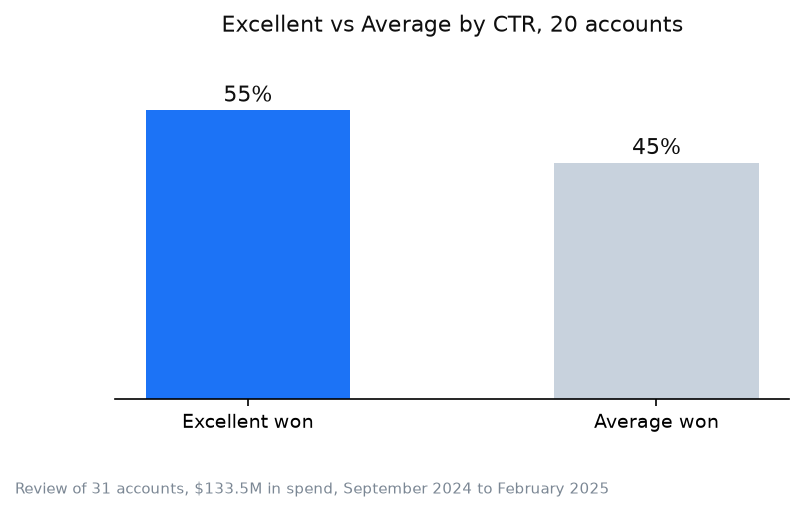
In our review of accounts with enough data to compare RSAs rated Excellent vs Average inside the same account (at least 10 RSAs in each category), Excellent won on CTR in only 11 of 20 cases (55%). That is closer to a coin flip than to a signal that “better copy = more clicks.” Window: September 2024 through February 2025.
Takeaways:
- Excellent does not mean “the ad makes money.”
- Average does not mean “rewrite everything now.”
- The label reacts to volume, diversity, and keyword presence; the business reacts to CTR, CR, and CPA.
- If you dilute the offer for “diversity” under a green score, you buy the label and sell precision.
Test message and landing. Treat the label as a checklist (“is there enough material to assemble combinations”), not as a KPI.
Individual findings pay off once they are built into a system. My e-book “19 Google Ads Secrets” shows how to get the most out of Google Ads without draining your budget, drawn from real campaigns and tests.
See the book →When this does not apply
A strong ad sample does not save you if:
- Conversion tracking is broken or missing. The algorithm and you optimize the wrong thing. Defining Google Ads Conversions: What Counts, What It Is Worth, and Why It Is Missing matters more than one more headline.
- The landing contradicts the ad. Different price, different timeline, different geography.
- The query is non-commercial. “Buy now” on informational traffic raises CPC without leads.
- Too many intents in one ad group. One RSA cannot answer both “what is this” and “price with install today” honestly.
- There is no offer. If the product differs only by “we exist too,” no sample becomes leverage.
- Budget is too thin to learn. 5-10 clicks a week will not separate a weak set from a strong one.
In those cases fix structure, tracking, and the page first. Ad copy comes second or third.
FAQ
Google Ads ad sample: where to start if you have no time?
With one intent: 5-7 headlines (query + offer + proof + condition + CTA) and 2 descriptions. One precise set beats fifteen “universal” ones.
Which ad samples work better: with price or without?
If the price is competitive and matches the page, put it in. If “from” is far from the real number, price kills trust after the click. Test both; watch CPA, not only CTR.
How many headlines does a responsive search ad need?
Technical minimum: 3. Working target: 8-12 that are different in meaning, not 15 clones. Google allows up to 15 headlines and 4 descriptions (About responsive search ads, accessed: 10.08.2026).
Do you have to chase an Excellent rating?
No. The score does not run the auction directly. In our within-account comparison across accounts, Excellent won on CTR in only 55% of cases. Track clicks, leads, and cost per lead.
SOURCES
- Google Ads Help. *About responsive search ads*. https://support.google.com/google-ads/answer/7684791?hl=uk · accessed: 10.08.2026
- Google Ads Help. *About ad strength for responsive search ads*. https://support.google.com/google-ads/answer/9921843?hl=uk · accessed: 10.08.2026
- Google Ads Help. *Tips for creating effective responsive search ads*. https://support.google.com/google-ads/answer/6167122?hl=uk · accessed: 10.08.2026
- Google Ads Help. *About assets*. https://support.google.com/google-ads/answer/7331111?hl=uk · accessed: 10.08.2026