
The wider context of the system is covered in Google Ads: The Complete 2026 Guide. See also what PPC advertising really costs. It is also worth seeing how account structure works.
How much does Google Ads cost for a massage business, and is it worth it?
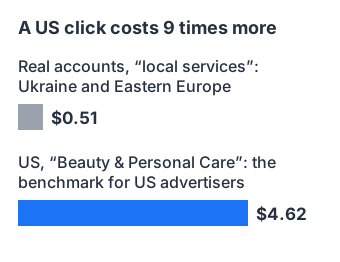
In the US, the median search click in the “Beauty & Personal Care” industry costs about $4.62 (WordStream/LocaliQ 2026). In our real ad accounts, mostly in Eastern Europe, a click in “local services” costs about $0.51 (2025 median): a cheaper market, relevant only if you advertise there. Figures in this block are for 2025; the article below may mention prices from other years. Where the figures come from ↓
Real accounts = ad accounts managed by Igor Ivitskiy's team, mostly in Eastern Europe.
A $1,500 monthly budget → about 325 (265–520) clicks → about 35 (20–55) conversions at this industry's US median of 10.35% (a call, a form or a purchase).
To get about 30 leads a month (a practice rule: with that many, Google's automated bidding runs more steadily), you would need about $1,339 a month.
An estimate, it may not hold.
Estimate your budget
A rule from Igor Ivitskiy's practice: automated bidding needs about 30 conversions a month to have enough data. A scenario, not a measurement or a promise.
| Metric | Real accounts (mostly Eastern Europe) | US (WordStream/LocaliQ 2026) |
|---|---|---|
| Cost per click | $0.51 | $4.62 ($2.89–$5.70) |
| CTR (clicks per impression) | 5.28% | 6.75% |
| Leads (conversions) per 100 clicks | no data | 10.35% |
| Cost per lead | no data | $39 |
- For a typical advertiser in the “local services” category (median), about 57.7% of tracked search spend goes to queries without a single conversion (2023 to 2025). Before raising the budget, review your search terms and cut the useless ones.
- In the “local services” category a click is usually cheapest in June (about $0.41) and most expensive in July (about $0.48): monthly medians over the whole observation period.
- Data covers only some months of the year.
- In the US, a click in the “Beauty & Personal Care” industry moved from about $3.42 in 2022 to about $4.62 in 2026, according to WordStream/LocaliQ reports.
Where the figures come from
Panel: the open “Ivitskiy Ads Lab Google Ads Panel & Benchmark Compilation 2026” dataset (version 1.0, CC BY 4.0) on Hugging Face and GitHub; real managed ad accounts, mostly Eastern Europe (business country is not recorded in the primary data); a convenience sample, not a market norm; dollar amounts at a fixed mid-2026 exchange rate.
Unit of observation: advertiser; median across advertisers in the category for the year (6 advertisers in “local services” over the whole period).
US: WordStream/LocaliQ “Google Ads Benchmarks 2026” report, medians across LocaliQ client search campaigns (called averages in the report), Google and Microsoft combined, April 2025 to March 2026; a conversion there can be a call, a form or a purchase.
Updated: 2026-09-24 · release r1
Hugging FaceGitHubDownload the values (CSV)Reading time: 10 minutes
In short: effective massage advertising combines three channels: Google Ads targeting precise keywords, Google Maps for nearby clients, and Instagram or Facebook for building trust through reviews, photos, and stories. Create a separate ad and landing page for each service, such as classic, therapeutic, or sports massage. One generic ad for every massage type usually attracts less qualified traffic.
This guide includes three Google Ads examples that follow the limits of 30 characters per headline and 90 characters per description, plus an invitation message you can adapt for social media or messaging apps.
Being a skilled massage therapist is not enough to build a profitable practice. You also need a clear offer, a convenient booking process, effective advertising, and a website that helps prospective clients choose the right service.
How to advertise massage therapy
Start by deciding which keywords you want to target with paid search campaigns in Google Ads.
Search those keywords on Google and review several competing websites. Look at their offers, page structure, photos, prices, reviews, and booking options. The goal is not to copy competitors. It is to understand what prospective clients see before they reach your website.
If you provide several services, such as massage therapy and osteopathy, create a separate ad for each offer. Build a dedicated landing page for every major service within the same domain. The pages may have a similar structure, but the title, copy, proof, and call to action should match the specific keyword.
How to write a massage advertisement
A massage ad should be specific enough to answer three questions:
- What service do you provide?
- Who is it for?
- What should the person do next?
Focus on the client’s situation and the practical value of the session. Avoid vague phrases such as “the best massage in town.” Explain the type of massage, session length, location, therapist qualifications, and booking availability.
Prepare separate ads and landing pages for services such as:
- Classic massage
- Therapeutic massage
- Pediatric massage
- Anti-cellulite massage
- Sports massage
- Machine-assisted massage
- Thai massage
Massage services often appeal to women aged 25-45, but the audience varies significantly by service. A sports massage campaign, for example, should speak to active people concerned with training and recovery. A relaxation massage campaign may focus on stress, comfort, and taking time to recharge.
Combining every service in one ad mixes several different intentions. Someone searching for sports recovery is not necessarily interested in anti-cellulite massage, while a person seeking relaxation may not respond to clinical language.
Match the channel to the service
Anti-cellulite massage tends to attract more interest in spring, when clients begin preparing for summer. Promote it through visual social media content, local lifestyle publications, fitness communities, and partnerships with relevant businesses.
Sports massage can be promoted near gyms, running clubs, sporting events, training communities, and websites used by athletes. Search campaigns can target high-intent terms such as “sports massage near me” or “massage after running.”
For a local studio or private treatment room, use tight location targeting. Most clients prefer a therapist close to home, work, or their regular commute.
Create and maintain a Google Business Profile so the practice can appear on Google Maps. Add accurate opening hours, services, photos, reviews, booking links, and the correct address or service area.
Check performance by device
Practice data shows that mobile devices consumed most of the budget in most reviewed advertising accounts, with a median share of 72%. However, mobile conversion rates were noticeably lower than desktop conversion rates, with a median gap of 28.6%.
The practical lesson is simple: do not direct the entire budget to mobile traffic by default. Compare conversion rates, lead quality, and cost per booked appointment by device. Adjust bids and landing pages based on actual performance.
The underlying analysis covered $133M in advertising spend.
Ready-to-use massage advertising examples
The following Google Ads examples cover different search intentions. Their headlines fit the 30-character limit, and their descriptions fit the 90-character limit.
Use them as a starting framework. Replace the location, offer, qualifications, availability, and practice name with accurate information from your own business.
Ad 1: classic massage
Headlines:
- Classic Massage Downtown
- Book Online in 2 Minutes
- 15% Off Your First Visit
Descriptions:
- Release back tension in 60 minutes with a qualified massage therapist. Book today.
- Trusted by 500+ clients. Every session is tailored to your needs and comfort.
Suggested landing page content:
- Session duration and price in dollars
- Photos of the treatment room
- Therapist qualifications
- Available appointment times
- Reviews from local clients
- A clear online booking button
Ad 2: therapeutic massage
Headlines:
- Therapeutic Back Massage
- Licensed Therapist, 10 Years
- Free Initial Consultation
Descriptions:
- Neck or lower back discomfort? Discuss a suitable massage plan with a trained therapist.
- Appointments available throughout the day. Book a convenient time online.
Use clinical or medical wording only when your qualifications and local regulations allow it. Do not promise to diagnose, treat, or cure a condition unless you are legally permitted and able to support the claim.
Ad 3: massage at home
Headlines:
- Massage at Home in Austin
- Therapist Arrives in 1 Hour
- Pay After Your Session
Descriptions:
- An experienced therapist visits your home or office. Choose from several massage types.
- Flexible hours and booking by message in 30 seconds. No advance payment required.
Only advertise a 1 hour arrival time if you can deliver it consistently within the selected service area.
Invitation message for social media or messaging apps
> Hi! I have several openings for classic massage this week. A 60 minute session can help you relax after a busy week and give your body time to recover. Appointments are available on Thursday and Saturday. Reply here or call the studio, and I will help you choose a convenient time and suitable massage technique.
When the ads are ready, plan the budget around local cost per click, conversion rate, booking rate, and customer value. Search demand and click prices vary by city and service, so use Google Keyword Planner and your own campaign results instead of relying on one universal benchmark.
How to build a website for a massage practice
A strong advertisement cannot compensate for a confusing website. The landing page should quickly confirm that the visitor has found the right service and make it easy to book an appointment.
Google recommends checking mobile usability and page speed so visitors can find essential information and complete the intended action after clicking an ad.
What to check before launching local ads
Open the landing page on a phone before starting the campaign. A visitor should immediately see:
- The specific massage service
- The location or service area
- The session duration
- The price in dollars
- The therapist’s qualifications
- The booking method
- The next available appointment
Test the form, phone number, messaging link, confirmation page, and appointment calendar yourself.
Introduce the massage therapist
Clients want to know who will be providing the service. This is especially important for therapeutic massage and other services associated with health concerns.
Include professional photos of the therapist and treatment room. List relevant training, licences, certifications, specialisations, and experience. If permitted, show certificates or link to the appropriate licensing register.
Choose a clear positioning model:
- Personal brand: promote the individual therapist, their expertise, approach, and reputation.
- Studio brand: promote a business that selects and manages qualified therapists under one consistent standard.
A therapist who plans to continue providing sessions personally may benefit from building a recognisable personal brand. An owner who intends to hire more specialists and focus on management may be better served by promoting the studio.
Describe qualifications accurately. Do not combine unrelated titles in a way that could mislead clients. If someone is a licensed healthcare professional who has also completed osteopathy training, list those qualifications separately and clearly.
Use social channels to build trust
Instagram, Facebook, and YouTube can support the website and search campaigns. Publish useful content, treatment room photos, answers to common questions, and client reviews shared with permission.
Comments and direct messages can reveal the audience’s concerns, fears, and objections. Use those insights to improve the website and advertising copy.
Paid social advertising can introduce the practice to local audiences, but search advertising is usually better at capturing people already looking for an appointment. Evaluate the channels separately instead of expecting them to perform the same role.
State three meaningful advantages
The first screen of the landing page should communicate why someone should choose this practice. Select 3 advantages that can be verified.
Examples include:
- Relevant professional training
- Experience with a specific client group
- Convenient evening or weekend appointments
- Home or office visits
- A quiet private treatment room
- Online booking without a phone call
- Additional options such as aromatherapy, when appropriate
Avoid generic claims that could apply to every therapist.
Explain the consultation and session
Briefly explain what happens before, during, and after an appointment:
- Initial consultation: concerns, health history, contraindications, and session goals
- Massage session: duration, techniques, products, and client comfort
- Optional additions: wraps, aromatherapy, or music, if offered
Keep this section concise. Most visitors want reassurance and practical details, not a technical manual.
Explain which service fits which goal
Describe each service in terms that clients understand:
- Classic massage: relaxation and relief from everyday muscular tension
- Sports massage: support for training, mobility, and post-exercise recovery
- Pediatric massage: age-appropriate techniques provided by a properly qualified professional
- Anti-cellulite massage: a cosmetic service focused on skin appearance and temporary changes in tissue texture
Be careful with health and cosmetic claims. Do not guarantee pain relief, injury recovery, fat loss, or permanent changes in body measurements.
Present services and prices clearly
Create a simple service list with:
- Service name
- Suitable client or goal
- Session duration
- Price in dollars
- Important preparation details
- Booking button
A price table can make comparison easier. Mark current discounts and packages clearly, including their terms and expiration dates.
Make contact and booking effortless
Include the phone number, address, map, social profiles, and messaging options. Add a prominent button for booking a session or requesting a consultation.
You can also show opening hours and available appointment times. If the therapist travels to clients, define the service area and any travel fee.
Publish credible reviews
A review is more persuasive when visitors can verify its source. With the client’s permission, embed reviews from Google, Facebook, or another relevant platform instead of publishing anonymous text alone.
Ask satisfied clients for honest feedback after the appointment. Do not require a positive review or offer a reward that violates the review platform’s rules.
Improve the landing page
Offer clearly structured packages where they make sense. For example, a “Healthy Spine” package might include 3 massage sessions, provided the wording complies with local advertising and healthcare rules.
Before-and-after photos may work for visibly measurable cosmetic services, but use them only with written consent and realistic context. Do not use lighting, angles, or editing that exaggerates the outcome.
A short quiz can also help visitors choose a service. Possible questions include:
- Where do you feel discomfort: head, back, or arm?
- How old are you?
- What is your gender?
- Which best describes your lifestyle: office work, standing all day, or regular sport?
- What name and phone number should the therapist use to contact you?
Ask only for information you genuinely need. Explain how personal and health-related data will be stored and used.
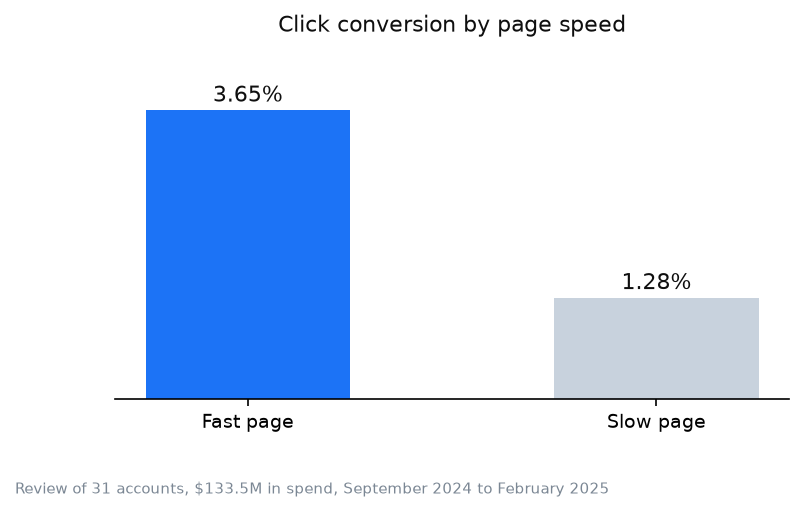
Among the reviewed technical landing page metrics, only mobile loading speed showed a meaningful correlation with conversion rate. Pages scoring 9-10 out of 10 converted clicks at 3.65%, while pages scoring 1-5 converted at 1.28%.
The difference was almost 3 times. Mobile speed should therefore be one of the first technical checks for a massage website. This finding came from 4425 landing pages in the analysis of $133M in advertising spend.
Key takeaways for massage advertising
Choose a positioning model before investing heavily in promotion. If you plan to expand the practice, hire therapists, and move into management, build the studio brand. If you intend to continue providing massage personally, invest in your name, expertise, and reputation.
Create separate campaigns and landing pages for distinct services. Match each keyword, ad, page, and call to action to one clear client intention.
Use Google Ads to capture active search demand, Google Maps to reach nearby clients, and social channels to develop familiarity and trust.
Keep improving the website after launch. Update photos, services, packages, reviews, and availability. Measure booked appointments rather than form submissions alone. Even a small landing page improvement can produce more clients from the same advertising budget.
My e-book “19 Google Ads Secrets”: how to get the most out of Google Ads without draining your budget, drawn from real campaigns and tests.
See the book →When this does not apply
This approach may not work when:
- One ad combines therapeutic, sports, cosmetic, and relaxation massage into a single offer.
- The service area is too broad for clients to travel conveniently.
- Calls and messages are answered too slowly.
- The booking process is difficult or unavailable on mobile devices.
- The practice has weak or unverifiable reviews.
- The landing page does not match the keyword or advertisement.
- The campaign promises medical or cosmetic outcomes that cannot be supported.
- The therapist lacks the licences required for the advertised service.
- The local market has insufficient search demand for a narrowly defined treatment.
- The practice cannot track which campaigns generate completed appointments.
Advertising cannot repair an unreliable service, misleading positioning, poor client communication, or a consistently inconvenient appointment experience.
FAQ
How to advertise massage therapy
Create separate Google Ads campaigns for the services people actively search for, optimise the Google Business Profile for local discovery, and use social media to demonstrate expertise and trust. Send each campaign to a landing page that matches the search term.
Massage therapist advertising ideas
Useful ideas include service-specific search ads, Google Maps optimisation, referral partnerships with gyms, local content, client reviews, short educational videos, seasonal offers, and separate landing pages for different massage types.
Massage advertising examples
A clear example is: “Classic Massage Downtown,” followed by a concrete benefit, session duration, qualification, and booking option. Avoid vague claims. State the service, location, relevant proof, and next action.
How to get massage clients
Focus on local visibility, high-intent keywords, strong reviews, fast responses, simple online booking, and follow-up with existing clients. Track completed appointments and repeat visits, not just clicks or leads.
How much does massage advertising cost
Cost depends on location, competition, keyword selection, conversion rate, and the value of a booked client. Estimate a test budget using local cost-per-click data, expected landing page conversion rate, appointment booking rate, and acceptable customer acquisition cost.