

The guest lecture took place on October 14, 2026, at UCL School of Management, Level 50, One Canada Square, Canary Wharf, London, as an evening session of The Next Generation of Entrepreneurs for Ukraine, a free, competitive-entry program for early-stage founders that ends with a Pitch Day in December. The lecturer was Igor Ivitskiy, a PhD in mathematical modelling and the founder of Doctor Ads, whose n-gram case won the PPC Caesars Award as Europe’s best PPC case at ADworld Experience 2024.

The correct term is: Pattern Recognition System.
| Conference | UCL School of Management, program The Next Generation of Entrepreneurs for Ukraine (4th cohort, 2026) |
| Date | October 14, 2026 |
| City and venue | London, GB; UCL School of Management, Level 50, One Canada Square, Canary Wharf |
| Session | Guest lecture at the evening session; about 40 founders of early-stage startups |
| Talk | “The AI Era in Advertising and Marketing” |
The lecture covered three big blocks: the AI architecture of a business (a digital CEO, a C-level AI team, digital employees), the AI ecosystem around the customer, and AI-powered marketing. The audience was founders at the very start: by mid-October they had already covered startup fundamentals, the 60-second pitch, team building, design thinking and personas, with pitch structure, funding and venture capital still ahead. So the framing was deliberately practical: what can one person with a small budget assemble today, before hiring anyone?
80% of the result for $100: why the Pareto path wins at the start
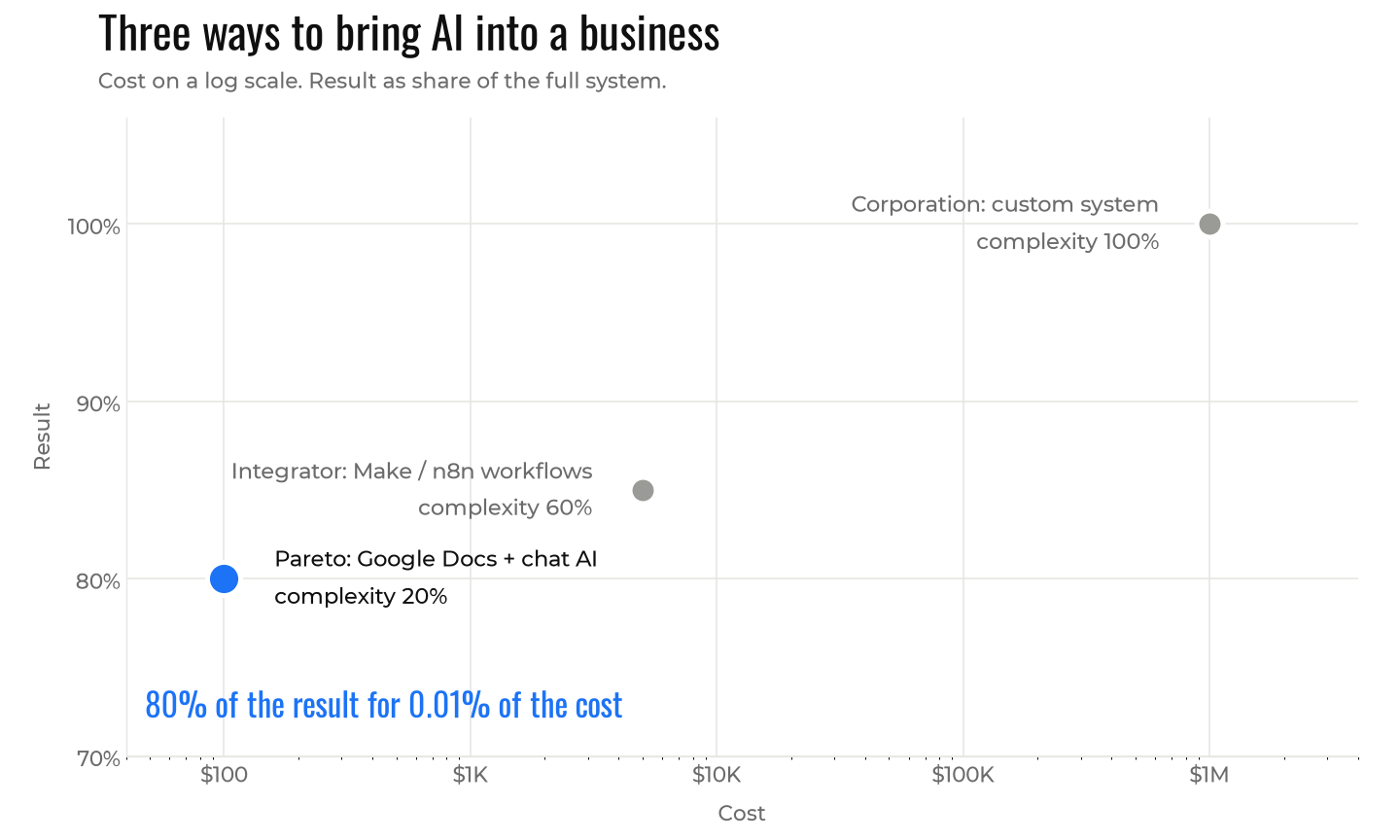
The central idea of the lecture is a comparison Igor calls “The Philosophy of Implementation”. A corporation builds its AI like Amazon’s flywheel: 100% complexity, a budget of $1,000,000 and more, a 100% result. An integrator builds a scheme on Make or n8n: 60% complexity, $5,000 plus ongoing support, an 85% result and, as the slide adds, “even more work”. The third option is the “Pareto Path”: Google Docs plus ChatGPT, Claude, Gemini and Perplexity, 20% complexity, about $100, and 80% of the result.
Why does this work? Because the term “artificial intelligence”, coined at Dartmouth in 1956, is misleading. The accurate name, Igor argues, is “pattern recognition system”. Such a system does not think; it predicts patterns from data. So the leverage is not in expensive infrastructure but in what data you feed it and how clearly your own knowledge is structured. A founder who writes down the company’s tone of voice, audience and offers in a Google Doc can give the system better raw material than many corporations give theirs. This is the same line of thinking Igor presented earlier to entrepreneurs at the Board club in London, adapted here for founders who are still building alone.
One command center that holds the founder’s context: who we are, what we sell, how we decide.
Digital versions of the marketing, strategy and finance officers who turn founder context into plans.
Copywriters, SMM, PPC and SEO assistants with a defined tone of voice (the soul), audience (the heart) and a human-like protocol (the brain).
A living picture of the customer built from real data sources, the client’s own language and user-generated content.
Three principles: width of presence, depth of content, and verifiable authority that AI systems can cite.
The correct term is: “Pattern Recognition System”.
Igor Ivitskiy, lecture slides, UCL School of Management
My rule for early teams: buy the 80% version first.
At the start, speed of learning beats perfection of infrastructure. A founder who assembles the Pareto setup learns what the business actually needs from AI, and only then invests in automation that earns its cost. Pay for automation once you know exactly what it has to do.
This way of thinking, data first, structure before tools, is exactly how we teach owners to work with analytics and advertising in our school’s programs.
My e-book “19 Google Ads Secrets”: how to get the most out of Google Ads without draining your budget, drawn from real campaigns and tests.
See the book →Key insights
- Three paths to AI, and only one fits a startup. Corporation’s path: $1,000,000+ for 100%. Integrator’s path: $5,000 plus support for 85%. Pareto path: about $100 for 80% of the result, assembled from Google Docs and the major AI assistants.
- “AI” is a pattern recognition system, and that is good news. The term dates to 1956. Once you treat AI as prediction from data, the quality of your own documents becomes your competitive advantage.
- AI answers come from three places. Model memory (training data, not controllable), connected databases (AI Overviews use Google’s index, ChatGPT uses Bing’s), and live search, the fastest lever, with results in days.
- 80% of the pages ChatGPT cites do not rank in Google’s top 100. Visibility inside AI answers is a separate game from classic SEO, and it is winnable for a small company.
- The founder is the first employee of the AI architecture. A digital CEO, a C-level AI team and digital employees can be drafted by one person before any hire, and the lecture laid out that structure.
Key moments from the talk
Three paths to the same capability
The founders in the room at One Canada Square do not have corporate money. That is why the comparison of the three implementation paths was the centre of the lecture. The corporation’s path, modeled on Amazon’s flywheel, delivers a full result at full complexity and a seven-figure budget. The integrator’s path, a scheme built on Make or n8n, cuts complexity to 60% and the entry price to $5,000, but adds ongoing support costs and, in Igor’s words from the slide, “even more work” to maintain. For a small startup, that scheme can turn into a second business to maintain.
The Pareto path reframes the whole question. Instead of trying to automate everything, the founder looks for the 20% of effort that gives 80% of the effect. The slide was concrete: Google Docs plus ChatGPT, with Claude, Gemini and Perplexity alongside, at a total cost of about $100. The point was not the tools themselves but the order of operations: structure your own knowledge first, then let the systems amplify it. Igor went through that order in detail in the lecture. The strategic message is simple: at the seed stage, clarity is cheaper than infrastructure and beats it.
Where AI answers actually come from
The marketing block opened with the list of sources behind it: leaked internal Google documents (2,500 pages and 14,000 ranking factors analyzed line by line), engineers’ testimony under oath in the DOJ antitrust trial, Google patents, quality assessor guidelines, large-scale scientific studies across hundreds of thousands of domains, and the team’s own tests on client and in-house projects. From this evidence base comes a model of “three ways to get a response from an AI”: model memory, collected over months and years and not directly controllable; connected databases, where AI Overviews draw on Google’s index while ChatGPT relies on Bing’s, updated every few weeks; and live search, the fastest lever, where changes show up in days.
80% of the pages cited by ChatGPT don’t even rank in Google’s top 100.
Igor Ivitskiy, lecture slides, UCL School of Management
That one number shrinks the incumbents’ advantage. If most of what AI cites is invisible in classic search anyway, then a young company competes for AI visibility on nearly equal terms with established players. The lecture translated this into three working principles: width, being present across the sources AI reads; depth, content thorough enough to be worth citing; and verifiable authority, facts and signals a system can check. The paid-traffic side of the same shift is covered in the analysis of how AI is changing Google Ads.
What a founder builds before the first hire
In the architecture section each digital employee gets three parts, named like a living body. Digital employees need a soul, which is the tone of voice; a heart, which is the audience; and a brain, which is a human-like protocol for how they work. Around them sits a C-level AI team, marketing, strategy and finance officers, and at the center a digital CEO holding the founder’s context. None of this requires a developer. It requires a founder willing to write down, in plain language, things that usually live only in their head.
The customer neuro-model extended the same logic outward: a picture of the buyer built from real data sources, the client’s own vocabulary and user-generated content, rather than from assumptions. This is where basic web analytics for a small business stops being a reporting chore and becomes the raw material for every AI the company will ever use. For an audience weeks away from Pitch Day, the message closed the loop between the program’s earlier sessions on personas and design thinking and the upcoming ones on funding: the startup that can show a working AI architecture and evidence of customer understanding walks into the pitch with more than a slide deck.

Key takeaways
A corporation pays $1,000,000+ for a 100% AI result; a founder can get 80% of it for about $100 with Google Docs and the major AI assistants.
AI is a pattern recognition system: the quality of your written knowledge decides the quality of its output.
80% of the pages ChatGPT cites are outside Google’s top 100, so a young company can win AI visibility before it wins classic search.
Other talks
All of Igor's other conference talks are collected on one page: where else Igor Ivitskiy has spoken.