
In February 2025, I tested whether ChatGPT could handle Google Ads setup for my masterclass. I launched two campaigns: one based on the model’s recommendations and one I configured myself. After three weeks, I compared the results and considered which tasks AI had helped with and which decisions still needed an advertiser’s judgement.
Could artificial intelligence replace Google Ads?
ChatGPT’s popularity had prompted predictions about the end of search advertising. If an assistant could answer a question directly, why would someone keep browsing search results? My view at the time was that this did not automatically spell the end of Google Ads.
Artificial intelligence and human habits
My first argument was about habit. Initial excitement about a technology does not mean everyone immediately abandons an established way of doing things. I used electric cars as an analogy: the growth of a new approach had not instantly eliminated the previous one.
I still expected AI to change user behaviour, advertisers’ work, and campaign analysis. I anticipated a gradual change in advertising, rather than assuming it would remain exactly as it was.
Advertising as a foundation of Google’s business
My second argument concerned the importance of advertising revenue to Google. I believed the company had a strong financial incentive to preserve an advertising model even as search itself changed. That was why I expected advertising to evolve instead of treating its disappearance as inevitable.
Could ChatGPT change the approach to Google Ads?
I expected the advertiser’s central task to remain familiar: understand the prospective customer, present a relevant offer, and take them somewhere they can complete the desired action. Search queries, answer formats, and the route to that action could change.
How I tested AI on a tightly defined task
My approach was to give AI a narrow task with clear boundaries. For example, I could ask it to suggest messages using approved facts. I then checked whether it followed the constraints, matched the customer’s intention, and produced something that could be tested in a separate experiment.
If the model confused a hypothesis with a fact, I did not publish the response. I used the mistake to improve the inputs and instructions. For a separate example of AI working within Google’s advertising system, see Google’s explanation of Performance Max.
How AI might change customer behaviour
I used buying a generator to illustrate a familiar research process. A buyer started with a broad question, read explanations, compared specifications, and gradually moved towards a purchase.
- Search for “how to choose a generator”.
- Receive results containing ads and relevant articles.
- Read the material and compare features and specifications.
- Refine the search to “2 kW generator for a house” or “benefits of an inverter generator”.
- Search for somewhere to buy, adding a model, location, or price.
My prediction was that an assistant could take on much of the information gathering and comparison. A person could describe the whole problem at once: find a generator for a household of four with electric heating; find a dentist in London with good reviews and below-average prices; choose a laptop for gaming and video editing within a specified budget.
I expected that, with access to current information, AI could return a shortlist of suitable options. This was a possible direction for customer behaviour, not a claim that everyone already bought this way.
How advertisers would need to respond
Advertising follows the way the customer makes a decision. Early in the process, an ad might lead to an explanatory page. Later, it might lead to an order form or a conversation with a sales representative. I considered that logic more durable than any particular search format.
If requests became more detailed, ads would need to account for more conditions. I used the example of a kitchen selected by colour, room dimensions, price, and the appliances it needed to accommodate. My forecast was that buyers would describe their needs more specifically, and advertisers would have to prepare offers that answered those needs.
How AI helped with creating ads
The clearest benefit I saw in ChatGPT was help with writing. I also considered AI useful for working through information about buyers’ needs, interests, priorities, and resources. Automating bids and optimising campaign results were separate applications from generating ad copy.
Generating copy with ChatGPT
I used the model for headlines, descriptions, and text assets such as callouts and structured snippets. A plumbing supplies business, for example, could ask for 15 headline ideas and then edit the useful ones.
For descriptions, my advice was to specify the product model, its benefits, the desired action, and a limit of 90 characters. A precise task made it easier to judge whether the response was suitable.
I did not recommend copying the output straight into an ad. Its value was in saving drafting time and suggesting angles I might have missed. At the time, I preferred working with English prompts. For campaigns in another language, my workflow involved Google Translate and further adaptation of the answer. That was my working preference in this period.
Other questions I asked ChatGPT
Beyond copy, I saw the model as a way to prepare ideas for further checking.
- Suggest concepts for banner ads.
- Draft an initial Google Ads keyword list.
- Describe a possible audience and its interests for targeting.
The experiment: setting up ads with ChatGPT
To test these ideas in practice, I compared two campaigns promoting my Google Ads masterclass. They started together, sent visitors to the same registration page, and ran for three weeks. I built one using ChatGPT’s answers and configured the other myself.
For testing a small change, I recommended Google’s built-in experiments. Here, the approaches differed substantially, so I created separate campaigns. That distinction matters when reading the results: I was comparing two sets of decisions.
Stage 1: preparing the brief for ChatGPT
- I asked the model to act as a Google Ads expert and create a campaign for Igor Ivitskiy’s Google Ads training.
- I supplied background information about myself and the courses.
- I set the objective: registrations for my “3 Secrets of Google Ads” masterclass, with a target cost per conversion of $4.
- I described the audience as entrepreneurs and people with an entrepreneurial mindset who were willing to think, take responsibility, and work towards a result.
- I requested all Search campaign settings, ad copy, keywords, match types, bidding strategy, bids, and audiences.
Stage 2: what ChatGPT recommended
The model recommended a Search campaign with training registrations as the goal and the masterclass title as its name. It included Google Search and search partners, while excluding the Display Network. It selected two languages and the location used for the test.
For bidding, ChatGPT recommended Manual CPC with Enhanced CPC enabled. It set a daily budget of $28. These were the model’s historical recommendations, not a set of instructions for creating a campaign today.
The keyword list used plus signs, referring to broad match modifiers that were already obsolete. This was a practical example of a convincing answer containing an outdated mechanism.
The copy also needed repairs. Some headlines exceeded 30 characters, so I had them generated again. Exclamation marks in the headlines were another problem, and the first version of the ads was not approved. Still, I liked some of the ideas, including “Making smart people richer” and “Protection from scammers”. I launched the campaign after correcting the technical issues.
Stage 3: how I configured my campaign
- I chose Search and the same registration goal, naming the campaign “Test human”.
- I kept Google Search only. I disabled search partners and the Display Network to avoid spending the test budget on that inventory.
- I selected one language and the same location. My usual approach was to separate campaigns by language.
- I did not add the audience segments I had developed through my own work, because ChatGPT did not have those resources.
- I used a conversion-focused strategy with a target CPA of $4 and settings aimed at new customers. Someone who had already attended the masterclass was unlikely to need another registration.
- I used the same daily budget of $28.
- I drafted keywords without a detailed review of my historical conversion data, although I would normally use that information to guide selection.
- I completed the headlines and descriptions and included relevant keywords. I gave the ads the same attention I would in my regular work.
Stage 4: the results
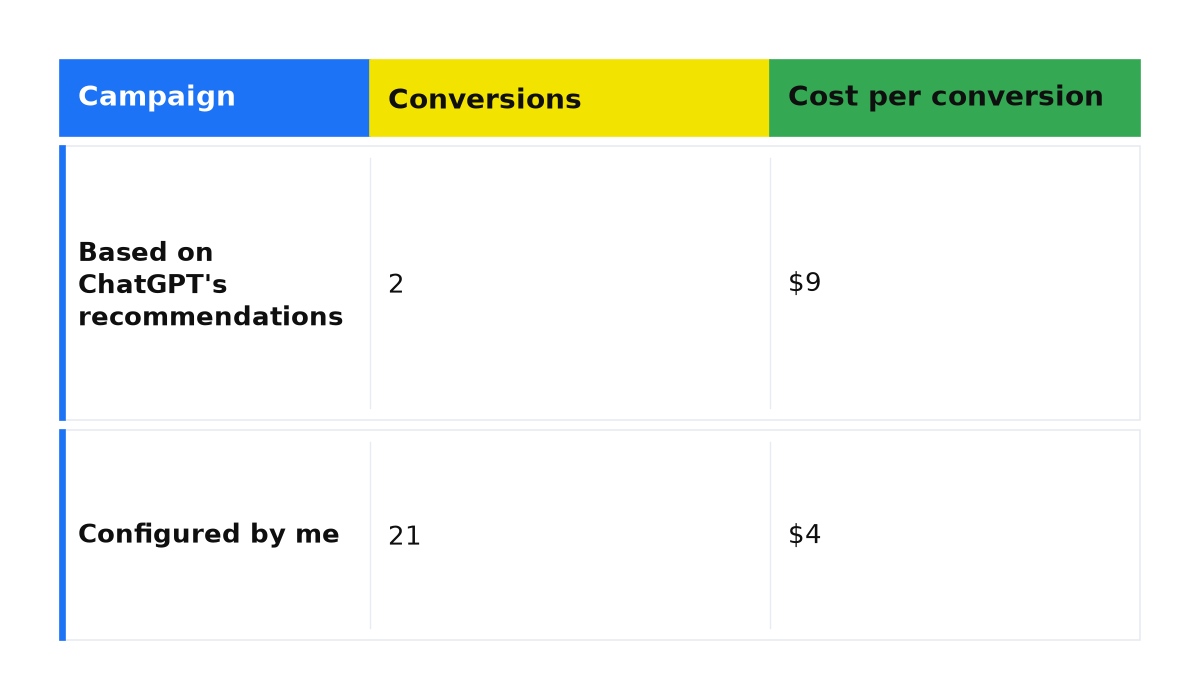
The campaigns shared a daily budget, location, objective, and registration page. Their settings, keywords, and ads differed. After three weeks, the results were as follows.
| Campaign | Conversions | Cost per conversion | Spend |
|---|---|---|---|
| Based on ChatGPT’s recommendations | 2 | $9 | $18 |
| Configured by me | 21 | $4 | $84 |
My campaign produced roughly ten times as many conversions at less than half the cost per conversion. Equal daily budget limits did not mean equal actual spending: the campaigns spent $18 and $84 respectively.
Comparing click-through rates
The campaign based on ChatGPT’s recommendations had a CTR of 2.25%; mine achieved 5.6%. I considered both low for my particular task. In my courses, I discussed approaches to higher CTRs, including examples of 8% to 12% and 30% to 40%. Those figures were not results from this comparison or promises for every business.
Which searches triggered the ads?
The ChatGPT campaign appeared for searches directly related to Google Ads training. My campaign reached broader topics, including Google Ads payments, Google Ads Editor, and the Google Ads API.
My takeaway was that a future buyer does not always begin with a direct search for your product. Someone investigating a related problem could also become interested in training. I saw an opportunity to reach that person before they started comparing schools.
Auction insights
In the ChatGPT campaign’s auction data, I saw other Google Ads training providers. The campaign had entered auctions with direct competitors and, in my assessment, reached the audience reasonably well compared with those schools.
In my campaign, Google was the visible competitor. I interpreted that as a move beyond the usual competition between training providers. The different queries had also changed which advertisers my ads encountered in the auction.
Stage 5: why AI did not replace the specialist in this test
My main criticism of the model’s responses was that they were too generic. Effective advertising needed to explain what made this particular offer suitable for these particular people. Standard wording about a standard product did not resolve that task.
A specialist worked with a specific location, audience, and product. That context informed the choice of headlines, descriptions, and video, including the emotional reasons someone might respond.
For a training business, people cared about how they were welcomed, who would teach them, the company’s values, and other students’ experiences. I regarded those details as part of the advertising task, alongside a logical explanation of the offer.
I described generic responses as a loss of distinctiveness. That was my marketing assessment of the test: the model provided a starting point, but a person still had to sharpen the differences and decide what was fit to launch.
The Google AI features I was considering at the time
In February 2025, I also discussed the integration of Gemini AI into Google Ads for advertisers in the US and UK. I described the conversational assistant beside the ad creation interface, where an advertiser could generate headlines and descriptions and add selected text using the plus button.
I saw a practical advantage in keeping the work inside Google Ads. There was less copying between a separate chat and the advertising account. Producing 15 headlines and 4 descriptions could take a beginner considerable effort, so an integrated assistant looked useful to me.
The next AI integrations I expected
I expected further integration of image generation from written instructions for Performance Max, Display, and Demand Gen campaigns. I also discussed SynthID as a way to identify AI-generated images. These were the expectations I expressed about the tools at that time.
I was cautious about relying on generated images. My hypothesis was that real photographs could inspire more trust for some offers. I did not measure that in this campaign experiment, so it should not be treated as one of the test’s proven findings.
Conclusions
After the test, I still favoured using AI as an assistant in Google Ads work. It helped produce copy and ideas faster, while checking settings, understanding the buyer, and refining the offer remained my responsibility.
I expected changes in keyword selection, ad writing, automated bidding, and image creation. For a business owner, I considered product differences, emotional relevance, and checking actual results essential parts of that process.
When this does not apply: This test does not prove that a person will always outperform every model. The campaigns differed in several settings, actual spend, and copy, so I did not isolate a single cause of the performance gap. ChatGPT’s historical recommendations should not be copied as a ready-made setup for a campaign today.
Using AI well means being able to judge its proposal: whether the settings make sense, whether it understands the customer’s intention, and what the test actually shows. That combination of Google Ads knowledge and practical evaluation is what I develop in my training.
My e-book “19 Google Ads Secrets”: how to get the most out of Google Ads without draining your budget, drawn from real campaigns and tests.
See the book →