
Google Ads can create and add automated assets, formerly known as ad extensions, without the advertiser building each one. These additions are intended to improve CTR, conversions, website visits, and sales.
Automation can make an ad more useful, but a business owner still needs to know exactly what Google is showing prospective customers. Text, addresses, and images selected by the system may not always match your current offer.
How Google Ads creates automated assets
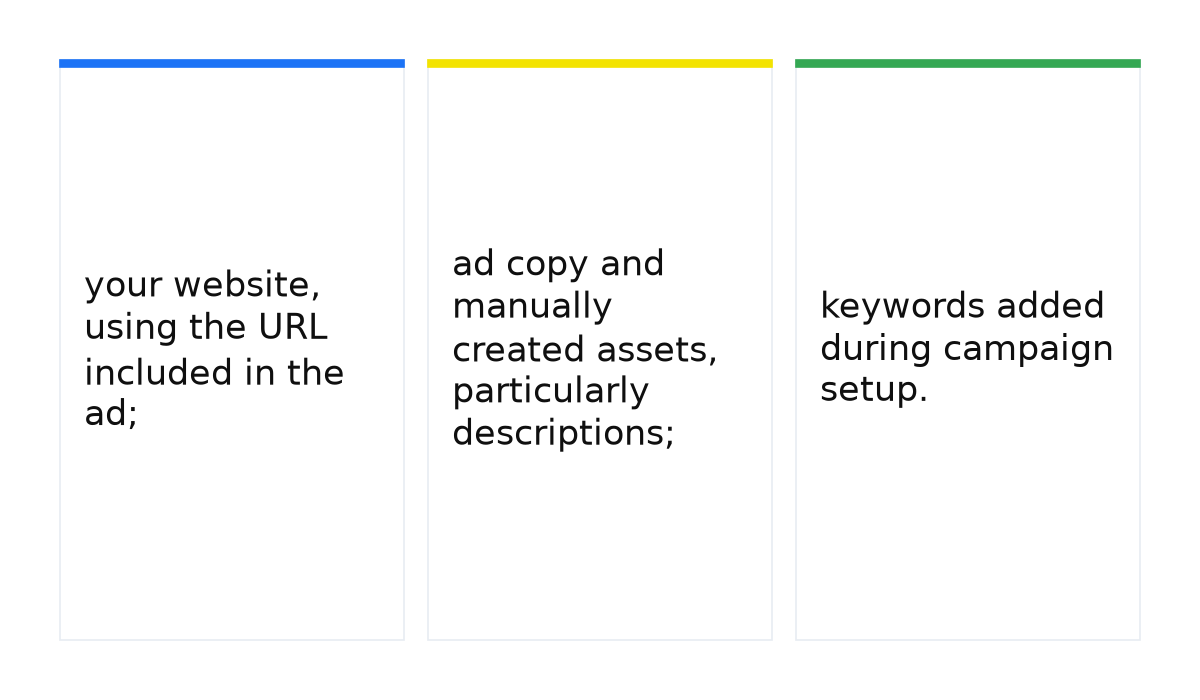
Google can use the following information to create automated assets:
- your website, using the URL included in the ad;
- ad copy and manually created assets, particularly descriptions;
- keywords added during campaign setup.
The system analyzes the user’s Google search. If an automated asset makes the ad more relevant and increases the chance of a click, Google may show that asset with the ad. The resulting ad may also appear in a higher position in the results.
Which assets can appear automatically
Some automated assets appear when you have not created a manual equivalent. Google’s help page explains how to manage account level automated assets.
What I allow automated assets to do
I do not turn off every automated asset on principle, and I do not accept them blindly. First, I decide which types can safely be built from the website. Then I regularly check where each displayed asset came from and what it actually says. If automation extracts an outdated condition or an overly broad promise, I fix the relevant page or turn off that specific type while keeping the useful options.
- Sitelink assets. These links take a user to a page containing the product or service information they want. For example, a search about pizza prices may lead directly to a pricing page.
- Callout assets. The system can show a short selling point that may influence the decision to click. Examples include free delivery, 15 years in business, a 30% discount, or a seasonal promotion.
- Structured snippets. These can appear when you have not added them manually. For a search about branded sneakers, Google may use the website to list the footwear brands available in the store.
- Phone. A mobile user can call with one tap, while a desktop user sees a number to dial.
- App. The link can take a customer straight to a mobile app, although not every advertiser needs it.
- Location. Google can take an organization address from the website, add it to the ad, and offer directions in Google Maps. If the business has several locations, check that the right address appears in each case.
- Business name and logo. It is better to configure these manually so the audience sees the information you have chosen.
- Dynamic images. The system selects them from the website. Make sure the images follow the platform’s rules and can pass review.
Message assets are a separate beta feature, configured manually with a supported messaging platform and contact details. They are not account-level automated assets.
Monitor both the asset type and its actual content. If the information helps the campaign, you can leave it in place. If it is irrelevant or makes the business, product, or offer look worse, turn off the specific type causing the problem.
For the wider relationship between manual and automated formats, see the guide to Google Ads assets and their setup.
If you want to identify which automated assets support your advertising and which ones distort the offer, start by reviewing their wording and delivery statistics.
My e-book “19 Google Ads Secrets”: how to get the most out of Google Ads without draining your budget, drawn from real campaigns and tests.
See the book →How to turn off automated assets in Google Ads
In Google Ads, open “Assets” in “Campaigns,” then “Associations.” Use the three-dot menu to select “Account-level automated assets.” Open the next three-dot menu and select “Advanced settings.” Choose the type to turn off, provide a reason, and save.
The “Assets” section also shows CTR, clicks, impressions, and average cost per click, or CPC. Review these statistics before turning anything off. Otherwise, you may remove useful assets along with the poor ones.
Automated assets whose content you cannot control
Some automated assets are assembled from other data providers, so an advertiser cannot configure them manually. Seller ratings are one example. Google uses Google Customer Reviews, supported review partners, and research evaluations by Google or its partners, as described in the ratings documentation.
Ratings appear as stars, with a maximum score of 5. Text ads require a composite rating of at least 3.5 and a matching website domain. Google needs enough eligible reviews from the relevant country over the last 24 months; most merchants obtain a rating after 100 or more, but the required number varies. A research evaluation by Google or its partners is another qualifying route. Meeting these conditions does not guarantee display.
Checklist for reviewing automated assets
Check the displayed text and destination against the current offer on your website. Correct outdated information and prepare a manual asset when you need precise wording.
Review the statistics alongside the actual content. Metrics show how the ad performed when an asset appeared; they do not isolate the effect of that asset.
If an automated type misrepresents the offer, turn off that type in its settings. Keep reviewing the useful types rather than treating the initial setup as permanent.
When this does not apply
Do not try to manage data manually when Google builds the asset from independent information, as it does with seller ratings. Turning off every automated type is not a universal solution either. Useful automated and manual assets can appear together, although the system more often gives preference to manual assets.
The practical answer is oversight. When you can choose between precise manual wording and text selected automatically by Google, create the manual asset. Turn off an automated type only when its actual content is irrelevant or harms the offer.