
Google Ads assets, formerly known as ad extensions, make an ad larger and add useful information to it. They can make your offer more visible than competing ads, give people a larger area to click, and explain more about your business before a visitor reaches the website.
- A larger ad is more noticeable on the results page.
- It is easier to click because it occupies more space, and on mobile it can even fill the screen.
- People see more relevant details about the company, product, or service before clicking.
- CTR, the ratio of clicks to impressions, rises by 15% to 20% on average. Better ad quality can eventually reduce the average cost per click.
For most Search campaigns, the minimum useful set is sitelinks, callouts, and structured snippets. Configure these first, then decide whether prices, promotions, images, and other assets make the offer stronger.
How to add and edit ad assets
You can add assets at several levels in Google Ads:
- Account level for information that applies across the account.
- Campaign level for details related to a particular offer.
- Ad group level for information about a specific product.
The lower level takes priority. If the account and a campaign have different versions, Google uses the version assigned to that campaign.
You can manage these elements in “Assets” within the “Campaigns” menu. To add one, click “+” and choose the required type.
Automated and manual assets
You enter manual assets yourself, so you know exactly what information a user may see in the ad. Whenever an element can be configured manually and accurately, I prefer to keep control of it.
How I route local addresses
I treat the location asset as a router, not as decoration. For each campaign, I select only the locations that genuinely serve its offer instead of connecting the entire company list by default. This gives the user a relevant route and stops the team from confusing demand for one offer with activity near a different location.
Google explains how to filter and connect locations at different levels in its official guide to location assets.
Google creates automated assets from information on the website, and their descriptions may not always be accurate. Some elements are fully automated and cannot be controlled in the same way:
- Seller ratings are based on reviews available to Google.
- Dynamic sitelinks and callouts may be used if you have not created them manually.
- Location details and phone numbers can come from a connected Google Business Profile. This does not create a message asset: message assets require separate setup with a supported messaging platform and its contact number or address.
Types of Google Ads assets
In practice, I divide manual assets into three groups:
- Use in every campaign: sitelinks, callouts, and structured snippets.
- Often useful: promotions, prices, a logo, the business name, and images.
- Use only with a clear reason: locations, phone numbers, lead forms, affiliate locations, and apps.
Assets every campaign should have
Start with three types: sitelinks, callouts, and structured snippets. Together they explain the offer in more detail without pulling attention away from the user’s main intent.
Sitelink assets
Add at least 4 sitelinks. The more relevant options you provide, the more freedom Google has to choose one that matches the user’s search. You can then track the performance of each link separately. The full setup is covered in the guide to Google Ads sitelink assets.
Sitelinks can open different pages or different anchors on one landing page. For example, Google treats domain.com/landing-page#1 and domain.com/landing-page#2 as separate links even though they lead to different places on the same page. If you do not know how to create anchors, ask your website support team or developer.
- On desktop, a user may see the link text and two descriptions.
- On mobile, only the link text may appear.
Sitelinks should focus attention, not scatter it. If a company offers several services, the links in one campaign should expand on the same service instead of sending visitors to unrelated offers.
Callout assets
Callouts hold short, flexible details about the company, product, or service. They usually present specific benefits such as:
- free delivery;
- 7 years of experience;
- a registration bonus.
A callout is not clickable, but it helps a potential customer understand the offer. More examples and writing rules are available in the guide to Google Ads callout assets.
Structured snippets
Google Ads provides a predefined list of headers. Under them, you can list brands, models, courses, training programs, styles, and other categories. Headers such as “Types”, “Amenities”, and “Service catalog” work for many businesses.
Use as many relevant structured snippet types as you can. Add at least 4 values under each header. The guide to Google Ads structured snippets explains the format in more detail.
If you want to build these three essential asset types around one clear offer without distracting potential customers, continue with the practical campaign setup.
My e-book “19 Google Ads Secrets”: how to get the most out of Google Ads without draining your budget, drawn from real campaigns and tests.
See the book →Assets I recommend using
- Business name. You can add it after completing Google’s advertiser verification. In practice, this is the legal name.
- Business logo.
- Images. Use photos of the product or service without text. You can add up to 20 images, while Google recommends 3 or 4. This option is not available in every account and requires advertiser history. With dynamic images enabled, Google selects the most relevant picture.
- Price. Choose the product type and currency, then enter an exact amount or indicate that it is a starting, maximum, or average price. The final URL should open the pricing page or landing page.
- Promotion. This appears at the bottom of the ad with a price tag symbol. A promotion can be linked to an event such as Black Friday or Christmas. Specify the discount as a percentage or amount, eligible products, the final URL, and any code or minimum order value. Start and end dates are optional, but an end date prevents an expired offer from continuing to appear.
Assets I do not recommend without a clear reason
Some assets can reduce campaign effectiveness when they pull a person away from the landing page and its primary conversion.
- Phone number. A person can call before seeing the full offer on the landing page, and the call is charged like an ad click. This format can work well for taxis, towing services, and pizza delivery.
- Lead form. After clicking, the user opens a contact form instead of the website. In practice, people who submit it often have little purchase intent and may not realize that they have requested contact from a manager.
- Location. This is added through Google Business Profile Manager. Instead of visiting the landing page, a user opens the address in Google Maps, sees business hours, and can get directions. It can be useful for local businesses such as cafes, restaurants, and salons. Other businesses are usually better served by sending the visitor to the website.
- Affiliate location. This is rarely needed, but it can help when one brand’s products are sold through multiple stores and a buyer needs to find the nearest one.
- App. The asset includes an app icon, name, and call to action, then opens Google Play or Apple’s App Store. It often distracts from the primary goal unless the campaign is specifically intended to drive app installs and purchases inside the app.
Google Ads asset setup checklist
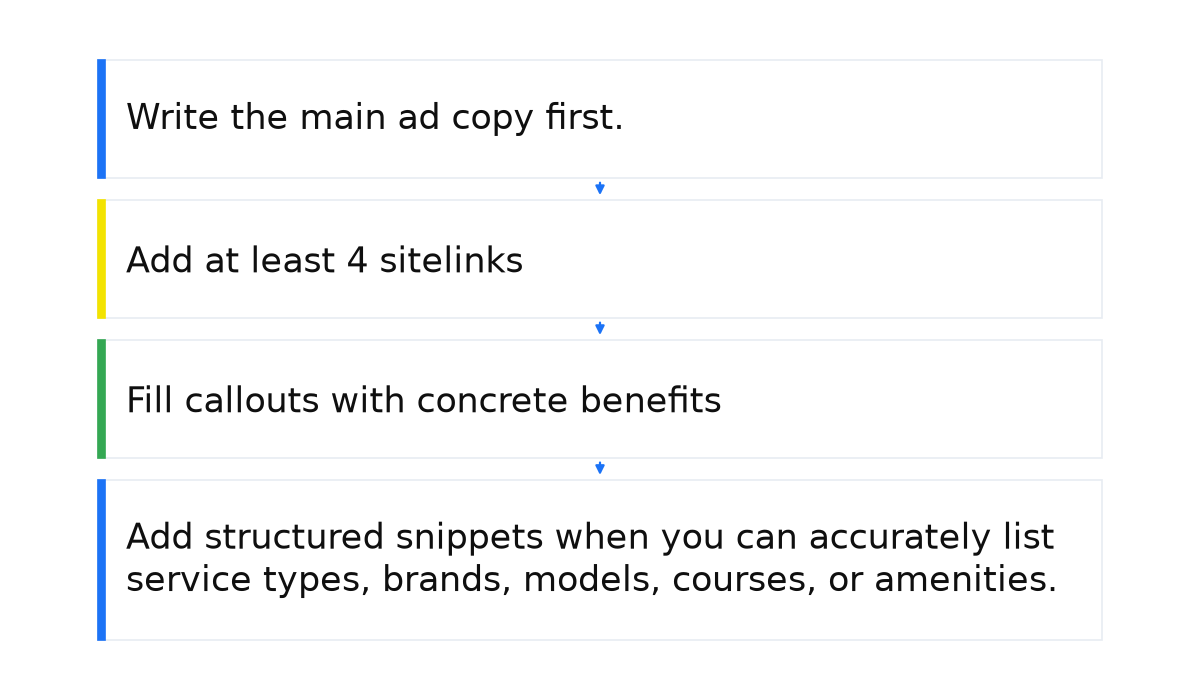
- Write the main ad copy first. Its headlines and descriptions should answer the search without help from assets.
- Add at least 4 sitelinks to sections that reinforce the same product or service.
- Fill callouts with concrete benefits such as turnaround time, guarantees, delivery, work format, or bonuses.
- Add structured snippets when you can accurately list service types, brands, models, courses, or amenities.
- Use prices, promotions, and images only when they help a potential customer decide before the click.
- Add a phone number, location, or lead form only when it does not pull the person away from the main website conversion.
- Every week, review clicks, conversions, and cost per conversion for the assets, not just CTR.
How to use ad assets effectively
- Add as many relevant manual assets as possible. Google periodically changes the available types, and some features operate in a test mode marked Beta.
- To turn off an automated asset type, open “Campaigns”, then “Assets” and “Associations”. In the three-dot menu, select “Account-level automated assets”, then use the next three-dot menu to open “Advanced settings”. Select the type, provide a reason, and save. Google documents this in its automated assets guide.
- Review statistics for each type so you can compare website visits and outcomes after the click.
- Optimize both the website and ads for mobile devices, where an increasing share of conversions takes place.
- Assets do not appear every time. Google decides whether to show them, so essential information must remain in the main ad headlines and descriptions.
- Every asset goes through review, so avoid repeating text or URLs.
- Keep all information current, especially prices and promotions.
What to read next
When this does not apply
- Adding an asset does not guarantee that it will appear. Google decides whether to use it in an ad.
- Assets cannot fix irrelevant keywords, a weak offer, or a poor landing page.
- Automated assets need review because their text and destination page may not fit the campaign’s goal.