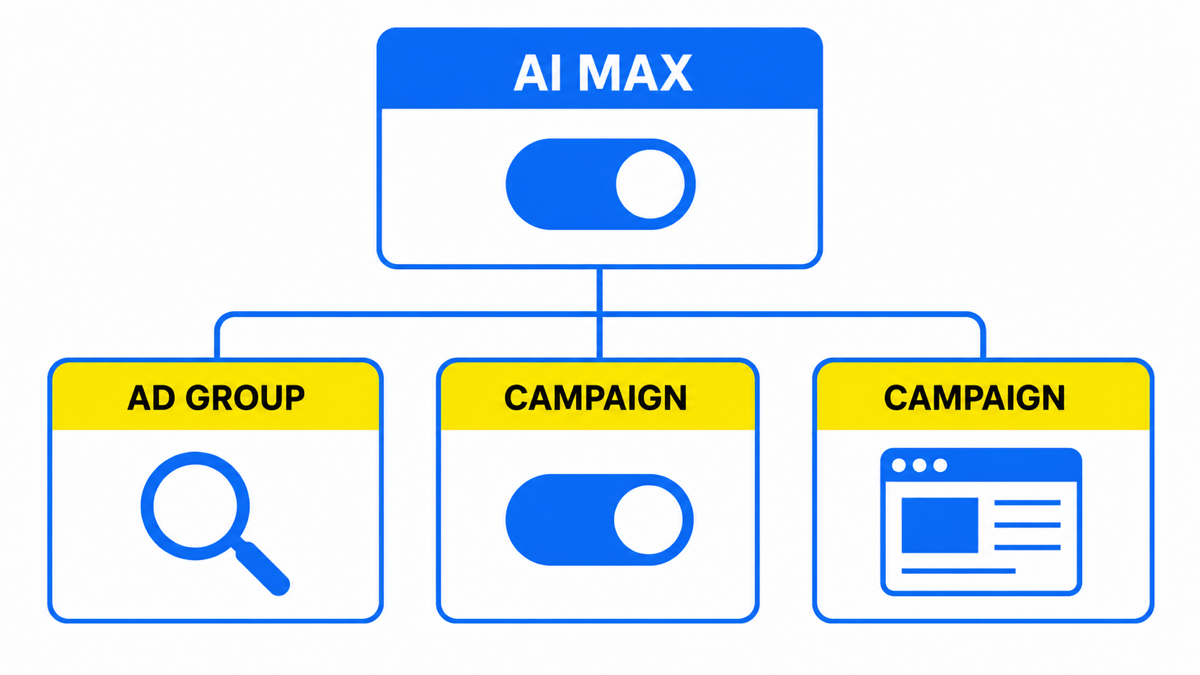
If a Search campaign uses text customization, Google says it will be upgraded automatically to AI Max starting in September 2026. A business owner does not need to master the full product, but should know which controls turn on and where they can be managed. The practical complication is that one control sits at ad group level while the others sit at campaign level.
Search term matching is controlled here.
Text customization and Final URL expansion are separate switches.
Identify the Search campaigns affected by the upgrade
This change matters to owners and marketers running Google Search campaigns, whether the account is managed in-house or by an agency. The immediate indicator is text customization, the setting previously associated with automatically created assets. Google’s text customization help page says that campaigns using it will automatically upgrade to AI Max starting in September 2026.
If an account has no Search campaigns, or a particular campaign does not use text customization, that campaign is outside this specific September auto-upgrade condition. DSA advertisers still face a separate change in the same period because new DSA campaigns will no longer be available.
Separate the September change from the DSA schedule
Google’s official upgrade announcement brings three existing capabilities into AI Max:
- Dynamic Search Ads, or DSA.
- Automatically created assets, or ACA.
- The campaign-level broad match setting.
The dates are not identical. ACA and the campaign-level broad match setting begin upgrading in September 2026. Automatic DSA migration has been moved to February 2027. However, advertisers will be unable to create new DSA campaigns from September 2026.
An existing DSA campaign therefore receives more time before automatic migration, but that is not a cancellation. A business planning to create a new DSA campaign faces the earlier cutoff. Treat these as separate operational events.
Find each AI Max control at the correct level
AI Max enables capabilities that are not all managed from one screen. Google documents the control levels in its AI Max help page.
| Control | Where it is managed | Owner’s decision |
|---|---|---|
| Search term matching | Ad group settings | Whether broader query matching is suitable for that group |
| Text customization | Campaign settings | Whether Google may create additional ad text |
| Final URL expansion | Campaign settings | Whether Google may choose other relevant pages on the site |
Enabling AI Max turns on search term matching for the campaign, but that feature can be disabled in ad group settings. Text customization and Final URL expansion are campaign settings, and each can be turned off separately. Reviewing only the main campaign screen will not reveal every available control.
The distinction also reflects different business risks. Allowing Google to create text is not the same decision as allowing the system to select a different landing page. Each deserves its own review against the site’s approved messages and destinations.
Complete the account review before September 2026
Base the review on the three documented capabilities rather than a general decision to accept or reject AI:
- Text customization. Open each important Search campaign and record its current status. If it is enabled, the campaign meets the stated condition for the automatic upgrade beginning in September 2026.
- Final URL expansion. Decide separately whether Google may select a different final page. This is an independent campaign-level switch, not part of the text customization control.
- Search term matching. After the transition, review the settings of each important ad group. That is where this feature can be disabled even though AI Max is enabled for the campaign.
Google recommends moving voluntarily in order to maintain full control over campaign setup. That is the vendor’s recommendation, not a guarantee of performance. The announcement does not describe an explicit opt-out mechanism, but this absence is not evidence that opting out is impossible.
My operating rule for automation decisions is to compare the cost of a qualified CRM enquiry over 30 days, not simply the conversion count in Google Ads. If the platform report improves while qualified enquiries become more expensive, the setting is worse for the business.
A useful preparation step is to capture the current campaign and ad group settings beside the qualified-enquiry cost from your CRM, then use the same view to assess the account after the upgrade.
Tags and reports matter when they show payback. My e-book “19 Google Ads Secrets” shows how to get the most out of Google Ads without draining your budget, drawn from real campaigns and tests.
See the book →When this does not apply
Frequently asked questions
Does this automatic upgrade apply to Performance Max?
The announcement discussed here concerns Search campaigns and the migration of DSA, ACA, and the campaign-level broad match setting into AI Max. It does not establish the same upgrade path for Performance Max.
What if text customization is turned off?
The automatic upgrade starting in September 2026 is stated for campaigns already using text customization. The separate restriction on creating new DSA campaigns still begins in September 2026.
Will existing DSA campaigns move in September?
No. Automatic DSA migration has moved to February 2027. The September 2026 change for DSA is that advertisers can no longer create new DSA campaigns.
Can text customization and Final URL expansion be disabled separately?
Yes. Both are managed at campaign level, but they have independent controls.
Where can search term matching be disabled?
In ad group settings. AI Max enables the feature for the campaign, while its off control is available one level lower.