
ROAS, ROI, and ACoS are not three names for the same kind of return. ROAS compares conversion value with advertising cost, ACoS shows advertising cost as a share of revenue, and ROI compares profit with total cost.
ROAS is convenient for an agency because it isolates advertising. ACoS is essential for an owner because it immediately reveals how much revenue customer acquisition consumed. This is not an argument over terminology. It is a question of who sees and carries the risk of cost of delivery.
Our guide to ROAS in Google Ads explains the advertising metric itself. Here, we will place all three formulas side by side and watch the same month change character as the reported number changes.
What ROAS, ROI, and ACoS mean
| Metric | Formula | The question it answers | What it leaves out |
|---|---|---|---|
| ROAS | conversion value / advertising cost | How much value did each unit of advertising cost produce? | Cost of delivering the product or service |
| ACoS | advertising cost / revenue | What share of revenue did advertising consume? | Other business expenses |
| ROI | (revenue minus total cost) / total cost | What return did all invested cost produce? | It does not isolate advertising from the rest of the business |
Google defines Conv. value / cost as total conversion value divided by the total cost of advertising interactions. Cost of delivery does not appear in that formula. It does appear in Google’s official ROI formula, which subtracts total cost from revenue and divides the result by total cost.
The same month in all three metrics
Consider a month in which advertising consumed one quarter of revenue, while total cost including advertising was two thirds of revenue. The data remain unchanged. Only the question changes.
| View of the same month | Result | First impression | What it actually reveals |
|---|---|---|---|
| ROAS | 400% | Advertising returned a lot | Revenue was four times advertising cost, but cost of delivery is still missing |
| ACoS | 25% | Advertising consumed a quarter of revenue | Three quarters remain for delivery, other expenses, and profit |
| ROI | 50% | The business earned half of invested cost | The month remained profitable after total cost |
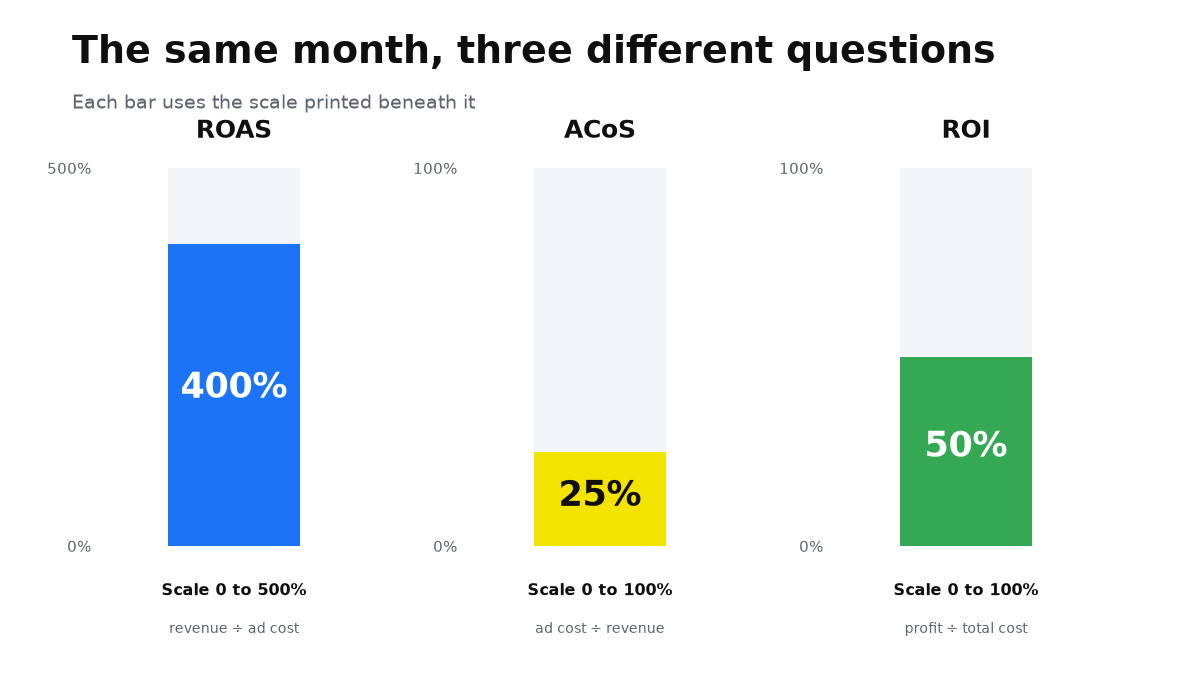
ROAS of 400% creates the strongest first impression. ACoS of 25% sounds more sober because the owner immediately sees acquisition cost inside every unit of revenue. ROI of 50% no longer answers a question about the advertising account. It answers whether the complete set of costs produced a profit.
Why agencies and owners prefer different numbers
ROAS is a fair way to assess how much reported value advertising produced. An agency can influence campaigns, bids, queries, and conversion setup, but it usually does not control supplier prices, staff utilisation, or the cost of delivering an hour of professional service.
An owner cannot stop at ROAS because the owner pays cost of delivery. If that cost rises, the advertising report may remain unchanged while profit disappears. ACoS moves the conversation from “we generated plenty of revenue” to “this is the share of revenue acquisition required.”
This does not mean an agency is deliberately hiding anything. The metric simply has a boundary. Conflict begins when ROAS is presented as proof of profit even though it does not subtract cost of delivery.
Which metric belongs to which decision
- ROAS helps compare advertising campaigns when they use the same definition of value.
- ACoS helps set and monitor an acceptable share of revenue for customer acquisition.
- ROI tells you whether all business costs paid back, not merely the advertising budget.
ROAS and ACoS are reciprocals only when both use the same revenue definition. ROAS of 400% corresponds to ACoS of 25%. If ROAS uses gross profit while ACoS uses revenue, that relationship disappears.
ACoS and the margin ceiling
Compare ACoS with gross margin before advertising cost. When advertising consumes the entire margin, sales can grow without profit. That is why an owner should approve an acceptable ACoS instead of asking an agency for an abstractly high ROAS.
In our advertising dataset, 27% of campaigns reached their own target ROAS. The median ratio of actual performance to target was 0.86 across 622 campaigns with approximately $16.9 million in advertising cost. A target in the platform is an instruction for the bidding system, not a guarantee for a financial plan.
What to require in an agency report
- A definition of the ROAS numerator. Is it revenue, gross profit, an assigned lead value, or the actual value of closed deals?
- ACoS for the same period. It must use the same revenue definition as ROAS.
- Reconciliation with actual payments. Compare platform data with the CRM or accounting records, especially when the sales cycle is long.
- A limit tied to margin. The agency needs the share of revenue the business can afford for acquisition, not a percentage chosen because it looks attractive.
When this does not apply
- ACoS does not replace ROI when cost of delivery, payroll, logistics, or other expenses change sharply.
- ROAS and ACoS are not reciprocals when they use different value definitions or different periods.
- For a business without a reliable connection between advertising and payment data, all three metrics depend on assumptions. Restore the data before judging return.
The three metrics now have clear management roles: ROAS evaluates advertising output, ACoS controls the revenue share spent on acquisition, and ROI checks the complete economics. Your next agency conversation can begin with agreement on these three views instead of one impressive percentage.
Tags and reports matter when they show payback. My e-book “19 Google Ads Secrets” shows how to get the most out of Google Ads without draining your budget, drawn from real campaigns and tests.
See the book →Questions and answers
What is the difference between ROAS and ROI?
ROAS divides conversion value by advertising cost and does not subtract cost of delivery. ROI includes total cost and measures the return on it.
What does ACoS mean in plain English?
ACoS is the share of revenue spent on advertising. The higher it is, the less revenue remains for delivery, other expenses, and profit.
Which metric should an agency report?
Ask for ROAS with a precise definition of value and ACoS for the same period. Calculate ROI with the business’s financial data, which the advertising agency may not have.