
A Google Ads tracking template adds information about an ad click to the URL used for tracking. For a business owner, the practical questions are where to set it, which details your analytics needs, and how to avoid a broken link that stops a potential customer reaching your website.
Where you can set a tracking template
You can apply a template across your account or set it for a smaller part of your advertising:
- Account. Applies to campaigns and ads that do not have a more specific template.
- Campaign. Applies to its ad groups and ads unless a lower level has its own template.
- Ad group. Lets you use a separate setup for a particular group.
- Ad or ad asset. Individual settings are available for ads and supported assets, such as sitelinks.
- Keyword. The most specific level in this hierarchy.
The most specific template takes priority. Suppose a campaign contains 10 ads and has a campaign template. Nine ads have no individual template, while one does. The nine use the campaign setting; the remaining ad uses its own.
Keep that hierarchy in mind when reading reports. If tracking looks different for one ad, check its individual settings before assuming the analytics platform has a problem.
What a Google Ads tracking template is for
A template is useful when your measurement setup needs more than the standard reports in Google Ads and Google Analytics. You might use another analytics tool and need to pass UTM tags or additional details about individual advertising clicks to it.
How I standardize tracking parameters
I design a tracking template as a consistent data structure. Each parameter has someone responsible for it, a defined set of acceptable values, and a system that reads it. Before publishing, I check the resulting address and confirm that the analytics system receives the data. A correctly formatted URL does not automatically produce a useful report.
Google explains how to add parameters and check the resulting URL in its tracking template setup guide.
To compare campaigns, keywords, and traffic channels, use a consistent set of parameters so equivalent data does not end up under different labels in your reports.
Depending on the campaign and the parameters it supports, click details can include:
- The advertising network, such as Google Search or the Display Network.
- The device type: computer, tablet, or phone. Mobile device model information is available for Display campaigns.
- Geographic information about where the click happened, within the available parameter’s scope.
- The placement where the ad was clicked, when the campaign supports that information.
- The keyword that triggered the ad.
- The keyword’s match type.
- Information that distinguishes clicks on ad assets.
Availability varies by campaign type. Check the fields you need against Google’s list of ValueTrack parameters before building your setup.
These details help you assess Google Ads performance and make more informed changes. You can use them to:
- Review bids in the context of the campaign’s bidding strategy.
- Improve ad copy and choose wording that connects with potential customers.
- Assess advertising placements.
- Refine the audience you want to reach based on leads and customers.
- Look for opportunities to reduce cost per click, or CPC.
How to set up a tracking template
Choose the level where you want the template to apply. For a campaign, for example, open its settings in Google Ads, find Campaign URL options, and fill in the Tracking template field.
A simple example is {lpurl}?device={device}&matchtype={matchtype}.
Here is what each part does:
{lpurl}inserts the final landing page URL.?separates the address from the parameters in this example.device={device}pairs a parameter name with its value using=. Google fills in the values inside braces automatically. Here,deviceidentifies the device type andmatchtypeidentifies the keyword match type.&separates parameters when you include more than one.
If you only need to append these details without a redirect, you can use the Final URL suffix field. Enter the part after the question mark: device={device}&matchtype={matchtype}. Leave out the landing page address and the initial ?.
For simple tagging, choose one approach and avoid adding the same parameters twice. A more complex setup may use the template for a tracking redirect and the suffix for UTM tags. Those are separate jobs, so the two fields can sometimes work together.
utm_mediumlabels the type of channel, such as paid advertising or organic search.utm_sourcelabels the platform or other origin of the visit. Its value should follow the naming scheme used in your analytics.
Keeping tracking information separate from the landing page address makes repeated tagging easier to manage. You do not need to rebuild every destination link manually. Alongside UTM tags, templates can use ValueTrack for campaign, placement, and keyword information. Custom parameters have their own field.
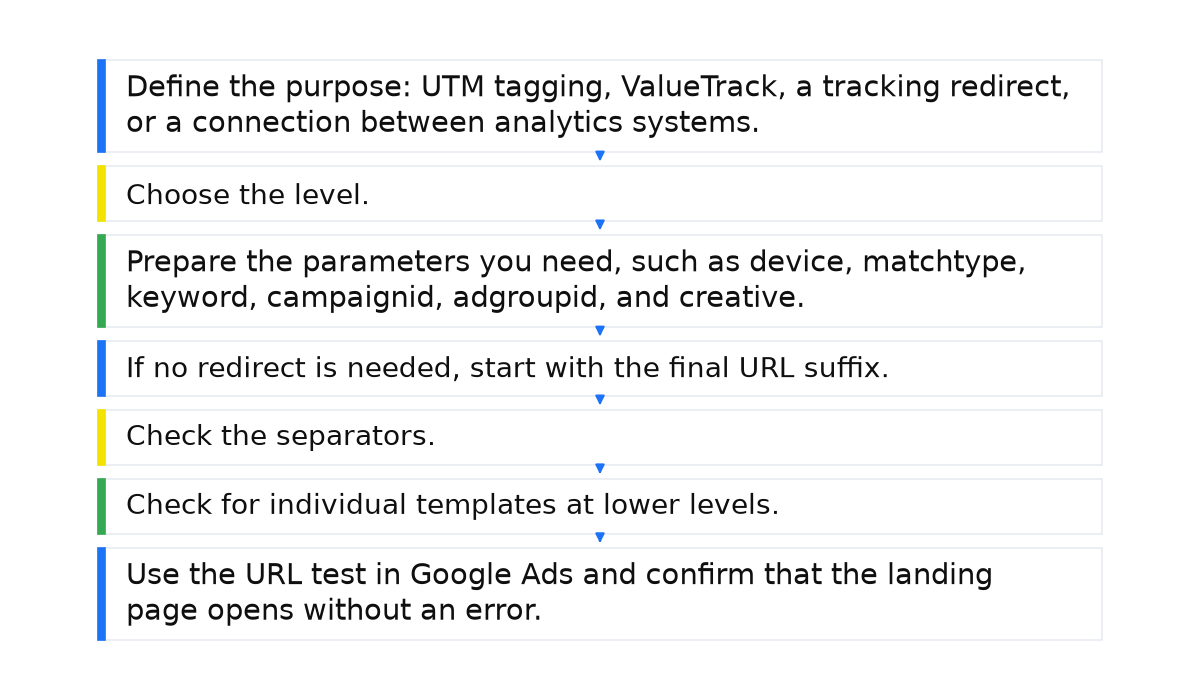
Tracking template setup checklist
- Define the purpose: UTM tagging, ValueTrack, a tracking redirect, or a connection between analytics systems.
- Choose the level. Use account or campaign settings for consistent tagging; use an ad or keyword setting for a specific test.
- Prepare the parameters you need, such as
device,matchtype,keyword,campaignid,adgroupid, andcreative. - If no redirect is needed, start with the final URL suffix.
- Check the separators. In the simple template above, parameters begin after
?and additional parameters are separated by&. - Check for individual templates at lower levels. They take priority over shared settings.
- Use the URL test in Google Ads and confirm that the landing page opens without an error.
What to remember about tracking templates
- If Google Ads and Google Analytics already provide the statistics you need, a separate tracking template may be unnecessary.
- When you need extra click details, a template lets you pass them at the relevant levels of the account.
- A developer connecting your tracking system will often identify the need for a template. Agree on the information that system needs to receive.
- A mistake in the address or parameters can break the visit. Someone may click your ad and reach a page that does not work or does not exist. Testing the link is part of the setup.
What next?
- Only need tracking tags? Learn how the Google Ads final URL suffix works.
- Preparing to launch? Review the basic Google Ads setup.
- Investigating wasted spend? Check three mistakes that can drain your advertising budget.
- Want control over account changes? Read about automatically applied Google Ads recommendations.
- Need to limit unwanted visits? Learn how and why to exclude IP addresses in Google Ads.
When this does not apply
- A tracking template does not set up conversions or fix attribution on its own.
- An incorrect address or parameter can break a visit, so a URL test is essential.
- Lower level settings can override the account or campaign template and make tagging inconsistent.
Once your links are consistent and tested, the next step is using the data to assess leads and guide campaign decisions. My e-book below explains how to get the most out of Google Ads without draining your budget.
My e-book “19 Google Ads Secrets”: how to get the most out of Google Ads without draining your budget, drawn from real campaigns and tests.
See the book →