
There are many search engines; Google is still the default for most owners running Search ads in the US, Canada and the UK. Search ads show against real queries people type. If you do not know query types, you pay $ for the wrong intent. Related setup context: keyword research for Google Ads.
Organic results work on the same raw material: Google compares page titles and topics with the query. How well a page answers a real need affects both SEO traffic and the quality of the paid click that lands on that page.
You will see several taxonomies: by intent (types), by market traits (frequency, competition, geo), and by the only owner question that matters: does this phrase make money for this business.

The advertiser adds this input and chooses its match type.
This is the real query a person typed.
Add useful terms as keywords and exclude irrelevant intent.
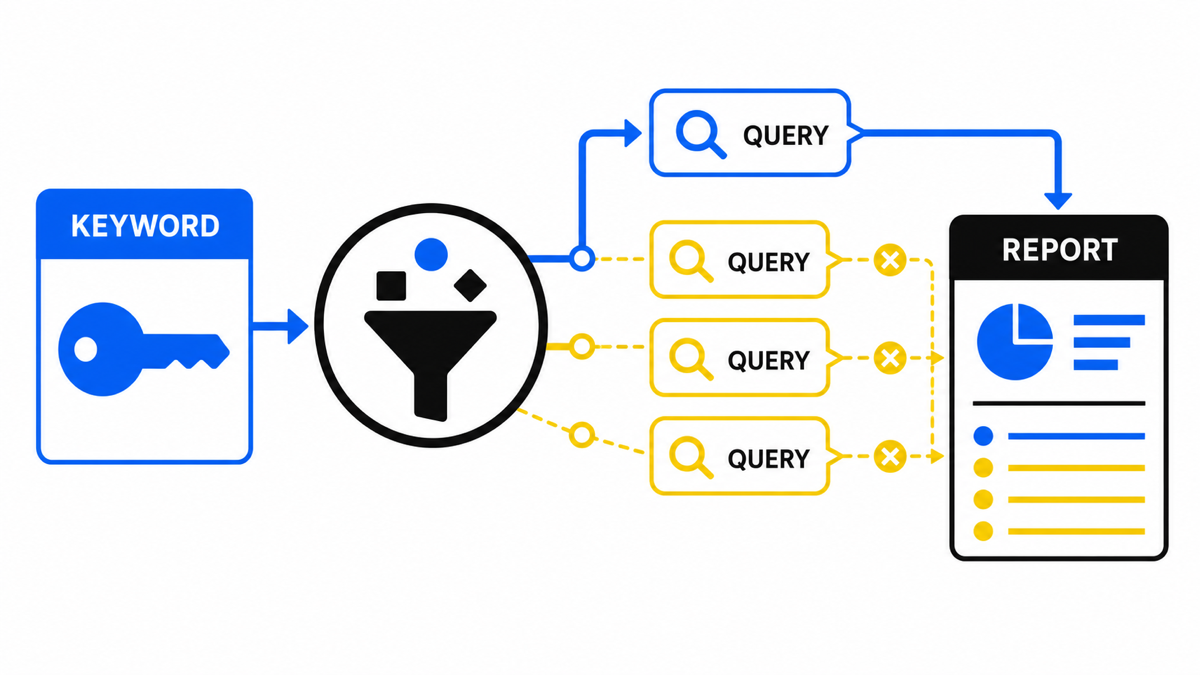
Main types of search queries
Query types describe why someone is searching:
- Navigational. The person wants a specific site or page and may not remember the URL. Brand + login, account, app name.
- Multimedia. Video, images, music, templates. They want media, not your price list.
- Informational. The largest class: how-to, where is, why it fails, what is better.
- Commercial. Highest priority for most businesses. Purchase intent often shows in words like buy, order, cheap, price, cost, discount, near me.
Commercial queries often mix product and place: “order office furniture Chicago”, “sushi delivery Toronto”. Close cousins are transactional queries: the next step is an action (download, buy, book).
- Generic / fuzzy. One or two words with unclear intent: toys, watch, smartphone. In Search ads these rarely work “as is”: reach grows, but most landings are off-intent.
Other useful ways to slice queries
Beyond intent, advertisers also sort queries by market traits that change cost and conversion:
How I classify queries by intent
I do not classify by length or by isolated words. I classify by the answer the person expects to see. The same term can mean research, comparison, finding a place, or readiness to act. Fuzzy queries stay in their own bucket until search terms prove commercial value.
The live wording of what actually triggered ads lives in the Google Ads search terms report.
- frequency;
- competition;
- business value;
- geo-dependence.
By frequency
Frequency bands:
- High frequency. Often 1-2 words, many advertisers, expensive clicks, fuzzy intent, weak conversion.
- Mid frequency. Often 2-3 words. Cheaper than head terms, more useful for leads and sales.
- Low frequency. Often 4+ words: very specific products or services. Less volume, higher conversion; you need many of them.
- Near-zero. Almost no demand (the original used a “few times a month” orientation).
If volume spikes around seasons and holidays, call the query seasonal: Halloween costumes for hire, Christmas trees, outdoor grills.
Once types and bands are clear, the useful next step is to check which of your phrases in Google Ads actually produce $ and which only buy curiosity clicks.
My e-book “19 Google Ads Secrets”: how to get the most out of Google Ads without draining your budget, drawn from real campaigns and tests.
See the book →By competition
Frequency and competition move together, but they are not identical. In practice advertisers talk about:
- high competition;
- medium competition;
- low competition.
The more strong advertisers fight a query, the harder and more expensive it is to stay visible. Small and mid-size businesses usually build on mid and low competition phrases rather than only head terms.
By geo-dependence
Many services are place-bound: clinics, garages, salons, local stores. Google knows this. A search for “dentist” often surfaces ads for the user’s city or area. That query is geo-dependent.
If two people in different countries search “Google Ads course online”, they may see very similar results: the query is geo-independent and the product is digital.
The practical cut that owners actually need
Whatever taxonomy you prefer, an advertiser ultimately has two buckets:
- queries that put money into the business;
- queries that do not.
The same phrase can sell in one niche and waste spend in another. The site matters: even a non-commercial query can produce leads if the page matches the expectation.
Example: “free legal consultation” for two law firms:
- Firm A states that consults start at a paid fee in $. People who typed “free” leave immediately.
- Firm B’s model starts with a free first consult, then paid representation. Here “free” can still be a selling query.
Landing page alignment decides the outcome:
- pricing page with no free offer + query “free” = bounce;
- page offering a short online consult = a path to conversion.
Judge every query inside your business model. A phrase that is high frequency in one niche can be a tail phrase in another at the same absolute volume. Compare demand for “buy a yacht” versus “buy a laptop”.
How to turn queries into keywords
Keywords and match types control which queries can trigger ads. Broad match on “legal consultation” can reach people looking for law-school advice or textbooks, not only clients ready to hire counsel:
- admission advice for a law faculty;
- books on jurisprudence, and similar.
Phrase match filters harder. Exact match is tighter still. High-frequency lines need negatives so you do not buy the wrong audience.
Takeaways
- SEO and PPC both depend on query types: they decide who lands on the page. Sites need a semantic core. Ads need keywords, match type, bids and negatives.
- Do not aim only at “buy / order”. Some informational queries build trust: guides, expert explainers, comparisons. People read, return, and sometimes become customers.
Check whether keywords make money in the Google Ads keywords report for Search. The columns that matter most are conversions and cost per conversion. The point of paid search is sales, qualified leads or deliberate brand work, not “lots of clicks”.