
Google Ad Grants is an in-kind search advertising program for nonprofits. A qualifying organization gets access to up to $10,000 USD per month for text ads shown on Google.com.
You do not pay for Ad Grants campaigns. Unused funds do not roll over, and there is no spend requirement. Before treating $10,000 as free media, check two things: whether the organization is even eligible, and whether the account can survive the monthly program policies.
If you first need to see whether the ads create any business value, start with the guide to ROAS in Google Ads. A grant budget still has to be measured by results, not by the fact that the clicks were not billed.
What Google Ad Grants actually gives you
The official description is short. The Google Ad Grants landing page says each qualifying nonprofit has access to up to $10,000 per month in search ads shown on Google.com. Additional Google Ads may be purchased in a separate account.
The program FAQ is more specific: these are text-based ads on Google.com search results pages. After you qualify, you have a $10,000 USD monthly in-kind budget to use across campaigns. The funds do not roll over if unused. There is no spend requirement.
So the grant is not a free copy of a full Google Ads account. It is a separate Search text contour with its own rules.
Who can apply
To qualify, the organization must be an eligible nonprofit, have a high-quality website that meets the website policy, and be able to meet the program policies. Those are three checks, not one slogan about doing good.
The doorway is Google for Nonprofits, and the accepted legal form is country-specific. In the United States the usual bar is IRS 501(c)(3) status. The eligibility page is also explicit about who does not get in.
| Organization | Eligible for Google for Nonprofits? | What to check before you apply |
|---|---|---|
| Registered eligible nonprofit in your country, such as a US 501(c)(3) | Yes, if the local form matches the country list | Registration, website quality, and the capacity to keep Ad Grants policies |
| Governmental entity or organization | No | There is no separate grant path for the government body itself |
| Hospital or health care organization | No, the institution itself | A charitable arm or foundation tied to it can be eligible |
| School, academic institution, or university | No, the school itself | A philanthropic arm of the educational organization can be eligible |
That list is the Google for Nonprofits doorway. After verification, the ads account still has to live under Ad Grants policies. Mixing the two is how an organization gets into the program and still loses the account later to CTR or missing conversions.
How a grant account differs from a paid account
You can keep an Ad Grants account and a standard paid Google Ads account at the same time. The FAQ says the paid account is how you reach extra features such as remarketing, image ads, and video ads. The accounts do not compete, because Ad Grants ads sit in a separate auction after paid ads. The organization’s ads may appear on their own or in positions below paid ads.
| Question | Grant account | Paid account |
|---|---|---|
| What the media costs | Up to $10,000 USD per month in-kind, with no charge for those campaigns | The organization’s own money |
| Where the ads show | Text Search ads on Google.com | A wider set of formats, including image ads, video ads, and remarketing |
| How the two stand next to each other | A separate auction after paid ads | The ordinary paid auction |
| Can you run both | Yes | Yes |
That is why the grant rarely replaces paid media. It covers mission-based Search text. If you need image ads, video ads, or remarketing, Google points you to a separate paid account instead of promising those formats inside the grant.
Policies you have to keep every month
Free budget is not a free-form account. The account management policy asks for several things that glossy grant roundups often leave in the fine print.
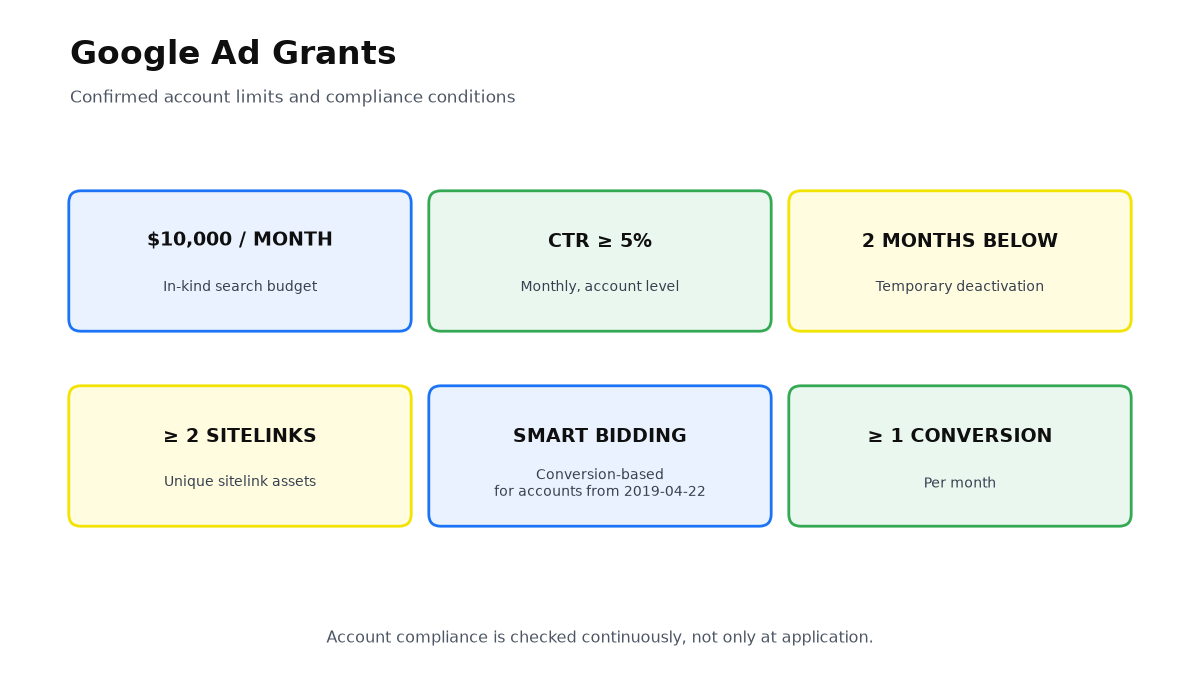
- A 5% monthly CTR at account level. Accounts that are not exclusively on Smart Campaigns must hold that rate each month. It is measured for the account, not necessarily for every keyword. Two consecutive months below 5% lead to temporary deactivation.
- Specific geo targeting and at least two unique sitelink assets. A vague worldwide setting is not what the policy describes as proper location settings.
- Conversion-based Smart bidding. Accounts created on or after April 22, 2019 must use Maximize conversions, Maximize conversion values, Target CPA, or Target ROAS on every campaign, unless the campaign is a Smart campaign.
- Working conversion tracking. For accounts created since January 2018, and for advertisers already using Smart Bidding, accurate tracking means at least 1 conversion per month.
- The annual program survey. Every grantee has to complete it.
The compliance guide repeats the same CTR tripwire: fail 5% for two consecutive months and the account can be temporarily deactivated. One conversion a month is a compliance floor, not proof that the grant is useful.
Mission, keywords, and the website bar
Every ad and every keyword must reflect the organization’s primary mission. Single-word keywords are not permitted, except your own branded words, recognized medical conditions, acronyms, and a small published exception list. Overly generic keywords and keywords with a Quality Score of 1 or 2 are also out.
The website is a separate gate. The nonprofit must own the domain the ads point to. The entire site must be served over HTTPS. The site must not display AdSense ads. A borrowed landing page or an HTTP destination fails the application before any campaign exists.
Is the grant worth the work
It is worth applying when three things are true at once. The legal form qualifies. The site lives on a domain you own, over HTTPS, and states the mission clearly. Someone will watch CTR, conversions, location settings, and ads every month instead of launching once and walking away.
It is not worth applying if you treat the grant as a substitute for paid media or as $10,000 of unrestricted advertising. Search text after paid ads, plus the monthly policies, make the program useful for donations and inquiries and expensive in staff time. If you need to see whether the ads repay the effort, go back to the ROAS formula and use the value of a completed action, not a zero cost per click.
You now have the budget ceiling, the eligibility cuts, and the policies that switch the account off. The next useful step is to test your own organization against those three gates: legal form, website, and the person who will keep the account alive.
My e-book “19 Google Ads Secrets”: how to get the most out of Google Ads without draining your budget, drawn from real campaigns and tests.
See the book →When this does not apply
- The organization does not pass Google for Nonprofits. A government body, hospital, or school as such does not get the grant. A separate charitable or philanthropic arm has to qualify on its own.
- There is no owned HTTPS site with a clear mission. A borrowed landing page, HTTP, or a thin page fails at the door.
- Nobody will run the account every month. The 5% CTR floor and the one-conversion-per-month rule do not forgive a set-and-forget setup.
- Image ads, video ads, or remarketing are the main channel you need. The grant is officially described as text Search on Google.com. Google places those other features in a paid account.
- There is no action you can honestly call a conversion. Without tracking, the account cannot keep the required Smart bidding setup or stay compliant.
Questions and answers
Do you pay for Ad Grants campaigns?
No. After you qualify, the organization gets up to $10,000 USD per month of in-kind search advertising. You do not pay for those campaigns, and you are not required to spend the full budget.
Can you run a grant account and a paid account together?
Yes. Google allows both. The paid account is how you get remarketing, image ads, and video ads. Grant ads sit in a separate auction after paid ads and do not compete with them.
Why can a grant account be temporarily deactivated?
The most direct official reason is two consecutive months with account CTR below 5%. Missing geo targeting, sitelink assets, conversions, or the annual survey can also take the account down.
Can a hospital or a school get the grant?
The hospital, health care organization, school, or university itself cannot. A charitable or philanthropic arm of that organization can, if it separately qualifies as an eligible nonprofit.
Does unused budget roll over?
No. If part of the monthly budget is left unused, it is not added to the next month.