
Google usually suspends accounts for policy violations. Its advertising system connects users who have a need with businesses that can meet it. To protect both sides, Google reviews ads, websites, billing, and advertiser identity.
Google actively fights misleading advertising to make its ecosystem safer for users and to support fair competition between advertisers.
Advertiser Verification: a common suspension trigger in 2026
Advertiser details must match
Google began rolling out Advertiser Verification for Google Ads accounts in 2023. When an account enters the programme, Policy Manager displays a section asking you to verify the individual or legal entity managing the ads, its country of operation, and the match between the company name and payment details. Ads may show an unverified label or face restrictions until verification is complete. If the individual deadline in Google’s notice passes, delivery stops.
Verification often fails because the payment profile name, legal name in the documents, and company name shown to users do not match. After repeated failures, or when the data appears designed to conceal the real account owner, Google may treat the issue as a policy violation instead of an administrative mistake. That can lead to a full suspension.
Serious violations lead to suspension
Google treats these categories as severe violations that can lead to a permanent ban:
- Anything that can harm human life, including drugs and weapons.
- Illegal activity, including forged documents and prohibited products.
- Counterfeit branded goods.
- False information, offensive material, and hostile intent.
- Sexual content.
- Child sexual abuse and exploitation. Ads for children’s products are not banned by default, but Google restricts personalized advertising aimed at children and the collection of personal data from children.
Google does not benefit from suspending legitimate advertisers. Campaigns are reviewed before launch, and the system normally reports issues that can be corrected when the underlying offer is allowed.
A suspension normally follows a serious issue. Examples include presenting one topic during review and later redirecting visitors to a prohibited page, or using card details that do not match the advertiser.
Destination problems that are not allowed
- The displayed and final destination URLs do not match, such as showing youtube.com but sending the user to google.com.
- The website is unfinished, broken, or uses a parked domain.
- The website cannot be viewed in popular browsers.
- The website prevents the browser’s Back button from working.
Read the Google policy page for more detail.
Business practices that can trigger suspension
- Unacceptable business practices, such as using deception to collect personal data or publishing false information about a company or individual.
- Unauthorized access, when Google sees suspicious activity that may indicate fraud.
- Payment problems, including unpaid balances.
- Misrepresentation, often involving promises that cannot be supported, such as an implausible treatment for hair loss.
Circumventing systems
- Changing landing page content after it has passed review.
- Trying to deceive moderation with false information about products or services.
- Adding characters to images or text in an attempt to bypass automated review.
- Promoting the same business through a new account after the previous account was suspended.
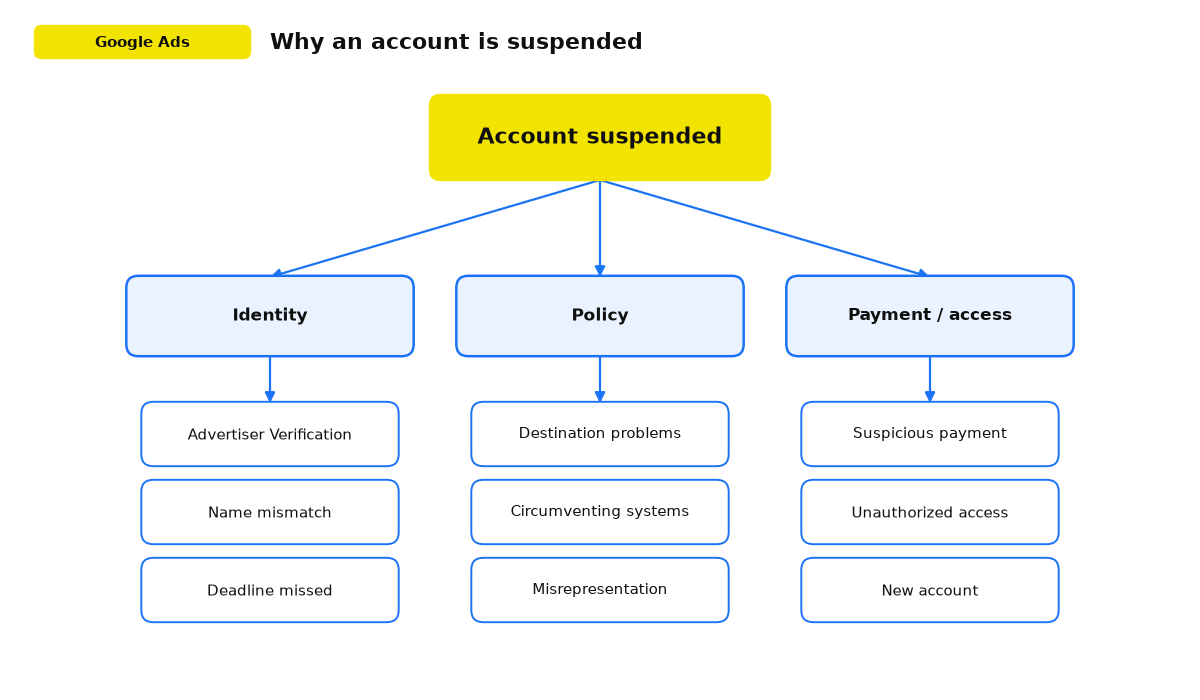
Once you can classify the issue as identity, policy, payment, access, or destination related, you know which evidence and correction the appeal must address.
My e-book “19 Google Ads Secrets”: how to get the most out of Google Ads without draining your budget, drawn from real campaigns and tests.
See the book →Ads must be clear
Topic eligibility is only part of the review. Your ad must also be written and formatted clearly.
Google’s editorial requirements apply to both wording and presentation.
Google’s editorial rules tell advertisers to avoid
- Grammar and spelling errors or typos.
- Meaningless text and claims that are too vague.
- Copy that exceeds character limits.
- Ads and assets that Google cannot interpret, including inappropriate numbered or bulleted lists.
Google analyses many signals, and the system changes over time. You cannot reliably trick it. An account with genuine violations will eventually be detected and suspended.
If Google Ads suspends your account, you will receive an email and see a red notice with a brief reason when you sign in.
You will no longer be able to run, create, or copy campaigns. You can still sign in to view statistics or withdraw the remaining balance.
Suspension types and what to do
The wording in Google’s notice is more useful than a guess. Read the exact reason first, then check the connected parts of the account.
How I investigate an account suspension
I first record the exact reason in the notice and check the website, payments, advertiser details, and documents. I appeal only after fixing the issues, with a clear sequence of facts and without sending repeated copies of the same request. I do not create a new account because Google may suspend connected accounts, and an attempted workaround makes the original problem harder to solve.
Google’s official documentation explains the consequences of violations, account suspension, and the appeal process.
| Google’s wording | What it means | Action |
|---|---|---|
| Unusual advertising activity | Google saw a pattern that resembles an attempt to evade review, such as links to other accounts, suspicious IP addresses, or unusual activity spikes. | Appeal through Policy Manager using real business details. Do not open a new account before the original case is resolved. |
| Circumventing systems | The landing page changed after review, or the ad sent visitors somewhere other than the declared destination. | Restore the page to the reviewed state and explain the discrepancy in the appeal. |
| Suspicious payment | The bank declined the payment, the card was blocked, or billing details do not match the account profile. | Use a payment method that matches the account’s legal entity and clear any balance. |
| Unauthorized access | Google treated a sign-in or action as suspicious because of a new device, unusual location, or possible compromise. | Change the password, enable two-factor authentication, and complete account recovery. |
| Advertiser identity is not verified | Advertiser Verification has not been completed. | Complete the process in Policy Manager. Documents must match the payment profile and company name in the ads. |
| Misrepresentation | The advertising promises an outcome that the product cannot objectively deliver. | Rewrite the ad and landing page around the product’s real properties, then appeal. |
| Repeated violations across accounts | Google connected a new account to an old suspended account through the owner, payment details, or website. | Stop creating replacement accounts and resolve the original suspension through the official appeal process. |
Follow the rules, document your corrections, and give Google one coherent account of what happened.
Student question: suspended for circumventing systems
“A yacht school’s account was suspended for circumventing systems. The company is in the Netherlands, management is in Montenegro, and the site is dynamic. An appeal with documents was rejected. What should we do?”
A company in the Netherlands with administration in Montenegro is not automatically a problem. The dynamic site is the more likely trigger. If JavaScript changes headings or content for each visitor, Google may see cloaking because the page shown during review differs from the page shown later.
First, disable the dynamic behaviour and make the site static while the case is reviewed. Second, check your email for a Google manager who previously contacted you. Write a polite message explaining that you want to comply and need help understanding the suspension. A manager may be able to investigate the specific reason internally in addition to the formal appeal.
▶ Answer from the live session: watch from 20:42, Q&A broadcast, April 2026.
Student question: ads for government payment services blocked
“Google blocked ads for services related to government payments, while competitors are still advertising. What could be wrong, and how can we solve it?”
Competitors may be cycling through new accounts. Their visibility does not prove that the restriction applies only to you. It can mean that they are paying for a workaround with repeated account losses instead of resolving the policy issue.
The legitimate route is to ask Google which restriction applies, which law or policy requires it, and which documents you need. One of my students in Ontario, Canada, faced a complex certification requirement. Workarounds achieved nothing, but the ads ran normally after the business obtained the licence. Meeting the legal requirement is more durable than changing accounts.
▶ Answer from the live session: watch from 0:51:49, Q&A broadcast, May 2024.
Student question: suspended for the business model
“We ran search ads for car sales for a year, then received a suspension for an unacceptable business model. The appeal returns an automated policy response. How can we resolve it?”
Start with an honest question. Does the model genuinely break the rules, or did Google make a mistake? If you know the model sits in a prohibited area, the suspension will probably return. Fixing only the account will not solve the business-level issue.
If you are certain it is an error, keep contacting support through the available channels. A phone option may sometimes be available, and trying support in another language can reach a different review path. An automated appeal response is not necessarily the end. If the violation is real, moving to accounts owned by other people only delays the next suspension. The whole plan depends on whether the case is an error or a genuine policy conflict.
▶ Answer from the live session: watch from 0:47:01, Q&A broadcast, July 2024.
Individual account and policy lines that are often confused with a suspension have their own guides:
- Ad disapproved: “Circumventing systems”
- “Unacceptable business practices” in Google Ads
- What “Misrepresentation” means in Google Ads
- What “Eligible (limited)” means in Google Ads
Suspensions for “Suspicious payment activity”, including paying with a relative’s card or a card from another country, are covered separately:
My e-book “19 Google Ads Secrets”: how to get the most out of Google Ads without draining your budget, drawn from real campaigns and tests.
See the book →